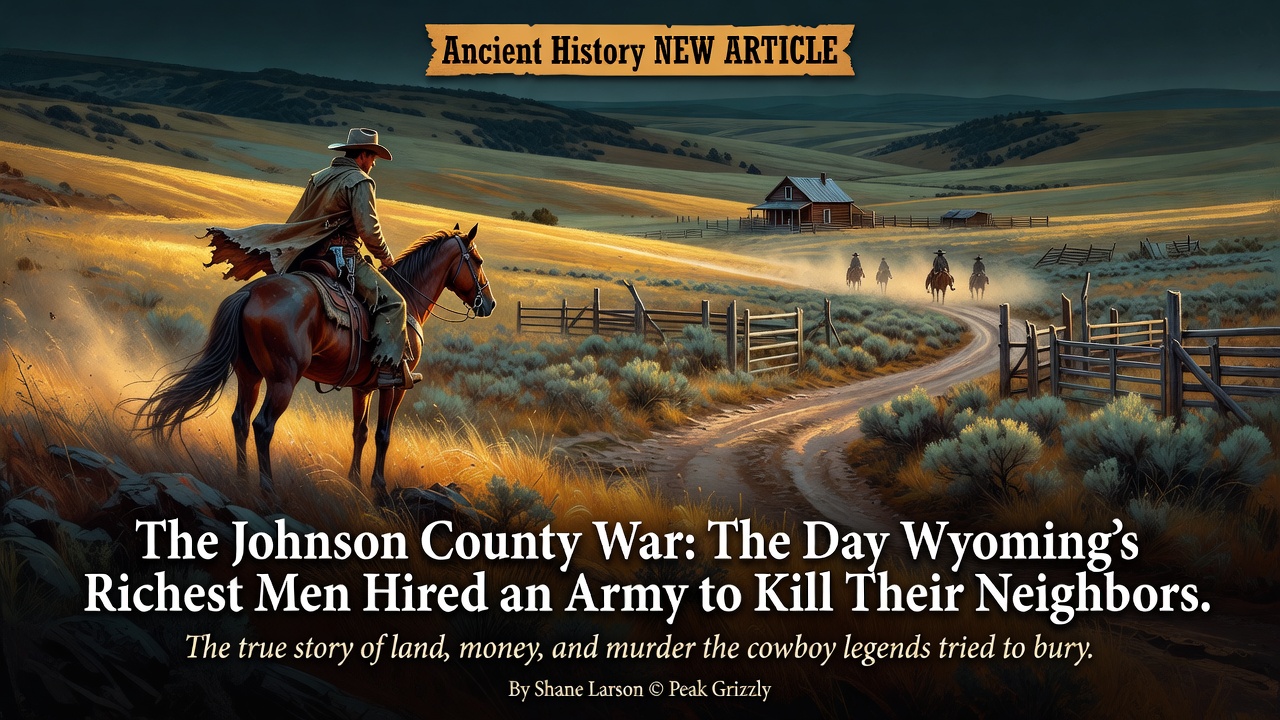
The Johnson County War: The Day Wyoming's Richest Men Hired an Army to Kill Their Neighbors
July 7, 2026 · 7 min read
We tell the story of the Old West as a morality play. Outlaws and lawmen. White hats and black hats. A lone gunfighter walking down a dusty street at noon. It is a comforting story, and it is mostly fiction. The real history of the frontier was less about gunfighters and more about land, money, and who got to decide what counted as a crime.
There is no better place to see that than Johnson County, Wyoming, in the spring of 1892 — when the wealthiest men in the state hired an army of fifty gunmen, drew up a list of names, and rode north to murder their neighbors. It is one of the most extraordinary episodes in American history, and it has almost nothing to do with the West we think we know.
A kingdom built on grass
To understand why it happened, you have to understand who ran Wyoming. In the 1870s and 1880s, a handful of large cattle operations had built fortunes on the open range — free grass, federal land, and a beef market hungry enough to make a man rich in a few good seasons. These operators organized themselves into the Wyoming Stock Growers Association, and the Association did not merely raise cattle. It ran the territory.
Its members set the rules of the roundup, controlled the brands, and decided whose cattle were whose. They had the ear of the governor and the legislature. They had friendly judges and friendly newspapers. From the leather chairs of the Cheyenne Club, they governed a domain the size of a European country, and for a while it worked beautifully — until the winter of 1886 to 1887, when blizzards killed cattle by the hundreds of thousands and left the great herds, and the men who owned them, badly shaken.
The newcomers and the word "rustler"
Into this kingdom came the small people: homesteaders taking up claims under federal law, former cowboys starting herds of their own, families fencing a quarter-section and branding the unbranded calves — the "mavericks" — that wandered the open range. To them, this was the American promise working exactly as advertised. Land was there to be claimed and worked.
To the barons, it was theft. Every fence closed off grass they considered theirs by custom. Every maverick branded by a small rancher was, in their telling, a calf stolen from a big one. And so they reached for a word that would do the work of a verdict without the inconvenience of a trial: rustler. It was a brilliant piece of language. Call a man a rustler, and anything you did to him became law enforcement. The label did not have to be proven. It only had to be repeated.
The trouble was the juries. When the barons actually hauled their neighbors into court for cattle theft, local juries — made up of other settlers — kept refusing to convict. To the small ranchers, this was simply justice: you do not convict a man on a powerful neighbor's say-so. To the barons, it was proof that the courts were broken and that they would have to enforce "the law" themselves.
The warning: the lynching of "Cattle Kate"
The first blood came in 1889, three years before the invasion. On the Sweetwater River, a homesteading couple named Ella Watson and Jim Averell held land that sat athwart a powerful cattleman's range. Their real offense was being in the way. One day a group of Association men rode up, seized them both, and hanged them.
What happened next is the part worth remembering. The killers were never convicted — witnesses vanished, and the machinery of local power did its work. But more than that, the newspapers the cattlemen influenced went on the attack against the dead. Ella Watson was transformed, in print, into "Cattle Kate" — a prostitute who supposedly traded sex for stolen cattle, a woman so depraved that hanging her was almost a public service. Almost none of it was true. She was a homesteader with a land claim. But the story stuck for a century, because the people who told it controlled the telling.
That is the real lesson of "Cattle Kate," and it is why the episode still matters: the powerful do not just destroy people. They write the story afterward, so that the public thanks them for it.
The Johnson County War
April 1892: the invasion
By 1892 the barons had decided that murder, one settler at a time, was too slow. They would settle the matter all at once. They assembled a private army — Association members and their employees, a contingent of hired Texas gunmen, a surgeon to patch the wounded, and two newspapermen brought along to write the official version of the killing. They drew up a list of names: the men in Johnson County they meant to kill. And they loaded a special train in Cheyenne with horses, rifles, and dynamite.
They cut the telegraph lines to isolate the county. Then they rode for the KC Ranch, where two men on the list, Nate Champion and Nick Ray, were staying.
One man, one cabin, fifty guns
What happened at the KC Ranch is why the Johnson County War is remembered at all. The invaders surrounded the cabin at dawn. Nick Ray was shot down early. That left Nate Champion alone — one man, in a log cabin, against fifty.
He held them off for most of a day. And as he did it, he kept a diary. On a scrap of paper, between shots, he wrote down what was happening: that Nick was dying, that men were outside, that the bullets were coming through the walls, that he did not expect to live. "Shooting again," he wrote at one point. He knew how it would end and he wrote anyway, calmly, like a man leaving a record because he trusted that the truth would outlast him.
In the end the invaders set the cabin on fire. When Champion broke from the burning building, they shot him down in the open. They left his body where it fell — and they left the diary. When it was recovered and printed, it did more damage to the cattle barons than any army could. Here was the testimony of the man they had murdered, in his own steady hand. No newspaper they owned could rewrite that.
The county rises
The siege had cost the invaders a day, and that day undid them. Word raced to Buffalo, the county seat, and Johnson County rose. Led by the sheriff, hundreds of armed settlers poured out and ran the invaders to ground at the TA Ranch, where the would-be killers forted up in the buildings and found themselves besieged in turn. For days the barons' army was pinned down, outnumbered, and facing a furious county that intended to finish them.
They were saved by the thing they had always relied on: their connections. The Association's allies got word to the governor, and through him to President Benjamin Harrison, who ordered the U.S. Cavalry out from nearby Fort McKinney. The troops rode in and took the invaders into protective custody — rescuing the men who had come to commit mass murder from the people they had come to murder.
Justice bought and buried
And then, in the most modern-feeling turn of the whole affair, nothing happened. The prosecution dragged on. The defendants had the best lawyers money could buy and a venue and a calendar that worked in their favor. Witnesses were scattered, costs piled onto Johnson County until it could no longer afford to prosecute, and the case quietly collapsed. The wealthiest men in Wyoming had financed and led an armed invasion of their own state, and not one of them went to prison.
The settlers had won the battle at the TA Ranch and lost the war in the courtroom — which is to say, they lost it in exactly the place the barons had always been strongest.
Why it still matters
Strip away the hats and the horses and the Johnson County War is not a Western at all. It is a story about concentrated wealth, captured institutions, and the way the powerful define crime to suit themselves and then escape the consequences of their own violence. It is about who gets called an outlaw — the small operator branding a stray calf, or the rich men who hired an army to hang him. The cowboy myth could not absorb a story like this, so it mostly forgot it. The documented record — Nate Champion's diary, the military reports, the court files, the dueling newspapers — did not forget. It is all still there, and it tells a harder, truer story than any legend.
That record, told straight, is what my book is about.
The Johnson County War
New posts and releases, straight to your inbox. No spam, unsubscribe anytime.