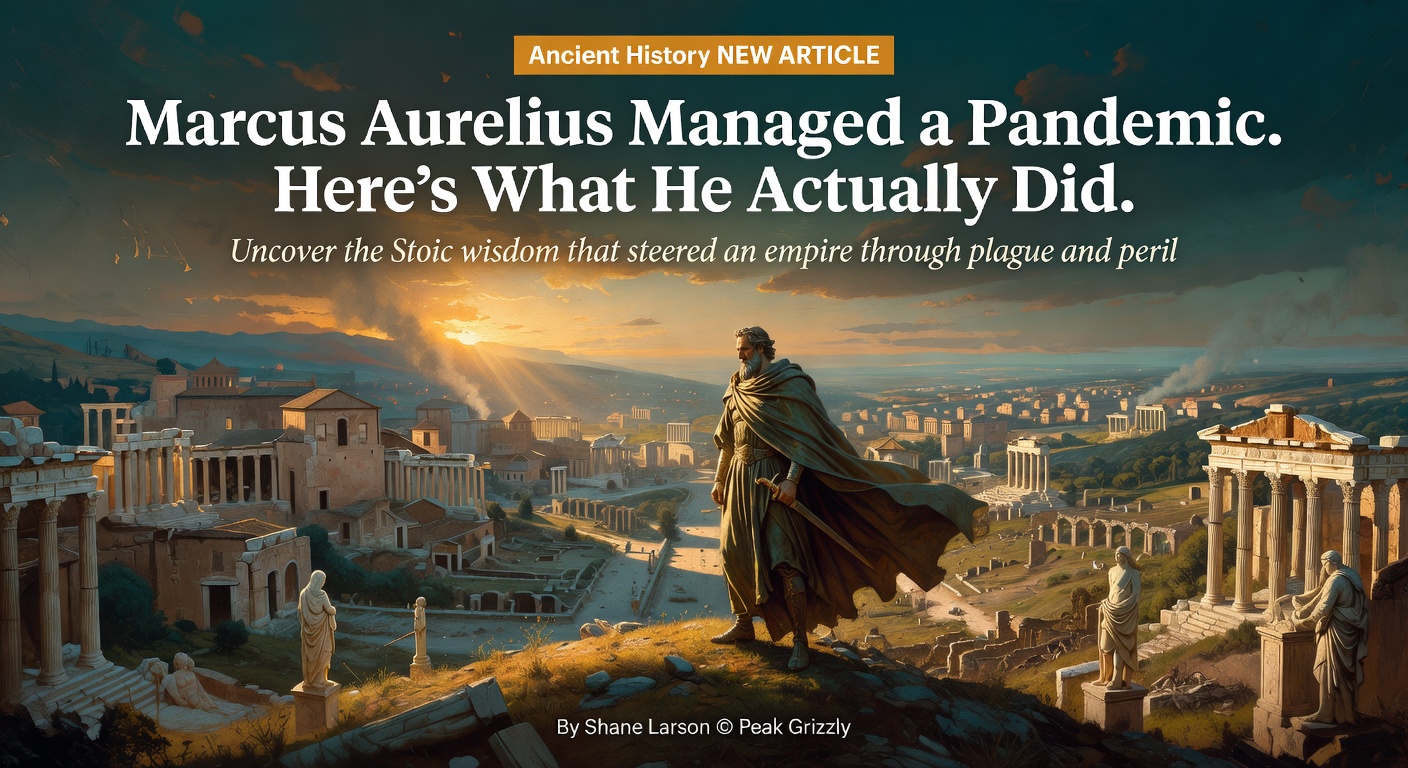
Marcus Aurelius Managed a Pandemic. Here's What He Actually Did.
April 11, 2026 · 6 min read
In 165 CE, Roman legions marched home from a victorious campaign against the Parthian Empire. They had sacked the enemy capital, Ctesiphon. They had avenged decades of border provocations. By every measure, it was a triumph.
They also brought home a plague.
The Antonine Plague -- named after the ruling Antonine dynasty, not after any medical understanding of the disease -- would rage across the Roman Empire for at least fifteen years. Modern epidemiologists believe it was most likely smallpox. The physician Galen, who witnessed it firsthand, described fever, skin eruptions, and a mortality rate that emptied military camps and towns alike.
Conservative estimates put the death toll at five million. Some historians argue it was closer to ten million -- roughly 10% of the entire Roman population.
And the man responsible for holding the empire together through all of it was Marcus Aurelius, the philosopher-emperor who never wanted the job in the first place.
The Emperor Who Didn't Want to Be Emperor
Marcus Aurelius was adopted into the imperial succession as a teenager, not because he sought power but because Emperor Hadrian saw something in him. Through an elaborate adoption chain -- Hadrian adopted Antoninus Pius, who adopted Marcus -- the boy was groomed for the throne.
What Marcus actually wanted was philosophy. He had been drawn to Stoicism from a young age, studying under masters like Junius Rusticus, Apollonius of Chalcedon, and Sextus of Chaeronea. The Stoic tradition taught that virtue was the only true good, that external circumstances were indifferent, and that every person had a duty to play their role in the rational order of the universe.
When Antoninus Pius died in 161 CE, Marcus became emperor at thirty-nine. His first act was to insist on sharing power with his adoptive brother Lucius Verus -- something no emperor had ever done voluntarily. It was a Stoic move: Marcus believed in duty over personal glory.
He had no idea what was coming.
The Plague Arrives
The timeline is brutal. In 161, Marcus becomes emperor. By 162, the Parthians have invaded Rome's eastern provinces, and Marcus sends Lucius Verus to manage the counteroffensive. By 165, the legions have won -- but the plague is already spreading through the returning army.
By 166, it has reached Rome itself.
Galen described the symptoms in clinical detail: high fever lasting days, a black skin rash, gastrointestinal distress, and death rates that climbed in waves. The plague didn't just kill soldiers and civilians. It disrupted the entire machinery of empire. Tax revenues collapsed. Trade routes emptied. Agricultural production fell as laborers died or fled. The military, Rome's backbone, lost so many men that the legions couldn't maintain their strength at the frontiers.
And the frontiers were where Marcus needed them most.
The Danube Crisis
The Antonine Plague didn't arrive alone. Almost simultaneously, the Germanic and Sarmatian tribes north of the Danube -- the Marcomanni, Quadi, and others -- began a massive southward push. In 167, they breached the Danube frontier. By 170, they had pushed into northern Italy itself, reaching the city of Aquileia. Germanic warriors hadn't penetrated that deep into Italian territory in over 250 years.
Marcus faced a compounding crisis: a plague devastating his population and military strength, and a frontier invasion that threatened the heart of the empire. His response tells you everything about who he was.
What Marcus Actually Did
First, he refused to raise taxes on a population already devastated by plague. Instead, he held an extraordinary auction of imperial possessions. Palace furniture, imperial robes, gold vessels, artwork -- Marcus sold them publicly in the Roman Forum. The message was unmistakable: the emperor would sacrifice his own luxury before asking more from his people.
Second, he got creative with military recruitment. With legionary manpower gutted by the plague, Marcus recruited from unconventional sources: gladiators, slaves (who were freed upon enlistment), bandits from Dalmatia, and even Germanic warriors from allied tribes. It wasn't elegant. It worked.
Marcus Aurelius
Third, and most remarkably, he went himself. Marcus was not a natural soldier. He was a bookish, sickly philosopher who suffered from chronic stomach problems and chest pain. But he took personal command of the Danube campaigns and spent most of the last fifteen years of his life in military camps along the frontier.
He lived in tents, ate camp food, presided over war councils, and made tactical decisions about river crossings and winter campaigns. The philosopher-emperor became a frontier commander by sheer force of will and duty.
The Journal
It was during these campaigns -- cold, exhausted, managing a plague and a war simultaneously -- that Marcus wrote the Meditations.
The title is misleading. Marcus didn't write a philosophical treatise. He wrote a personal journal, addressed to himself, never intended for any other reader. The original Greek title is best translated as "To Himself."
The entries are raw. Marcus reminds himself to get out of bed in the morning even when he doesn't want to. He talks himself out of anger at incompetent subordinates. He reflects on the deaths of people he loved. He returns, again and again, to the Stoic conviction that his job is to do his duty well and accept whatever comes.
"You could leave life right now," he writes. "Let that determine what you do and say and think."
This isn't a man philosophizing from comfort. This is a man using philosophy as a survival tool while his world falls apart around him.
The Succession Disaster
Marcus managed the plague. He held the frontier. He kept the empire intact through fifteen years of overlapping crises. But there was one problem he couldn't solve: his son.
Commodus was Marcus's only surviving biological son, and in a dynastic system, that meant he was the heir. The famous adoptive succession system -- which had produced five good emperors in a row -- only worked because the previous emperors had no biological sons to complicate things. Marcus did.
Marcus made Commodus co-emperor at fifteen, likely hoping to guide his development. But within months of Marcus's death on March 17, 180 CE, Commodus abandoned the Danube wars, returned to Rome, and began a reign that careened from erratic to genuinely delusional. He fought as a gladiator in the arena, renamed Rome after himself, and was eventually assassinated by his own inner circle.
Everything Marcus had fought to preserve, Commodus threw away. The philosopher-emperor's greatest failure was the one thing his philosophy couldn't fix: his own son.
Why This Still Matters
Marcus Aurelius managed a pandemic without epidemiology, virology, or public health infrastructure. He couldn't quarantine the empire or develop a vaccine. All he had were pragmatic decisions, personal sacrifice, and a philosophical framework that insisted on duty over self-pity.
He didn't manage it perfectly. The plague killed millions regardless of what he did. The frontier wars dragged on for years. His succession plan was a disaster.
But he showed up. Every day, for nearly twenty years, he did the job. He wrote in his journal at night, reminded himself that none of this was permanent, and got up the next morning to do it again.
The Meditations endures not because Marcus had answers, but because he was honest about not having them -- and did the work anyway.
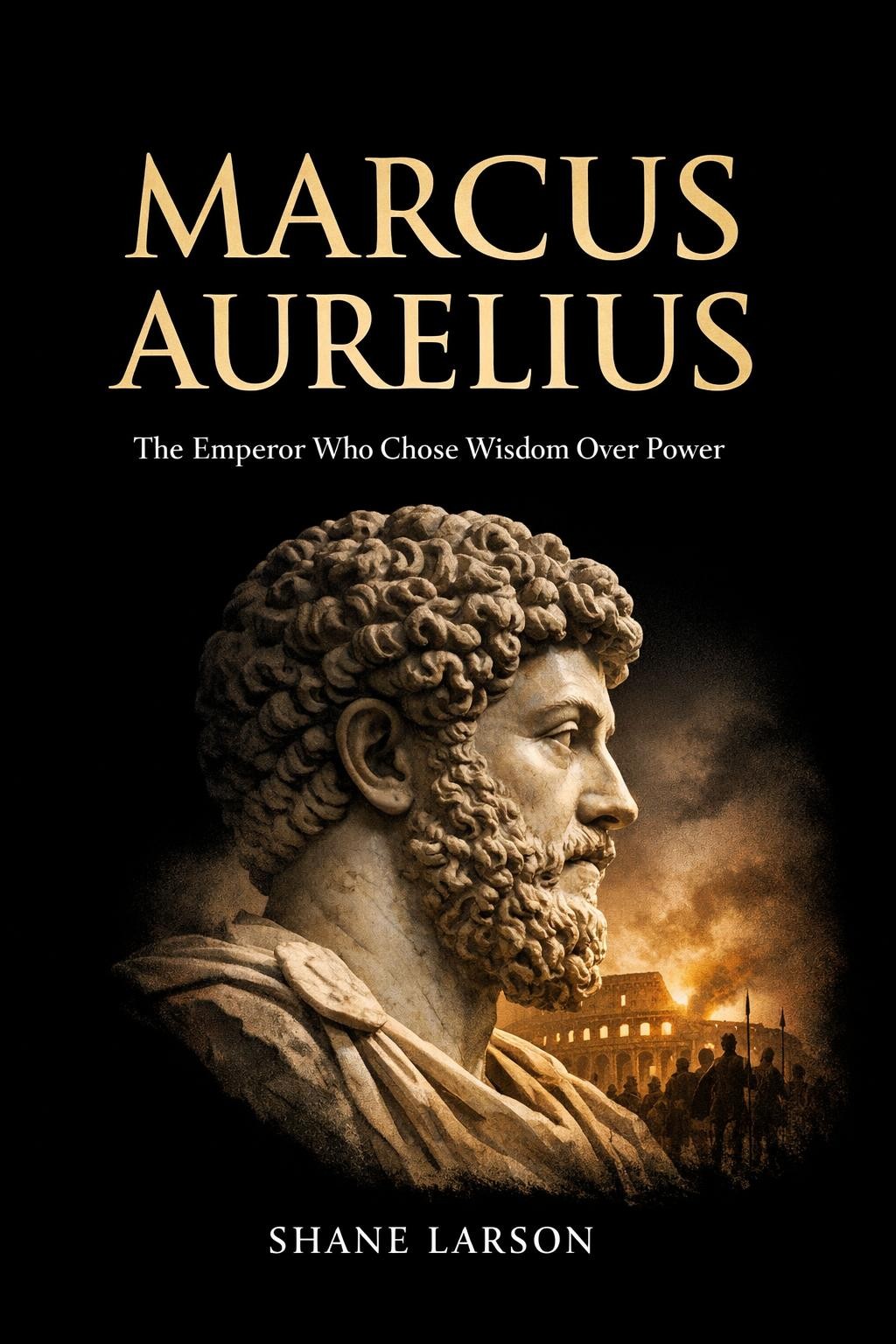
"Marcus Aurelius: The Emperor Who Chose Wisdom Over Power" tells the complete story -- from Marcus's Stoic education through the wars, the plague, and the Commodus succession that ended Rome's golden age. Available now on Kindle and Kindle Unlimited.
Shane Larson is the author of over 40 books on technology, history, and productivity. His Ancient History series covers everything from the Bronze Age collapse to the fall of Rome. Learn more at shanelarson.com.
Marcus Aurelius
New posts and releases, straight to your inbox. No spam, unsubscribe anytime.