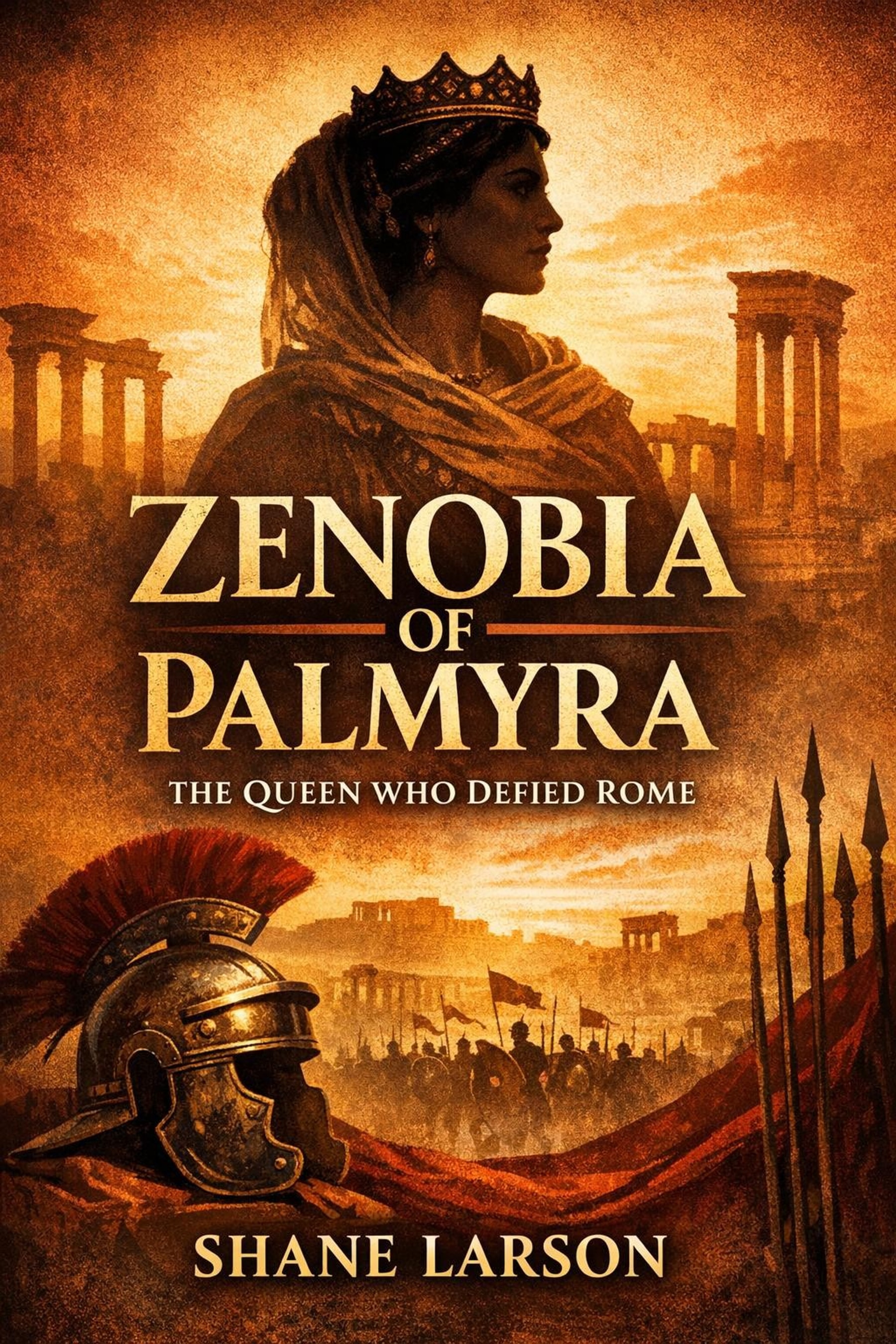
Zenobia of Palmyra
The Queen Who Defied Rome
By Shane Larson
About This Book
The morning Aurelian's army appeared on the plain east of Antioch, Zenobia's heavy cavalry — the clibanarii, men and horses both encased in scale armor — were already drawn up in formation. They were the most expensive military asset in the Near East. They had broken Persian lines. They were supposed to be the answer to every question a battle could ask.
By late afternoon, most of them were dead on the ground or scattered into the Syrian hills, undone by light Roman skirmishers who refused to stand still long enough to be charged. The Palmyrene Empire had eight months left to exist.
This is the story of how that empire was built, and how it fell.
The Rise of Palmyra
Palmyra was a city that should not have existed. It sat in the middle of the Syrian desert, two hundred kilometers from the nearest river worth the name. What it had was a spring, a strategic position on the overland trade route between the Persian Gulf and the Mediterranean coast, and — for about two centuries — a uniquely effective merchant class who turned that geography into one of the great commercial fortunes of the ancient world.
By the middle of the third century, Palmyra's wealth had bought it something more dangerous than money: a private army. When Roman armies in the east were destroyed by the Persians under Shapur I, and the emperor Valerian was captured and reportedly used as a footstool, it was the Palmyrene king Odaenathus who counterattacked, drove the Persians back across the Euphrates, and effectively held the eastern half of the Roman Empire together while Rome itself was busy losing emperors at the rate of one every two or three years.
Odaenathus was assassinated in 267 CE. His widow took over. Her name was Zenobia, and within three years she had pushed her armies into Egypt and Anatolia and was minting coins in her own name and her son's, with no further reference to the emperor in Rome.
What This Book Argues
The standard story treats Zenobia as a romantic anomaly — an exotic queen, vaguely Cleopatra-adjacent, who briefly defied Rome and was then put back in her place. That story is almost entirely a Roman construction, and it's wrong in most of its specifics.
The Queen Who Almost Broke Rome argues something less romantic and more interesting: that the Palmyrene Empire was a genuine structural alternative to Roman rule in the East, that it nearly worked, and that the only reason it didn't was the appearance of one specific Roman emperor — Aurelian — at one specific moment. Change the timing by even a year or two, and the political map of the late third century looks very different.
The book follows the full arc. Palmyra's centuries-long rise as a caravan city. The Crisis of the Third Century and how it created the vacuum Zenobia stepped into. Odaenathus and the suspicious end of his career. Zenobia's conquests and her brief, brilliant administration of the eastern provinces. The military campaign that ended her, fought across northern Syria in 272. The capture, the show trial in the form of a Roman triumph, and the long, contradictory afterlife of her story in the sources.
What's Inside
- The caravan economy — how Palmyra's merchants extracted wealth from a trade route that ran from the South China Sea to Roman Gaul, and why their tax records survive better than almost any other ancient commercial documentation
- The crisis that created the opportunity — the simultaneous Persian invasion, plague pandemic, breakaway Gallic Empire, and parade of short-lived emperors that hollowed out central Roman authority between 235 and 284 CE
- Odaenathus the kingmaker — the man who saved Rome's eastern frontier, took the title King of Kings, and died under circumstances his contemporaries did not believe
- The conquest of Egypt — Zenobia's seizure of the Roman Empire's most valuable province, accomplished with surprising speed and minimal resistance
- The Anatolian campaign — how Palmyrene forces pushed past Antioch, past Ankara, and were stopped only at the Bosporus
- The two decisive battles at Immae and Emesa — Aurelian's specific tactical solution to heavy Eastern cavalry, drawing them into broken ground and exhausting them with feigned retreats
- The siege of Palmyra and the queen's flight east toward Persia — caught, by most accounts, just short of the Euphrates
- The triumph and after — what the Roman sources claim happened to Zenobia, where they contradict each other, and what the archaeology actually supports
- Palmyra's long afterlife — the slow medieval decline, the 1751 rediscovery by Robert Wood and James Dawkins, the colonnades that became one of the most photographed ruins in the world, and the deliberate destruction by ISIS in 2015
Why I Wrote This
I came to Zenobia the way most people do — through a footnote. I was reading about Aurelian, the soldier-emperor who reunified the empire in the 270s, and the footnote mentioned the Palmyrene queen he defeated almost in passing, as if she were one of his bullet points rather than the ruler of a rival empire.
I started pulling at the thread and realized something I should have suspected earlier: most of what we say about Zenobia in popular history is downstream of a single late-Roman text, the Historia Augusta, which is unreliable enough that serious historians have spent the last century debating which of its passages are actual history and which are entertaining fiction. The result is a figure who has been romanticized and dismissed in roughly equal measure, and rarely just taken seriously as a political actor.
This book is my attempt to take her seriously. Not as a Cleopatra-replay, not as a feminist icon for export, but as a head of state who built a functional empire in the worst decade Rome ever had, ran it well enough that the Egyptians and Syrians and Anatolians went along, and lost it only because she ran into a better general at the wrong moment. — Shane
Frequently Asked Questions
How much do I need to know about Roman history to read this?
Very little. The book opens by setting up the political situation in the mid-third century from scratch — who Rome was, why it was in trouble, what the eastern frontier looked like. If you've read other accessible ancient-history books like Tom Holland's Rubicon or Mary Beard's SPQR, you'll be comfortable, but they aren't prerequisites.
Is this a military history or a political history?
Both, weighted toward the political. The battles get full treatment because they're decisive and tactically interesting, but the book spends more time on the structural questions — how Palmyra ran its empire, how Roman administration broke down in the third century, how a city of caravan merchants ended up fielding heavy cavalry units that could intimidate Persia.
How reliable are the sources on Zenobia?
Patchy. The two main narrative sources — Zosimus and the Historia Augusta — are both late, both Roman, and both have agendas. The Historia Augusta in particular has invented documents in it. The book is explicit throughout about which claims rest on solid evidence (coins, inscriptions, contemporary papyri) and which rest on later Roman storytelling. Where the trail is too thin to walk, the book says so rather than guessing.
Did Zenobia really claim descent from Cleopatra?
Probably not in the way later sources claim. The Cleopatra connection is most prominent in the Historia Augusta, which is exactly the kind of detail that author liked to invent. There may have been a propaganda link drawn in her own time — Egypt was the wealthiest piece of her empire and a Ptolemaic association would have been useful — but the specific genealogical claim is almost certainly a later embellishment.
What happened to her after the triumph in Rome?
This is the single most disputed question in her biography. Different sources have her executed, dying of illness on the journey to Rome, committing suicide by hunger strike, retiring to a villa at Tibur (modern Tivoli) and marrying a Roman senator, or simply disappearing from the record. The book walks through all five versions, what the evidence supports for each, and why the "villa at Tibur" story — strange as it sounds — may be the closest to true.
Is this part of a series?
It stands alone, but it pairs naturally with the other ancient-world titles in the Peak Grizzly catalog, especially the ones covering Egypt and the Eastern Mediterranean in late antiquity. See the related reading below.
If You Liked This, You Might Like
- Cleopatra's Egypt — the Ptolemaic queen Zenobia was repeatedly compared to, and the dynasty that actually invented the playbook of women ruling Hellenistic kingdoms.
- The Persian Empire — the Sasanian world east of the Euphrates, whose pressure on Rome created the opening Palmyra exploited.
- Assyria — the earlier Mesopotamian imperial tradition that shaped the political imagination of every Near Eastern state that came after, Palmyra included.
- The Fall of Rome — the long question Palmyra is a chapter in: when does Roman power actually break, and why does it take so long to admit it?
A Final Note
Five years is not a long time to run an empire. It is long enough to mint coins, raise armies, govern provinces, and frighten a much larger state into sending its best general to find you. Zenobia did all of that, and then she lost — to a man who deserves more credit than he usually gets, in a war she came closer to winning than the Roman sources ever wanted to admit.
The desert is still there. So are the columns. The story is worth the trip out.
Included with Kindle Unlimited — read it free if you're a member.
New Ancient History releases and free chapters — no spam, unsubscribe anytime.