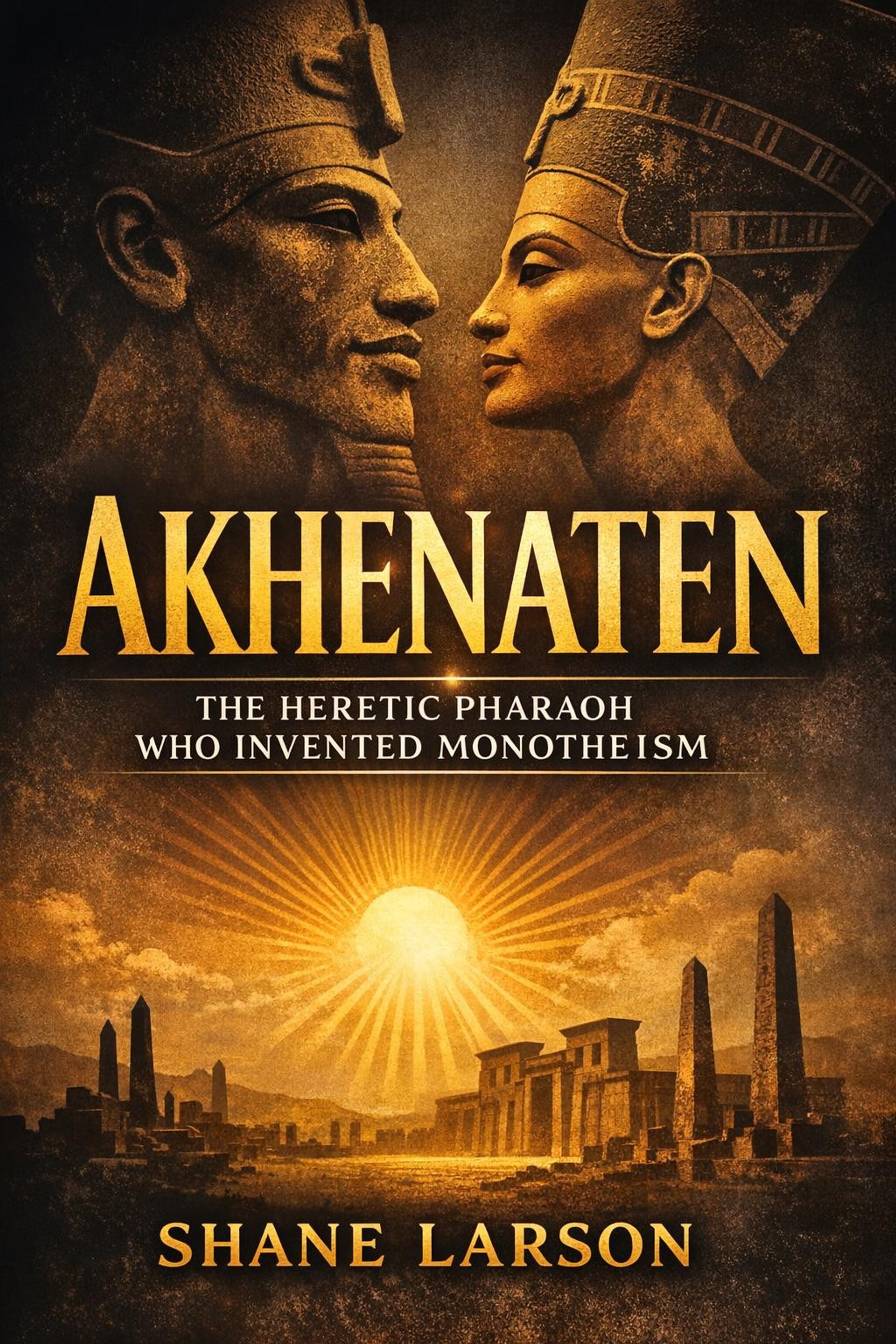
Akhenaten
The Heretic Pharaoh Who Invented Monotheism
By Shane Larson
About This Book
A peasant woman digging for fertilizer in a ruined desert city in 1887 found the first of them. Small clay tablets, baked hard, covered in cuneiform wedges she could not read. By the time scholars realized what she had found, hundreds more had been scattered across the antiquities markets of Cairo and Europe. The tablets were diplomatic correspondence — letters to a pharaoh from his vassal kings and from the great powers of the Late Bronze Age. They had been left behind in the records office of a capital city that had been abandoned, dismantled, and systematically erased from Egyptian memory more than three thousand years earlier.
The city was called Akhetaten. The pharaoh who built it was called Akhenaten. And until those tablets came out of the ground, almost no one knew either of them had ever existed.
This is the story of how the most radical religious experiment in the ancient world happened, why it failed, and why the dynasty that came after spent two generations trying to make sure no one ever knew it had been tried.
The Reign That Was Erased
Around 1353 BCE, a young man named Amenhotep IV took the throne of an Egypt that had reached the peak of three centuries of imperial expansion. Gold flowed in from Nubian mines. Tribute flowed in from vassal cities in Canaan, Syria, and the upper Euphrates. The state god, Amun of Thebes, had grown so rich on this imperial wealth that his temple complex at Karnak had become a parallel state — landed, staffed, hereditary, with a priesthood that no pharaoh in living memory had brought fully to heel.
The young pharaoh waited a few years. Then he renamed himself Akhenaten — "Effective for the Aten" — and detonated the entire system.
He declared that the visible disk of the sun, the Aten, was not one god among many but the only god worthy of worship. He closed the temples of Amun. He sent his masons through the country with chisels, gouging Amun's name out of every monument they could reach, including his own dead father's cartouches. He abandoned Thebes entirely and ordered the construction of a new capital — Akhetaten, "Horizon of the Aten" — on a virgin desert site in Middle Egypt that had never been dedicated to any god. He moved the court there, and the bureaucracy, and the army command. He commissioned an artistic revolution that depicted him and his queen Nefertiti with elongated skulls, sloping bellies, full hips, and domestic scenes of a kind Egyptian royal iconography had never before admitted.
Meanwhile, the empire in the north was coming apart. The Hittites were pressing south through Syria. Egypt's vassals in Canaan were writing increasingly desperate letters, begging for troops, for gold, for any acknowledgment that the great king in Egypt still cared whether they survived. The letters went into the archive. They did not come back out with replies.
Akhenaten died around 1336 BCE. What happened next is one of the most contested successions in pharaonic history. A figure named Smenkhkare ruled briefly — possibly a separate man, possibly Nefertiti herself ruling under a male throne name. Then a nine-year-old boy named Tutankhaten took the throne, was guided by his advisors back to Thebes, changed his name to Tutankhamun, reopened the temples of Amun, and died before he was twenty. His tomb, sealed in haste and forgotten under workers' huts, would be rediscovered intact in 1922 and become the most famous archaeological find in history.
His father's name, by then, had already been struck from the king lists. The general Horemheb, who eventually took the throne, organized a thorough campaign of erasure. Amarna was dismantled. The talatat blocks — small standardized stones the Aten temples had been built from — were broken out of the walls and reused as construction fill in later monuments at Karnak and Hermopolis. For three thousand years, Akhenaten was simply gone. The king lists skipped from his father straight to Horemheb, as if the seventeen years in between had never happened.
Then archaeology brought him back. The Amarna letters in 1887. The Petrie excavations through the 1890s. The Borchardt expedition that unearthed the Nefertiti bust in 1912. The systematic reconstruction of the Aten temples from the recovered talatat blocks. The recent DNA analyses of the royal mummies, including the contested identification of the body in tomb KV55. Piece by piece, a reign was reassembled from the rubble of the dynasty that had tried to erase it.
What's Inside
- The Eighteenth Dynasty at its imperial peak — the wealth, the bureaucracy, and why the Amun priesthood had become an institutional power that no pharaoh had succeeded in bringing under royal control
- The Aten theology in detail: what it actually claimed, how it differed from earlier Egyptian sun worship, and where it sits in relation to the later monotheisms of the Iron Age
- Akhetaten as urban design — a planned royal city laid out in the desert, with the boundary stelae still in the cliffs marking its limits
- Nefertiti's elevated public role — depicted smiting enemies, depicted in postures normally reserved for kings, and the serious modern case that she ruled as coregent in Akhenaten's final years
- The Amarna letters as primary source — what the vassal correspondence reveals about Egypt's foreign policy paralysis, and how the Hittites under Suppiluliuma I exploited it
- The Smenkhkare problem: the evidence for a separate male coregent versus the evidence that "Smenkhkare" was Nefertiti under a new throne name
- The succession of Tutankhamun, the reversal of the religious revolution, and the DNA evidence on his parentage — what it shows and where it remains contested
- Horemheb's erasure campaign — how it worked, what it destroyed, and the accident of preservation in the talatat blocks that made the recovery possible
- The modern rediscovery, from 1887 to the present, and the long afterlife of a pharaoh whose recovery has reshaped the history of religion
Why I Wrote This
Most of the people I know who got interested in ancient Egypt got there through Tutankhamun. The 1922 tomb, the gold mask, the curse stories — that's the entry point. But the moment you start asking who Tut's father was, you fall straight into a missing chapter. The kings lists won't tell you. The standard tour-guide narratives gloss it. And the academic literature on Akhenaten tends to be either a hundred years old or written for specialists.
I wanted a book I could hand to someone who'd just finished a popular history of the Eighteenth Dynasty and wanted the missing piece — the seventeen years that the next dynasty tried very hard to make sure no one would ever read about. I also wanted to take seriously the case for Nefertiti as a ruler in her own right, which has gone from fringe to mainstream in the last twenty years and which most popular accounts still haven't caught up with.
What I was not interested in writing was a speculative reconstruction. The genre is full of those — Akhenaten as proto-Christ, Akhenaten as alien, Akhenaten as Moses. The actual reign is strange enough without that. I tried to write the book at the level of what we can defensibly say, mark clearly where the evidence runs out, and let the genuinely unresolved questions stay unresolved.
Frequently Asked Questions
Do I need to have read other books on ancient Egypt to follow this one?
No. The book opens with enough context on the Eighteenth Dynasty and the role of the Amun priesthood to follow the story without prior background. If you've read a general history of Egypt — Toby Wilkinson's The Rise and Fall of Ancient Egypt, or any of the standard popular accounts — you'll recognize the landscape, but the book is written to stand on its own.
Is this an academic biography or a popular history?
Popular history, written for general readers. It draws on the academic literature — Hornung, Reeves, Dodson, Kemp, Laboury — but the structure is narrative, not citational. Where specialists genuinely disagree, the disagreement is presented honestly rather than papered over.
Does the book cover Nefertiti in detail?
Yes. Her public role, her iconographic prominence, the evidence for her elevation in the later years of the reign, and the case that she ruled as coregent under the name Neferneferuaten — and possibly continued ruling after Akhenaten's death under the throne name Smenkhkare — are covered at length. This is the part of the Amarna story that has shifted most in recent scholarship, and the book reflects that shift.
Was Akhenaten really the first monotheist?
The book takes this question seriously rather than answering it with a slogan. The Aten theology was the first known state-enforced exclusive monotheism in the historical record, but whether it qualifies as monotheism in the later Abrahamic sense — and whether it had any influence on Israelite religion three centuries later — is genuinely contested. The relevant evidence is laid out so you can form your own view.
Is this part of a series?
It sits alongside Shane Larson's broader ancient Egypt catalog as a standalone volume on the Amarna period. It can be read in any order relative to the others.
Is it available on Kindle Unlimited?
Yes, the ebook is available through Kindle Unlimited.
If You Liked This, You Might Like
- The Sea Peoples — The mysterious raiders whose arrival in the Eastern Mediterranean a century after Akhenaten helped collapse the entire Bronze Age world he had so carelessly governed.
- Hatshepsut — The female pharaoh of the same dynasty whose own monuments were defaced in a different erasure campaign, three generations earlier.
- The Bronze Age World — The wider context: the great powers, the trade networks, and the diplomatic system that the Amarna letters document at the moment of its decline.
- Ramesses the Great — The pharaoh of the next dynasty, who restored what Akhenaten dismantled and built an imperial revival on the wreckage.
A pharaoh tried to remake religion in a single reign. The dynasty that followed nearly succeeded in pretending he had never lived. This is what survived — and what the archaeology has been able to put back together.
Included with Kindle Unlimited — read it free if you're a member.
New Ancient History releases and free chapters — no spam, unsubscribe anytime.