
The Technical Co-Founder Is Dead. Domain Expertise Is the New Moat.
June 29, 2026 · 6 min read
There is a physical therapist in Portland who spent fifteen years watching patients forget their exercises between visits. The solution was obvious — a simple app with daily reminders and customized video demos. She tried everything. Development agencies quoted her sixty thousand dollars. No developer wanted to co-found a physical therapy app for free. She got halfway through a JavaScript tutorial and gave up because she had a business to run.
Then she sat down with an AI coding tool and described what she wanted. Three weekends later, she had a working prototype. Two months after that, she had forty paying customers — all physical therapists in her network with the exact same problem. Twenty-nine dollars a month per practice. She has never written a line of code by hand.
She is not unusual anymore. She is part of a pattern that is reshaping who builds software and why.
The New Founder Class Looks Nothing Like the Stereotype
A new class of founder is emerging, and they look nothing like the hoodie-wearing CS graduate building the next social network. They are domain experts — people who have spent years or decades in a specific industry, who understand problems deeply, who have networks of potential customers, and who have been waiting for the tools that would let them build solutions themselves.
They are physical therapists, warehouse managers, bookkeepers, corporate trainers, real estate agents, and insurance brokers. They share one trait: domain expertise so deep they can describe exactly what needs to exist, who would pay for it, and why every existing solution falls short.
Consider the difference between a technical founder and a domain expert founder building the same product. The technical founder starts with "I can build this" and then tries to find customers. The domain expert starts with "I know exactly who needs this and why" and then figures out the building. One of these approaches has a dramatically higher success rate. It has always been this way — the domain expert just could not do the building part before.
AI coding tools crossed a threshold. Not the incremental kind. Tools like Claude Code, Cursor, and Replit Agent do not simplify coding — they do the coding. You describe what you want in plain language, and they generate working code. The products being built by non-technical founders right now are real. They have real users and real revenue. They are not toys or demos.
Marcus spent twelve years in logistics and knew every warehouse manager used the same broken process for shift changes — spreadsheets, group texts, and hope. He built a shift management tool over four weekends. His first five customers were people he already knew. Within six months, sixty customers at two hundred dollars a month each. His code would make a senior engineer cringe. His customers do not care about his code.
Priya ran a bookkeeping practice for restaurants and noticed every client had the same nightmare: reconciling delivery platform payouts with bank statements. She built a reconciliation tool. She did not know what an API was when she started. Over a hundred restaurant clients at forty-nine dollars a month, all from referrals.
The Part That Most "Build With AI" Content Gets Wrong
Here is where the honest conversation starts. The tools changed, but the fundamentals did not.
A product still needs to solve a real problem. Customers still need to be willing to pay for it. The market still needs to be large enough. Distribution still matters more than features. Pricing still determines profitability. Retention still determines sustainability. None of this changes because the building tool changed.
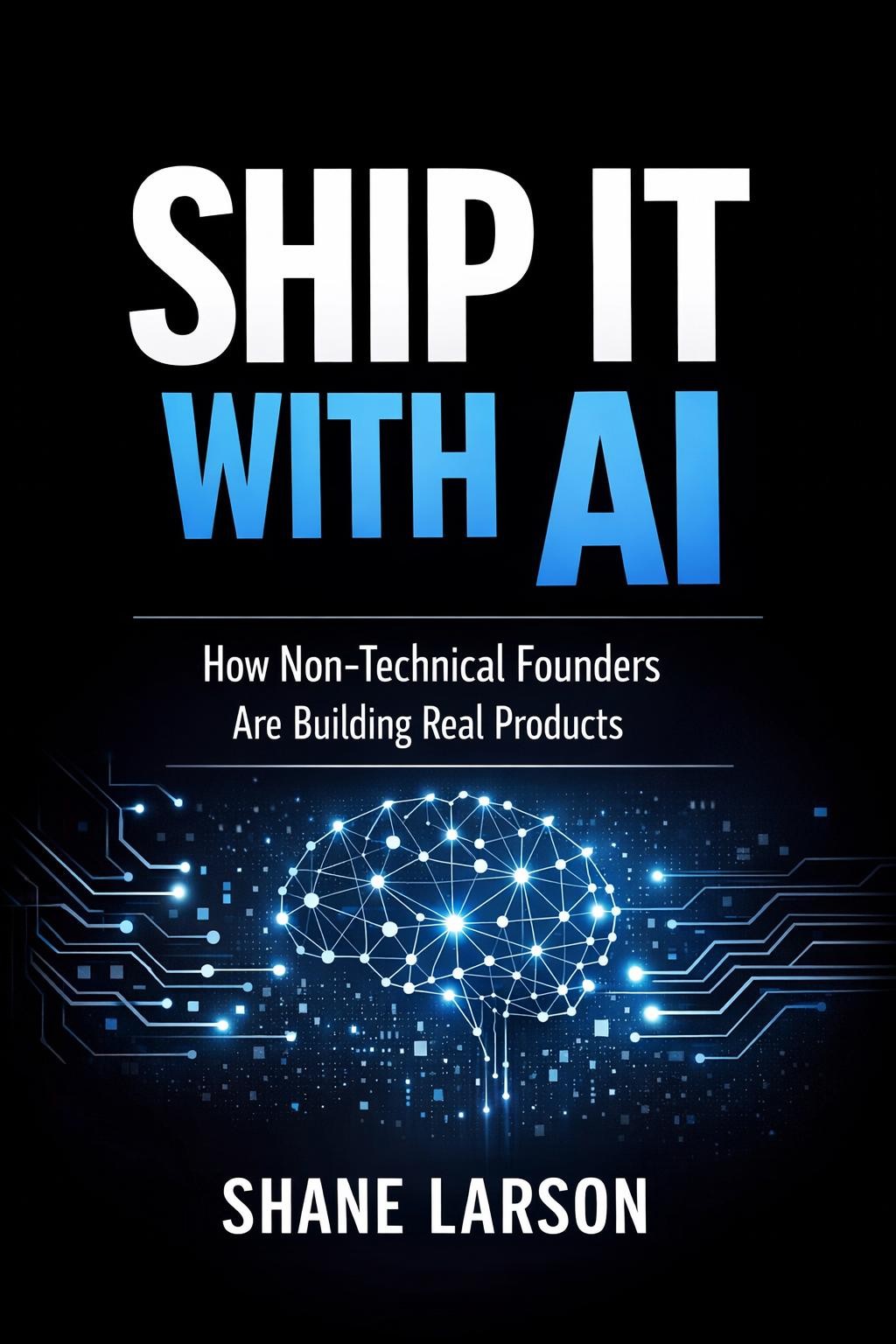
Ship It With AI
If anything, the fundamentals matter more now. When building was the hard part, the bottleneck was whether you could create the product at all. Now that building is easier, the bottleneck shifts to everything else — validation, positioning, distribution, pricing, retention. The founders who succeed with AI tools are not the ones who build the fastest. They are the ones who validate the hardest.
This creates a specific trap that AI tools make worse: the build trap. You have an idea. You sit down with an AI coding tool. Three days later, you have a working product. You are so excited by the fact that you built something that you skip the question of whether anyone will pay for it. You spend three months adding features without talking to a single potential customer. When you finally launch, you discover the problem you solved is not the one people pay to fix.
The antidote is disciplined validation before you write a single line of code — or more accurately, before you ask an AI to write a single line of code.
The validation framework is four questions, in order. Is this a real problem — not just an annoyance, but something causing measurable pain? Who specifically has this problem — not "small businesses" but "restaurant owners with 2-5 locations using multiple delivery platforms"? Will they pay for a solution — not "would you use this?" but "here is my credit card"? And is the market big enough to sustain a business at realistic conversion rates?
Five concrete methods test these questions without building anything. Customer conversations (ten people who actually have the problem, asking about their behavior, not their opinions). Landing page tests (describe the product, measure who clicks). Concierge MVPs (deliver the service manually to prove people will pay). Pre-sales (ask for money before the product exists). And qualified waitlists with enough friction to filter out polite liars.
Priya, the bookkeeper, started with a concierge MVP. She offered delivery platform reconciliation as a manual service for thirty dollars a month. Twelve clients in the first month. When she eventually built the software, she already had paying customers to migrate. That is validation.
The Reframe That Changes Everything
Most non-technical founders carry a belief that they are at a disadvantage because they do not know how to code. This belief is wrong, and it has been wrong for a long time.
The non-technical founder's disadvantage — the inability to build — has been eliminated by AI tools. The non-technical founder's advantages remain: domain expertise, customer relationships, industry networks, business instinct, and the ability to think about problems from the user's perspective rather than the developer's perspective.
The most common reason startups fail is not bad code. It is building something nobody wants. The non-technical founder who has spent years in their industry — who has heard the same complaints, watched the same broken processes, and has the phone numbers of fifty people who would pay for a solution — is better positioned to build something people want than any developer guessing at the market from the outside.
You are not at a disadvantage. You have an advantage you have not yet learned to use. The building barrier is gone. The question is no longer "can I build this?" It is "should I build this, for whom, and how do I get them to pay?" Those are business questions. And business questions are exactly what domain experts are good at.
Ship It With AI
New posts and releases, straight to your inbox. No spam, unsubscribe anytime.