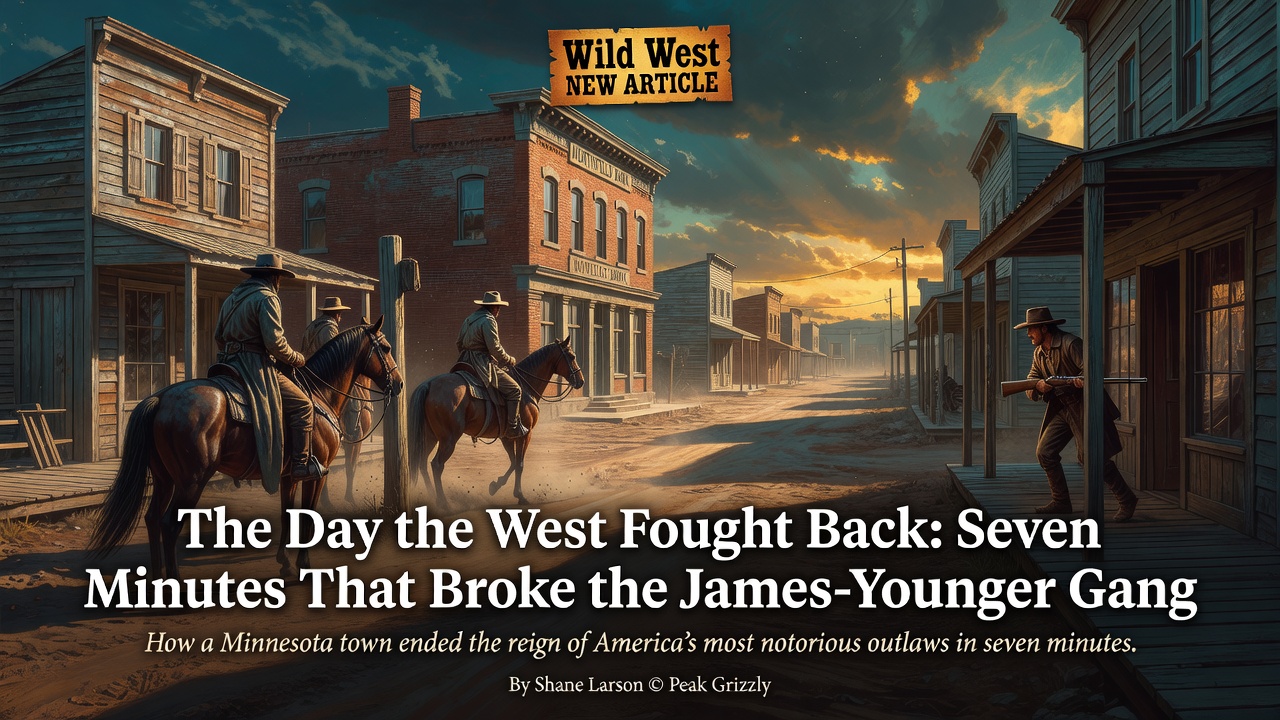
The Day the West Fought Back: Seven Minutes That Broke the James-Younger Gang
July 6, 2026 · 6 min read
For ten years, the most famous outlaw gang in America did roughly as it pleased. Jesse and Frank James and the three Younger brothers — Cole, Jim, and Bob — robbed banks and trains across Missouri and beyond, vanished into a countryside full of sympathizers, and were romanticized by a partisan press that recast cold-blooded robbery as a kind of noble rebellion. The Pinkerton National Detective Agency, the most formidable private police force in the country, took the case and failed. When the Pinkertons did strike, in 1875, they botched it so badly — killing Jesse's young half-brother and maiming his mother — that public sympathy swung even harder toward the gang.
By the summer of 1876, the James-Younger gang had every reason to believe it was untouchable. That belief is exactly what killed it.
The wrong town
On the afternoon of September 7, 1876, eight well-dressed men on good horses rode into Northfield, Minnesota. Besides the James and Younger brothers, the band included three hard men: Clell Miller, Bill Chadwell, and Charlie Pitts. Chadwell had claimed knowledge of Minnesota, and the gang had come a long way from the border country where their name carried dread. They had picked the First National Bank, and they expected what the border had always given them — a fast, terrifying strike and a clean ride home.
Here is the thing the gang failed to understand. Minnesota was not Missouri. Northfield had no Confederate loyalties. Its citizens had not grown up on the legend of the gallant Jesse James, and they felt no reason to stand aside while armed strangers robbed their bank. The gang's reputation, so useful at home, meant nothing here. It was, if anything, a liability — because the men of the gang were counting on a fear that simply did not exist.
Seven minutes
The plan divided the gang into groups: men inside the bank, men holding the street, and a rear guard. Inside, the robbers found acting cashier Joseph Lee Heywood and two other employees. They demanded the safe be opened.
Heywood refused. He told them the safe was secured by a time lock and could not be opened — a claim that may or may not have been true, but that he held to under direct threat. The outlaws beat him and put a gun to his head. He still refused. That refusal, made by an ordinary man with no obligation to be a hero, is the moral center of the entire Northfield story. It cost him his life; he was murdered before the gang fled.
Outside, things went wrong even faster. As the robbery dragged and the street group grew nervous and conspicuous, townspeople began to realize what was happening — and instead of scattering, they armed themselves with whatever was at hand. A young medical student named Henry Wheeler found a rifle and fired down into the street from a hotel window. A hardware merchant named A.E. Manning took cover by a stairwell and picked off outlaws and their horses one by one. Other citizens grabbed shotguns and fowling pieces.
In a matter of minutes — contemporaries reckoned it at roughly seven — the raid collapsed. Clell Miller and Bill Chadwell were shot dead in the street. Several of the Youngers took serious wounds. A local man, Nicholas Gustafson, was also killed in the chaos. The surviving outlaws, bleeding and stunned, spurred their horses out of town with nothing to show for it. The most feared gang in America had been wrecked not by a famous marshal, but by the people of a town it had underestimated.
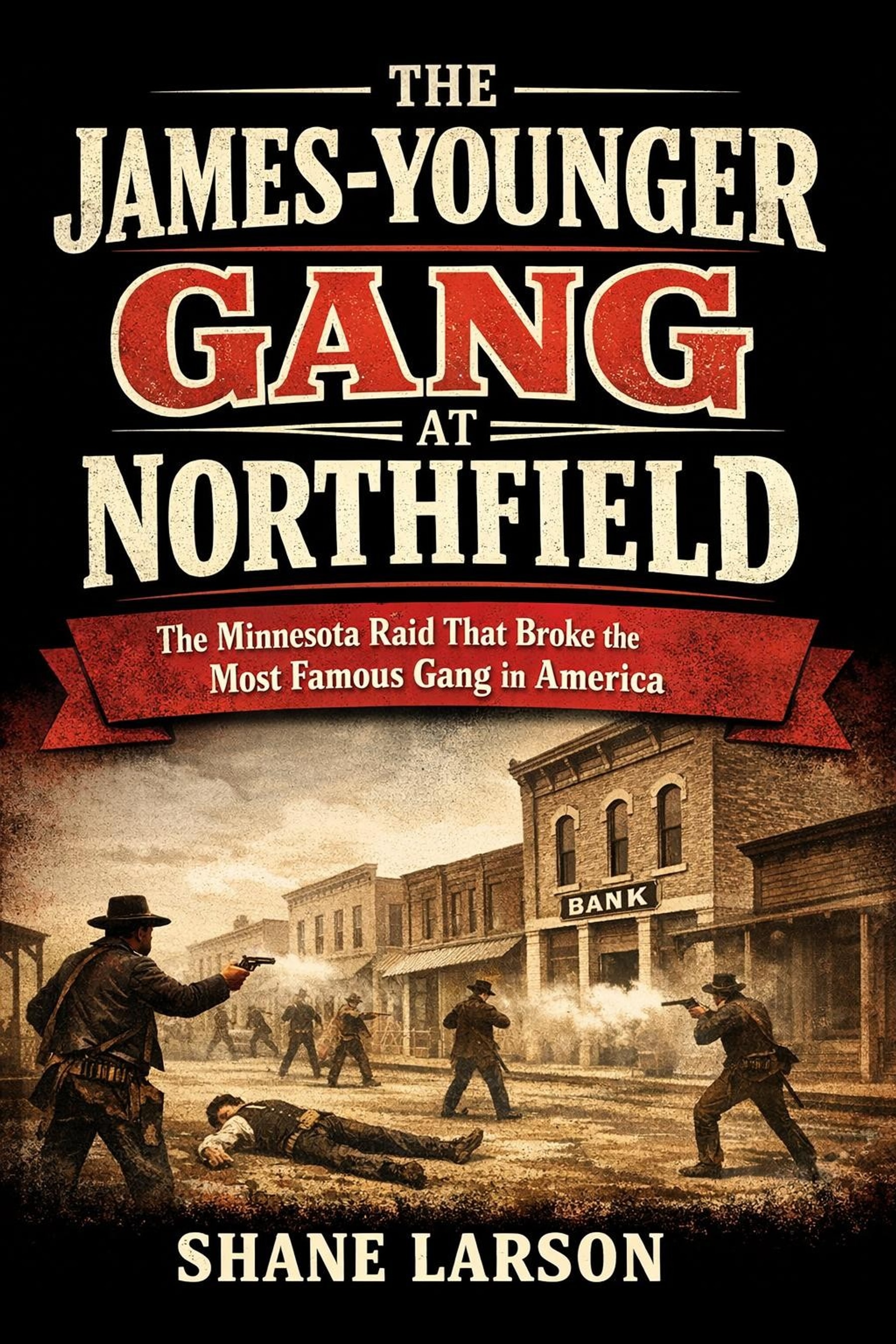
The James-Younger Gang at Northfield
The longest two weeks
What followed was one of the largest manhunts in American history to that point. The alarm spread by telegraph, and the southern Minnesota countryside rose. Hundreds and then thousands of armed men turned out, throwing cordons across roads and river fords, trying to seal the gang inside a shrinking box of unfamiliar, rain-soaked country thick with swamp and slough.
For the gang, the escape became a nightmare. Wounded, hungry, exhausted, and lost in terrain they did not know, they could not move fast or far. Eventually they made a fateful decision: the James brothers split off from the Youngers and Charlie Pitts. Jesse and Frank, traveling light, slipped through the net and out of the state.
The Youngers were not so lucky. About two weeks after the raid, a posse cornered them and Pitts in the Hanska Slough near Madelia. In the fight that followed, Charlie Pitts was killed. Cole, Jim, and Bob Younger — riddled with wounds, barely able to stand — surrendered. The capture closed the book on the James-Younger gang as it had existed for a decade.
Legend versus record
Here is what makes Northfield such a rare episode for a historian. It is one of the best-documented outlaw events of the entire era. The bank's own records survive. So do the coroner's findings, the trial documents, and the Youngers' confessions. Minnesota newspapers filed detailed coverage within hours, while memories were fresh. We know an unusual amount about what actually happened on that street.
And yet Northfield is also among the most mythologized stories in American folklore. For a century, dime novels and films recast the James-Younger gang as Robin Hood figures — gallant rebels robbing the rich, victims of Northern aggression, romantic outlaws hounded by a corrupt establishment. That version is durable, and it is mostly invention, propped up in its own time by a partisan Missouri press and the editorials of men like John Newman Edwards, who deliberately built the legend.
When you set the documents beside the legend, the documents win — and they tell a harder, more interesting story. Not noble rebels, but veterans of the Civil War's ugliest guerrilla fighting who carried the war's violence into peacetime crime. Not invincible heroes, but men so convinced of their own myth that they rode into a town that had never heard of it and paid the price. And at the center, not a gunfighter but a bank clerk who said no.
Why it still matters
Northfield inverts the usual outlaw story. In the standard Western, the gang are the aggressors and the lone marshal is the hero. Here, the heroes are the townspeople themselves — a medical student, a hardware merchant, a cashier, hundreds of ordinary citizens who decided collectively that they would not be victims. It is the clearest case in the era of a community refusing to be preyed upon, and winning.
The town has never forgotten it. The preserved First National Bank building is now a museum, and every September Northfield stages the Defeat of Jesse James Days, one of the largest civic celebrations in Minnesota. They are not celebrating outlaws. They are celebrating the day their town fought back.
That is the story this book tells in full — the long fuse of the Civil War border, the decade of impunity, the Pinkertons' failure, the seven documented minutes, the manhunt, and the long afterlife of both the survivors and the legend.
The James-Younger Gang at Northfield
New posts and releases, straight to your inbox. No spam, unsubscribe anytime.