Hundreds of People Have Obsolete Technology Implanted in Their Bodies Right Now
August 5, 2026 · 5 min read
Title: "Hundreds of People Have Obsolete Technology Implanted in Their Bodies Right Now"
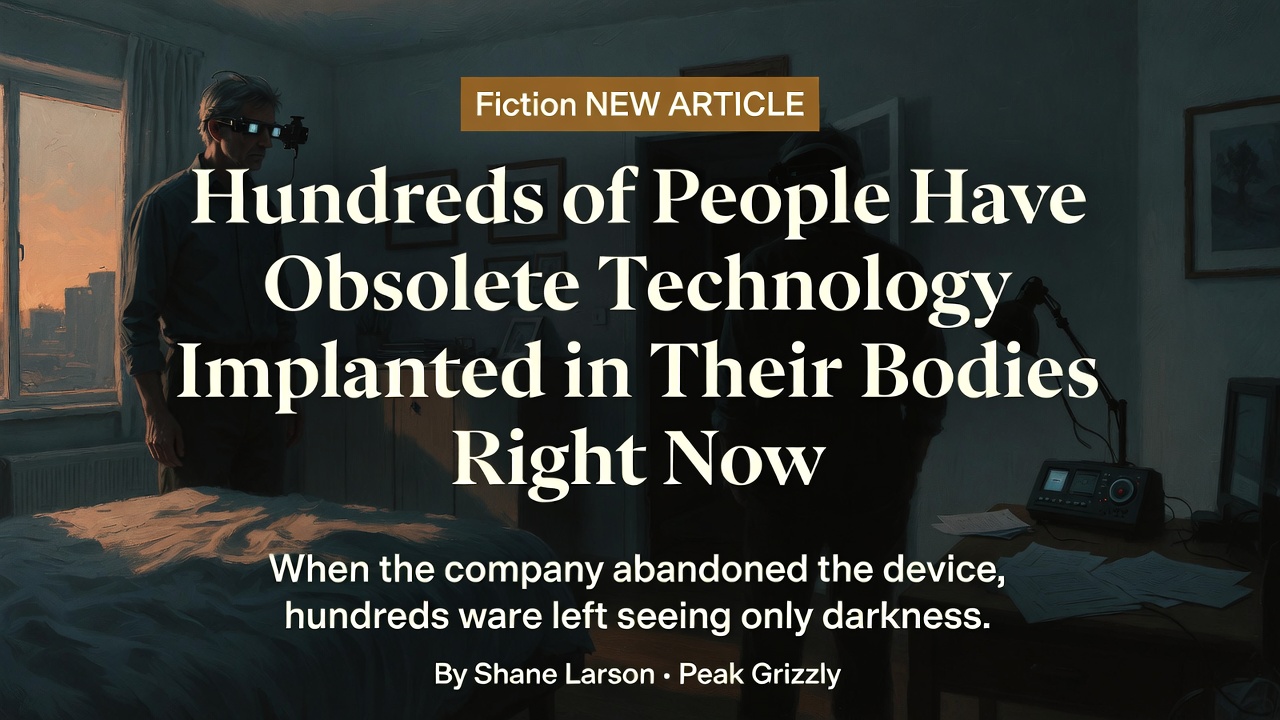
Second Sight Medical Products built something remarkable: a retinal implant that gave a form of vision back to people blinded by degenerative disease. Not normal sight — a low-resolution perception of light and shape, enough to make out a doorway, a kerb, a person moving. The system used a camera mounted on glasses to send signals through a wireless link to an electrode array fixed to the retina, producing flashes of light the brain learned to interpret as crude outlines.
Then the company ran into financial trouble, wound down, and stopped supporting the device. The last firmware update was issued years ago. Replacement glasses, the external half of the system, are no longer manufactured, and the internal arrays cannot be removed without further damaging what remains of the retina.
The implants did not come out. They are still in the patients — hundreds of people worldwide with a discontinued product wired into their visual system, no upgrade path, no repairs, and in some cases no way to get a replacement for an external component that failed. Some have gone dark. As reported in the technology press, people who had been given sight found that whether they kept it depended on a company's balance sheet. One patient described the sudden loss of the phosphenes as walking into a room where the lights had been switched off for good.
I did not have to invent anything for the world of Dead Man's Clutch. I just moved the clock forward.
The Pipeline Is Real
The book's antagonist made his fortune developing advanced prosthetics for wounded veterans, then moved into civilian enhancement when the market opened.
That trajectory is not speculative. Military funding has driven prosthetics research for two decades — programmes aimed at giving amputees from the wars something dramatically better than what existed, and producing genuinely extraordinary results: multi-articulating arms with individually controlled digits, devices driven by signals read from remaining muscle or nerve. The DEKA Arm, funded through DARPA, allowed users to perform tasks like picking up a grape or turning a key, movements that had been impossible with earlier myoelectric limbs. Those same control algorithms and sensor suites later appeared in commercial upper-limb systems sold to civilians.
Then the same technology, the same firms, and the same expertise become available commercially. That is not a conspiracy. It is the ordinary path any expensive technology takes — defence and medicine pay the development cost, and consumer applications follow once the price falls. The same pattern occurred with GPS, night-vision optics, and advanced materials before it reached prosthetics.
What follows from it is the interesting part.
Whose Device Is It
When a piece of technology is inside your body, the ordinary rules about product ownership stop making sense, and nobody has resolved this.
The device runs software. The software is proprietary. The manufacturer controls updates, and updates can change how the device behaves. Diagnostics are locked. Independent repair is generally prohibited by the manufacturer, frequently on safety grounds that are entirely genuine and also very convenient. Cochlear implants and certain deep-brain stimulators already operate under similar restrictions; clinicians must obtain manufacturer approval for even basic parameter adjustments.

So the ordinary state of affairs for a person with an advanced implant is that a company they have no relationship with controls the functioning of part of their body, and can stop doing so. A patient whose external processor fails after the support window closes has no legal mechanism to compel continued service.
The right-to-repair argument, which most people encounter in the context of tractors and phones, arrives here in a form that is much harder to be relaxed about. When a manufacturer refuses to release service documentation for a phone, you buy another phone. When the same refusal applies to an implanted retinal array, the choice is between living with darkness or undergoing another invasive procedure whose risks are unknown.
Where the Fiction Starts
I am a novelist, not an ethicist, so what I did with all of this was ask what a detective story looks like in that world.
The answer turned out to be about the gap between people who can afford to be upgraded and people who cannot, and about veterans on the wrong side of it — men and women who were given enhancement as part of recovery, by a contractor, under conditions they were not in a position to negotiate, and who now live with hardware whose support terms they never read. The contracts they signed at the time of implantation were written in the language of medical devices, not consumer electronics, yet the companies behind them treat the hardware exactly like consumer electronics.
My protagonist is a detective who is stubbornly analogue in a city that has moved on. That is partly a noir convention and partly the actual argument of the book: he is unaugmented, which makes him slower and worse at nearly everything, and also means nothing about him can be remotely altered, disabled, subpoenaed, or switched off.
In a world where capability is licensed, being obsolete is a form of independence. That is the trade the whole story sits on, and it is why it is called what it is called — a car you have to drive yourself, in a city of vehicles that drive themselves and log every trip.
The Part I Believe
The genre convention for this material is that enhancement is sinister and the resistance is heroic. I do not think that is right, and I tried not to write it.
The technology is good. Restoring sight is good. Giving a soldier back the use of a hand is good. The people building these devices are, in the main, doing something worth doing, and the version of this argument that treats augmentation as inherently corrupting has to explain why a wheelchair user should be grateful for less capability. The patients who received Second Sight implants did not ask for obsolescence; they asked for the limited vision the device could provide at the time.
The problem is not the enhancement. It is that we have attached life-altering capability to commercial arrangements designed for consumer electronics — end-user licences, discontinued product lines, support windows, firmware that updates when the vendor decides — and applied them to things that are physically part of a person.
The retinal implant patients did not lose their sight to a villain. They lost it to a company that could not raise another funding round.
That is the future the book is actually about, and most of it has already happened.
Dead Man's Clutch is a near-future noir about a detective with no upgrades, a city that runs on them, and bodies turning up fused to their cars.
New posts and releases, straight to your inbox. No spam, unsubscribe anytime.