In 2001 a Drunk Man With a Rifle Put a Hole in the Trans-Alaska Pipeline
August 5, 2026 · 5 min read
The Trans-Alaska Pipeline is one of the more impressive things ever built on this continent, and its security model is, in long stretches, distance.
That combination is why I set a thriller on it.
What It Actually Is
Eight hundred miles, from Prudhoe Bay on the Arctic Ocean to the port of Valdez. It crosses three mountain ranges and something on the order of thirty major rivers, through terrain where winter temperatures routinely run far below zero and road access is limited to a single haul road for much of the route.
Roughly half of it runs above ground, and the reason is the interesting part. Warm oil buried in permafrost would thaw the ground it sits in, and thawed permafrost does not hold anything up. Once the ice-rich soil melts, it loses bearing capacity, settles unevenly, and can shift laterally as the active layer refreezes each winter. So the engineers elevated it on vertical supports fitted with heat pipes — passive devices that pull heat out of the ground and radiate it into the air, keeping the permafrost frozen with no power input and no moving parts. The supports themselves are spaced to account for both thermal expansion of the steel and the seasonal heave of the ground beneath them.
It also does not run straight. The line zigzags in a deliberate lateral pattern, which allows it to expand and contract with temperature and, more importantly, to move sideways during an earthquake without shearing. The zig-zag geometry turns what would be compressive or tensile forces into manageable bending along the joints. That last decision was tested about as severely as it could be. In 2002 a magnitude 7.9 earthquake ruptured the Denali Fault directly beneath the pipeline. The ground on either side displaced by something in the region of eighteen feet. The pipeline, which had been designed for exactly this and mounted on sliding supports across the fault crossing, moved with it and did not break. No spill. It is one of the great quiet engineering successes of the last century, and almost nobody outside the industry has heard of it.
And Then the Other Thing Happened
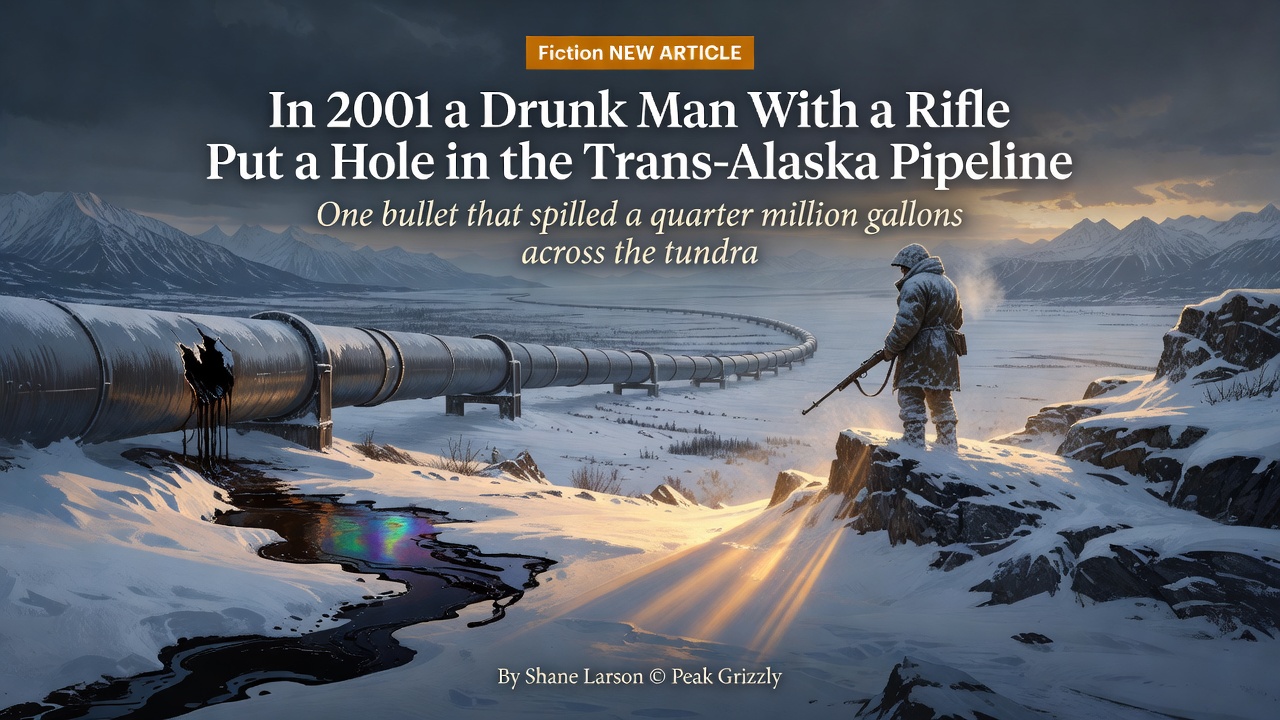
On 4 October 2001, a man named Daniel Carson Lewis, intoxicated, fired a hunting rifle at the pipeline near Livengood. The round penetrated the wall. Oil sprayed out under pressure. Before the leak was controlled, something on the order of 285,000 gallons had been released across several acres of tundra, and a section of the line had to be shut down for days. One person. One rifle. No plan, no organisation, no expertise, no access to anything restricted.
The contrast is almost too neat to be real. A structure engineered to survive a fault rupture that displaced the earth by eighteen feet was breached by a drunk man standing on a road with an ordinary firearm. The same pipeline that had been built to flex and slide across active seismic zones offered no comparable defense against a single high-velocity projectile at close range.
Why That Gap Exists
It is not negligence, and understanding why is the whole point.

Conspiracy Below Zero
You cannot guard eight hundred miles. There is no arrangement of personnel that meaningfully patrols that length of remote Alaskan terrain in winter. The protection for most of the route is the fact that it is extremely far from anywhere, hard to reach, and unpleasant to linger near — plus monitoring that detects pressure changes and can isolate sections. Valves can be closed remotely once a drop is registered, but closing them still leaves whatever oil is already between valves to drain or spray until the segment is depressurized. That is a rational design. It optimises against the threats that actually recur: weather, seismic activity, permafrost movement, corrosion, and the occasional vehicle collision at a crossing. Those are the things that were going to happen and those are the things it handles superbly.
What it does not optimise against is a person who wants to damage it, because defending linear infrastructure against a determined human being is close to impossible without turning the whole corridor into a restricted zone. Even then, the problem merely shifts to how you monitor and respond across hundreds of miles of empty country where winter darkness lasts twenty hours and temperatures drop low enough to disable vehicles and people alike. This is the general property of long infrastructure — pipelines, transmission lines, rail, undersea cable — and it is not specific to Alaska. Systems that stretch across hundreds of miles of low-population terrain are protected primarily by obscurity and inconvenience, and both of those are softer than they look. A single accessible point, whether a road crossing or a maintenance pullout, is enough to create a vulnerability that no amount of remote sensing can prevent in real time.
What That Buys a Novelist
A premise where the obstacle is real.
The satisfying thing about writing a thriller on this system is that you do not have to invent a vulnerability, and you do not have to make anybody stupid. The engineers were not careless — they solved the hard problems brilliantly. The operators are not asleep — the monitoring is genuinely good. The gap that exists is structural, acknowledged, and unfixable by any means anyone would accept. So the tension in the book is not "will someone find the weakness." Everyone involved already knows where the weakness is. It is what you do about a threat you cannot design out, in a place where the nearest response is hours away, in weather that limits how long anyone can operate outdoors. The same isolation that makes sabotage feasible also stretches the time between detection and arrival of any meaningful force.
Alaska helps too, in ways I did not fully appreciate until I started writing it. The distances are real. The cold is a participant in every scene. A place with thirty residents is a plausible base of operations for anybody, in either direction, because nobody is watching. The environment does not need to be dramatised, only described accurately. The pipeline survived an earthquake that moved the ground under it by eighteen feet. It did not survive one person in a bad mood.
That is the sentence the book is built on.
Conspiracy Below Zero is book two of the Eco-Thriller Chronicles, set along the Trans-Alaska Pipeline and in the country around McCarthy and the Wrangells.
Conspiracy Below Zero
New posts and releases, straight to your inbox. No spam, unsubscribe anytime.