No, You Cannot Set Off Yellowstone on Purpose — and the Real Numbers Are Stranger
August 5, 2026 · 6 min read
No, You Cannot Set Off Yellowstone on Purpose — and the Real Numbers Are Stranger
I wrote a novel in which someone tries to trigger the Yellowstone caldera. So it seems fair to be straight about which parts of that premise are real.
The short version: the volcano is real, the scale is real, the popular statistics about it are mostly wrong, and the part where a person sets it off deliberately is the part I made up.
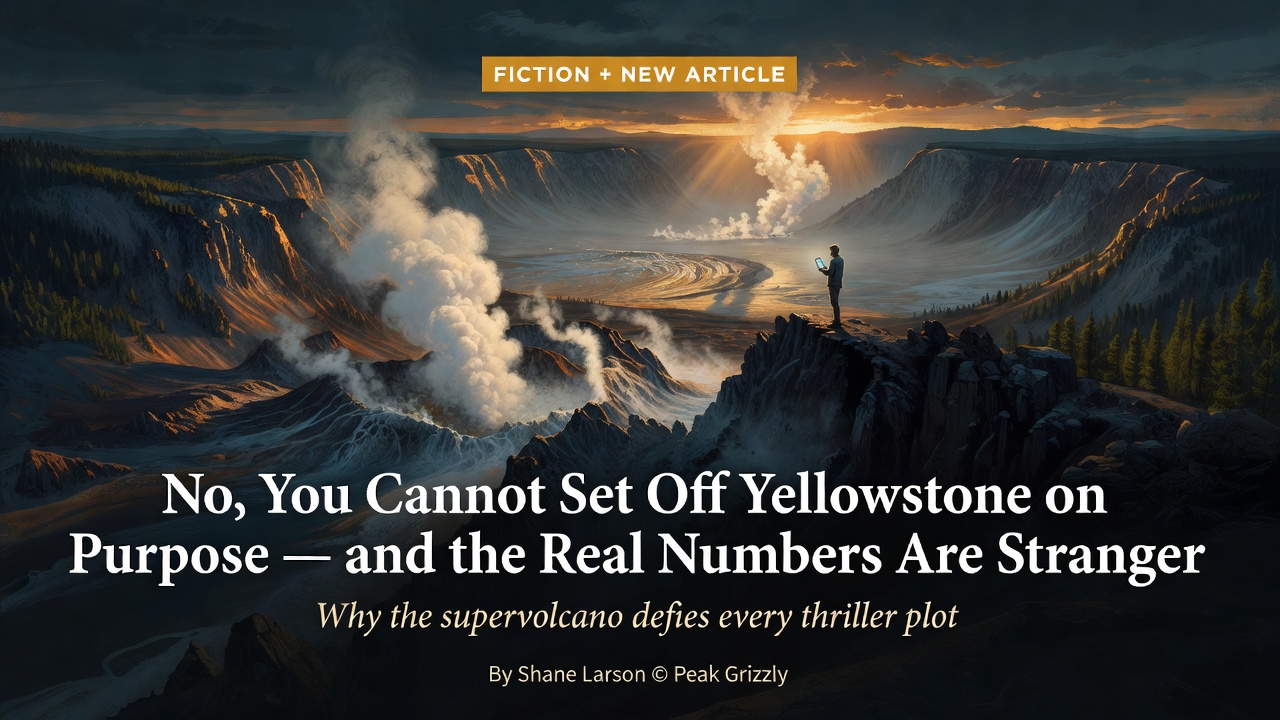
What Is Actually Under Yellowstone
The park sits on top of a caldera — a collapsed volcanic crater — that is roughly the size of a small county. It is fed by a hotspot, a plume of anomalously hot material in the mantle, which the North American plate has been drifting across for millions of years. The chain of older calderas stretching back across Idaho is the track it left.
There have been three enormous eruptions here: about 2.1 million years ago, about 1.3 million, and about 640,000 years ago. The first was among the largest volcanic events in the geological record. Ash from these eruptions has been identified across most of what is now the United States. Layers from the oldest event, for instance, reach thicknesses of several feet in places as far away as the Gulf Coast, and microscopic shards turn up in deep-sea sediment cores off both the Atlantic and Pacific margins.
All of that is true and all of it is genuinely alarming as a description of a place people take family holidays.
Where the Popular Version Goes Wrong
"It erupts every 600,000 years and we're overdue."
This is the single most repeated claim about Yellowstone and it does not survive contact with arithmetic.
Three eruptions give you two intervals: roughly 800,000 years, then roughly 660,000 years. That is not a cycle. It is two numbers. You cannot establish periodicity from two intervals, and volcanoes are not metronomes — they erupt when the physical conditions in the magma system are met, not on a schedule. The intervals themselves also vary because each eruption emptied different portions of the reservoir and left behind different volumes of material to rebuild pressure and melt.
The US Geological Survey's estimate for the annual probability of a caldera-forming eruption at Yellowstone is on the order of one in 730,000. That is a small number and it is not zero, and "overdue" is simply not a concept that applies. The same statistical framework shows that smaller eruptions or non-eruptive unrest events are far more common, which is why the agency’s hazard assessments focus on those nearer-term possibilities rather than a single fixed recurrence interval.
"There's a giant lake of molten rock down there."
Seismic imaging shows something less cinematic. The magma reservoir is largely crystalline mush — mostly solid rock with melt distributed through it, and estimates of the melt fraction generally run in the single digits to low tens of percent. A caldera-forming eruption requires a great deal more mobile magma than currently appears to be present, and getting there is a process measured in geological time. Tomography studies reveal separate pockets rather than one vast chamber, and the amount of eruptible melt is further limited by the fact that much of the heat is currently being vented through the hydrothermal system at the surface.
"The most likely disaster is the supereruption."
Eruption Point
It isn't. By a wide margin the more probable events at Yellowstone are hydrothermal explosions — steam blasts from the geyser system, which have happened repeatedly in the recent past and which would be locally dangerous and regionally irrelevant — and lava flows, which are slow, destructive within the park, and not a civilizational threat. The most recent hydrothermal explosion large enough to leave a visible crater occurred roughly 3,000 years ago at Mary Bay, and smaller steam-driven events continue to occur every few decades. Lava flows, such as those that built the Pitchstone Plateau, have covered tens of square miles within the last 200,000 years without ever producing continent-scale ash fallout.
The catastrophic scenario is the least likely of the available outcomes, which is the reverse of how it is usually presented.
The Part I Invented
Here is the honest disclosure about my own premise.
You cannot trigger a supervolcano deliberately, and the reason is a matter of energy accounting rather than security.
The energy released in a caldera-forming eruption exceeds anything humans can deliver by many orders of magnitude. Nuclear devices are not close — and detonating one in the crust would produce an enormous local disaster while doing essentially nothing to a magma system that requires a specific and long-developing set of pressure and melt conditions to fail. Even the largest underground nuclear tests ever conducted released energy equivalent to only a tiny fraction of the work needed to fracture and mobilize the volumes of rock involved.
Drilling does not do it either. The proposals that circulate for "relieving pressure" by drilling misunderstand the system; the practical objection is that boreholes are tiny relative to the volume involved, and the scientific objection is that the system is not sitting at a hair-trigger waiting for a nudge. Existing research wells at Yellowstone have been deliberately sited and cased to avoid intersecting the deeper, hotter zones precisely because the risk of unwanted fluid or pressure interactions is understood to be manageable only at small scales.
A supervolcano is not a bomb with a fuse. It is a very large, very slow physical process that will do what it does on its own timescale.
So the antagonist's plan in my book is fiction, and I would rather say so plainly than let a reader come away believing it is a live risk.
Why It Still Works as a Story
Because the interesting part was never the volcano.
What a premise like this actually gives you is a set of human problems that are entirely real. What happens to a monitoring agency when its data starts being read by people who want a particular answer? How does a scientific consensus communicate uncertainty to a public that wants a yes or a no? What does an organisation do when the credible expert and the persuasive one are different people?
Yellowstone is one of the most heavily instrumented volcanic systems on earth — seismometers, GPS stations measuring ground deformation in millimetres, continuous gas monitoring. Every small swarm of earthquakes gets reported, and every report generates a wave of online certainty that the end is imminent. During the 2008–2009 swarm, for example, more than 2,000 events were recorded in a few months, prompting both detailed USGS updates and a surge of unrelated speculation that had little connection to the actual deformation or gas data.
That gap — between a well-monitored, well-understood, extremely low-probability hazard and the way people actually respond to information about it — is where the tension in the book lives. The caldera is the setting. The failure modes are institutional and human, and those I did not have to invent.
Eruption Point is book one of the Eco-Thriller Chronicles, set in and under Yellowstone National Park.
Eruption Point
New posts and releases, straight to your inbox. No spam, unsubscribe anytime.