Why Have the Bones in Westminster Abbey Never Been DNA-Tested?
November 3, 2026 · 8 min read
Every few years the question comes round again, usually after a documentary. Two small skeletons lie in a white marble urn in Henry VII's Chapel at Westminster Abbey, under a Latin inscription that names them as Edward V and Richard, Duke of York, and names their uncle as the man who had them killed. The identification of Richard III's own remains in a Leicester car park in 2012 showed what can be done with a royal skeleton and a living relative. So why not swab the urn and settle the most famous unsolved case in English history in an afternoon?
The honest answer has three parts. Nobody with the authority to open the urn has agreed to. A test would settle less than most people assume. And the DNA comparison everyone has in mind, the one that worked for Richard III, is the wrong line for the boys.
What the workmen found in 1674
The bones came out of the ground on 17 July 1674. The Office of Works was clearing the White Tower of the buildings that had grown up against it, and the crew took down a stone forebuilding on the south side that housed the stair from the old royal lodgings up to the chapel of St John. About ten feet down they struck a wooden chest, or what was left of one, with the remains of two children inside. Charles II's principal surgeon, John Knight, called them the bones of two striplings and judged them proportionable to the princes' ages.
The identification was made on the spot and never inquired into. No one recorded how the bones lay or who first said the word "princes"; some were lost before anyone collected the rest, and the find was read against a story everyone already knew. Thomas More, writing in the 1510s, had placed the burial at the foot of a stair under a heap of stones. The bones were in the right place and the right size, and in 1674 that was enough.
Wren's urn and the word "supposed"
The remains apparently stayed at the Tower for about four years. In 1678 Charles II had them placed in a sarcophagus-shaped urn designed by Christopher Wren, in the corner of the Abbey's north aisle where two infant daughters of James I already lay. The warrant for the work, as it is usually quoted, refers to the supposed bodies of the two princes. That hedge did not make it onto the monument. The inscription states identification, method, perpetrator and date as settled facts, and has been read as a verdict ever since.
The one time it was opened
In early July 1933 the Dean of Westminster, William Foxley Norris, gave permission for an examination. The impetus came from Lawrence Tanner, the Abbey's Keeper of the Muniments; the anatomy was done by William Wright of the Royal College of Surgeons, with a dental surgeon consulted. The bones were laid out on a table inside the Abbey, measured and photographed over a few days, returned to the urn in a lead-lined box, and resealed. The findings appeared in Archaeologia a year or two later.
What they found was a jumble: incomplete, with many small bones missing, mixed with animal bones of several species and a few old iron nails. Wright sorted two individuals by size and estimated their ages from the teeth and the fusing of the long bones, about twelve to thirteen for the elder and nine to eleven for the younger. He noted chronic disease in the elder child's jaw, read some skull and dental features as a family resemblance, and recorded a stain on the elder's facial bones that he interpreted as blood. That last reading was never tested, and he labelled it as his own interpretation.
The list of what 1933 could not do is longer. Radiocarbon dating did not exist until the late 1940s. Sex cannot be determined from a pre-adolescent skeleton by eye. Kinship could be suggested from skull features and nothing more, and cause of death not at all. Later specialists working from the 1933 photographs have disagreed with Wright on the ages, the jaw and the resemblance, which is as far as anyone can go without reopening the urn.
Who would have to say yes
Westminster Abbey is a Royal Peculiar. It sits outside the ordinary structure of the Church of England; the Dean and Chapter answer to the sovereign directly, and it has generally been understood that the Crown would also have to agree to any disturbance of the urn. In 1933 that chain worked.
Since then, requests have been reported from Richard III Society members, from historians who accept the traditional account, from television companies and from ancient-DNA scientists, with calls increasing after 2013. The Missing Princes Project has been reported as supporting a test, and Philippa Langley has said publicly that she would welcome an examination. None has been granted, and the reasons are known mostly at second hand, through press reports and statements attributed to Abbey spokesmen. Four recur. The Abbey is a working church and the resting place or memorial of more than three thousand people, and holds the remains in trust. The present royal house descends from Edward IV through Elizabeth of York, and successive sovereigns have been reported as unwilling, without published reasons. There is precedent: St George's Chapel at Windsor is also a Royal Peculiar, and requests touching the children's coffins found there in 1789 have reportedly been declined on the same footing. And there is the argument that a result might not settle the question anyway, which is partly right.
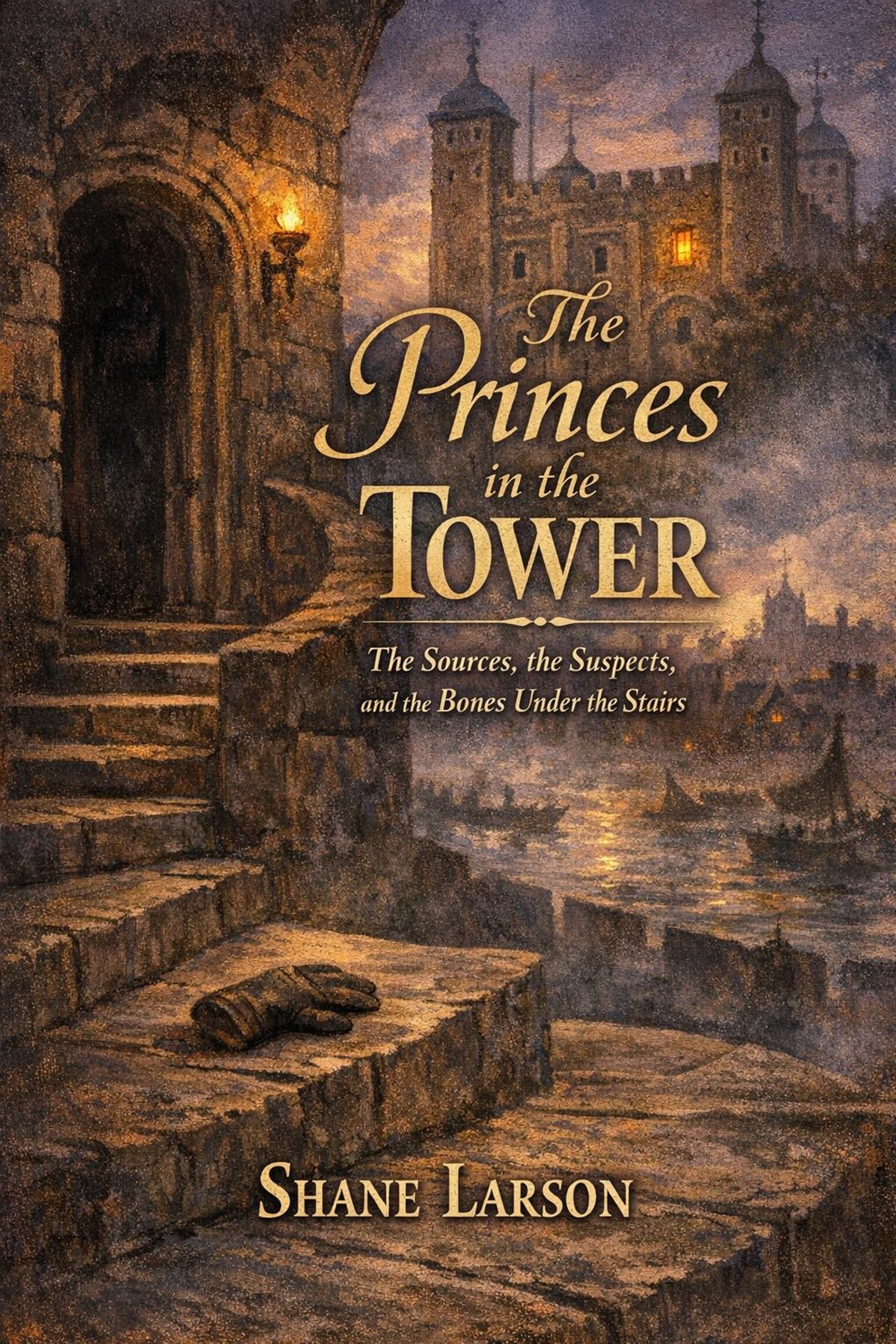
The Princes in the Tower
What a test could settle
Radiocarbon dating of a gram or less of bone collagen could show whether the bones are late medieval at all. The Tower stands on the site of a Roman city, older burials have been found inside its circuit, and a Roman or seventeenth-century date would end the identification. What radiocarbon could not do is split 1483 from 1486: the calibration curve wobbles through the fifteenth century, and a fish-rich diet pushes raw dates older and has to be corrected for, as it was for Richard III. The realistic output is a range of decades.
Modern ageing methods could tighten the estimates, and that matters. Edward V was twelve and three-quarters in the late summer of 1483 and his brother had just turned ten; by the summer of 1486 they would have been fifteen and nearly thirteen, and Wright's ranges fit 1483 better. Ancient DNA could determine sex, which no one has ever established, show how many individuals are in the chest, and test whether two of them are full brothers.
The DNA line everyone gets wrong
Here is the point most coverage of the urn misses. Richard III was identified in 2012 by matching mitochondrial DNA from his skeleton to two living women descended, through an unbroken line of mothers, from his sister Anne of York. Mitochondrial DNA passes only from mother to child. So the line that identified Richard is the line of his mother, Cecily Neville.
The princes were not Cecily Neville's children. They were Elizabeth Woodville's, and their mitochondrial DNA was hers, inherited from her mother, Jacquetta of Luxembourg. The Leicester reference sample is useless for them. To test the urn by the same method, a living person would have to be traced through an unbroken female line from Jacquetta or one of her daughters, with a pedigree documented well enough to carry an identification. Genealogists have proposed candidate lines; none has been tested or verified for this purpose.
The genetic link that does run through Leicester is the Y chromosome, which passes from father to son. Richard III's Y was typed for the 2012 study, and Edward IV's sons should carry the same one. But the Leicester Y did not match the living male-line descendants it was compared with, so a break in paternity sits somewhere in the royal male line and nobody knows where. A Y mismatch from the urn could mean the bones are not Edward IV's sons, or it could revive the old rumour about Edward IV's own paternity that was being preached in London in June 1483. Neither reading could be proved from the result alone.
The best comparison would be the two children's coffins found beside Edward IV's tomb at Windsor in 1789, usually taken to be the princes' siblings George and Mary. But that identification is itself unsettled, and they lie in another Royal Peculiar.
What no test could ever tell you
Suppose everything went right: a fifteenth-century date, two boys of the right ages, a verified Woodville maternal match. That would establish that Edward IV's sons died young and were buried at the foot of a stair in the Tower. It would end the survival hypotheses in their most prominent form, since the young man hanged at Tyburn in 1499 could not have been Richard of York. It would confirm the first half of More's burial story and leave the second half, the reburial by a priest, unexplained.
It would not tell you who put them there, or whether they died in August 1483 or October. The question people actually fight over, whether their uncle gave the order, is a question about the documents, and no laboratory will answer it. The urn could tell us whether we have been looking at the right bones for three and a half centuries. Everything after that would still have to be argued, from the same thin file, the same way it always has been.
*The Princes in the Tower: The Sources, the Suspects, and the Bones Under the Stairs* is a standalone case file on the English shelf, beside The Wars of the Roses and Richard III. It takes the boys from Edward V's birth in sanctuary to the last summer of 1483, puts every source in the order it was written, runs each suspect through the same four questions, gives Perkin Warbeck a full act, and devotes two chapters to the bones: what was found in 1674, what was seen in 1933, and exactly what a modern examination could and could not settle.
The Princes in the Tower
New posts and releases, straight to your inbox. No spam, unsubscribe anytime.