Why Did Richard the Lionheart Turn Back From Jerusalem? He Was Twelve Miles Out, Twice, and Both Times It Was His Decision.
November 1, 2026 · 8 min read
The Third Crusade was preached, paid for and fought to take back Jerusalem, which Saladin had captured in October 1187. In January 1192 the army that had sailed to do it stood at Beit Nuba, in the foothills above the coastal plain, about twelve miles from the walls. It turned round and went back to the coast. In June it came up the same road to the same place, stood there for most of a month, and turned round again. Four months later Richard sailed for home with a treaty that left the city in Saladin's hands.
Most people who know one thing about Richard's crusade know this, and most of them know it as a failure. Richard's own army thought so; a jongleur who marched in it describes men weeping when the order came. The question worth asking is not whether they got there but why they did not, because the answer tells you more about how Richard made war than any of the battles he won.
The road he had already built
By the time the army reached Beit Nuba the first time, Richard had done the hard part. He had arrived at Acre in June 1191 to find a siege two years old and finished it in five weeks. He had then moved a large force down a hostile coast without losing it, the thing that defeated most crusading armies before and after him: the fleet in step with the column offshore, the infantry in a screen round the knights, the knights under orders not to charge however badly provoked. At Arsuf on 7 September Saladin's army spent a morning trying to provoke them, two Hospitallers broke, and Richard turned an unauthorised charge into a victory by committing everything behind it. He then refortified Jaffa, which gave him a port twelve miles from the hills and a line back to Acre and the sea.
That line is the whole story. A medieval army did not carry its food; it drew it from behind, and Richard's came by ship to Jaffa and then overland. Every mile the army moved inland was a mile of road to be held against a mounted enemy who knew the country, and Saladin's horsemen had already shown how easily they could cut a column that was not screened.
The first turn, winter
The army left Jaffa in late autumn 1191 and crept inland through the ruined towns of the plain, rebuilding as it went: Saladin had pulled his garrisons out of the fortresses between the coast and Jerusalem and demolished them so the Franks could not use them. It took weeks and it rained; the chroniclers on both sides record a bad winter, with men and horses sick and the carts bogged. By the first days of January 1192 the army was at Beit Nuba, and the men believed, as men who have marched a long way towards a holy place do, that they were about to arrive.
Richard called a council. Its members were the men who had been in the country longest: the Templars, the Hospitallers and the barons of the kingdom of Jerusalem, who had held these hills before 1187 and knew what holding them cost. Their advice, as the sources in Richard's camp report it, came in three parts. The army could probably take the city, since Saladin's forces were dispersed for the winter and the garrison was not large. It could not hold the city, because the crusaders who had sworn to take it had sworn to go home afterwards, and when they went the garrison left behind would be a few hundred men in a hostile hill country forty miles from the sea. And it could not supply itself while it besieged the city, because the twelve miles of road back to the plain would be behind it, with Saladin's cavalry on it.
Richard took the advice. The army went back to the coast and rebuilt Ascalon instead, the port Saladin had demolished, which was the key to the road between Egypt and Syria and which the men who knew the country thought was worth more than a city they could not keep.
The second turn, summer
The spring went on politics. Conrad of Montferrat, the ablest of the local barons and the man the army had finally agreed should be king of Jerusalem, was stabbed to death in Tyre on 28 April 1192 by two members of the sect the Franks called the Assassins. Richard was suspected of arranging it, then and now; he almost certainly did not, and the book this article belongs to sets out the case. Letters from home told him his brother John and the king of France were dividing his lands between them. He had to leave. Before he did, the army demanded one more attempt on the city, and in June it marched inland again.
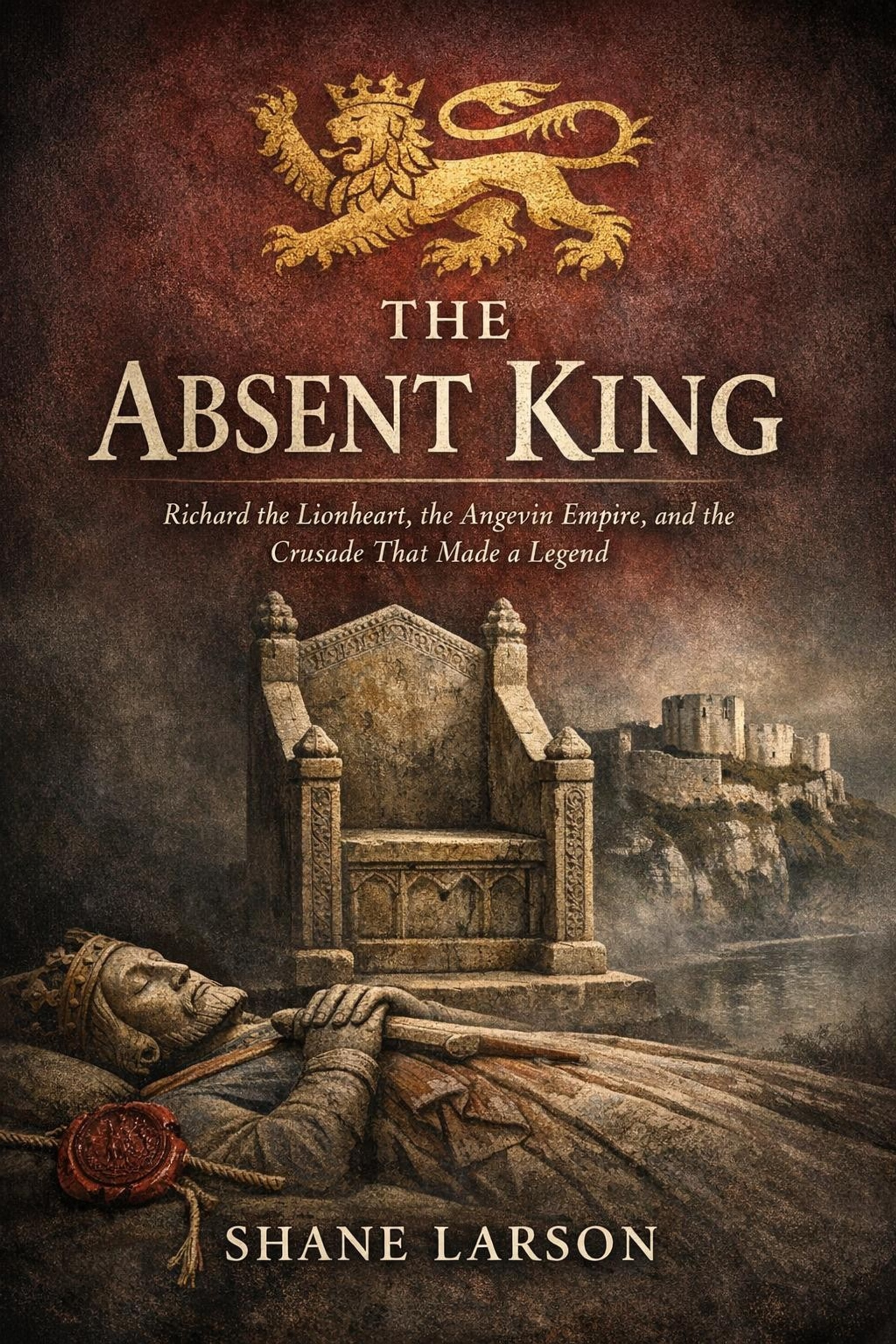
The Absent King
This time it reached Beit Nuba in good weather and stayed about a month. Richard captured a great supply caravan coming up from Egypt, with its horses and camels and food, which made the army richer and the argument for marching on louder. And then he called the council again, and the council said what it had said in January: take it, perhaps, and lose it, certainly. The French contingent, under the duke of Burgundy, wanted to go on. Richard would not order an assault he believed he could not follow through, and he would not let the army vote him into one. It turned round in early July.
There is a famous story that on one of these two occasions Richard was taken to a hilltop from which the city could be seen, and that he covered his face with his shield and said he would not look on a city he could not deliver. It is a good story. It first appears a century later, in the memoir of a French knight who was on a different crusade, and nobody who was with Richard records it. The men who were there record something plainer: an army that wanted to go on, a commander who would not, and the sound it made on the way down.
What he took instead
Saladin tried to make Richard's departure cost something, and in late July 1192 he took the town of Jaffa, the port on which the whole position depended. Richard came down the coast by sea with a few ships, waded ashore on 1 August with a few dozen knights and whatever crossbowmen he could carry, retook the town, and on 5 August held it against Saladin's whole army with a force the chroniclers on both sides describe as absurdly small. It was the last fight of the crusade and the one that made the treaty possible.
The Treaty of Jaffa was sealed on 2 September 1192. The crusaders kept the coast from Tyre to Jaffa. Ascalon's new walls were to be pulled down. Jerusalem stayed Saladin's, and Christian pilgrims were free to visit the Holy Sepulchre unarmed. Many of Richard's men went, in parties, under escort. Richard did not. He sailed from Acre on 9 October 1192, having never seen the city, and the question of whether he had failed went with him.
Judgement or failure
The case that he failed is simple and it has been made since the army wept. The crusade had one object. The army was twelve miles from it, twice, and the commander did not try.
The case that he judged rightly is the one his council made, and it has the support of a witness from the other side. Baha al-Din, the judge in Saladin's household who wrote his master's life, records that Saladin's own emirs were far from sure they could hold Jerusalem if it were attacked, that the sultan spent anxious days in the city during the first advance, and that his army was exhausted and his treasury empty. In other words both commanders, in the winter of 1191–92, were looking at a city that was easier to take than to keep, and the one who could have taken it declined to, because he could see the second half of the sentence.
That is the quality that runs through everything Richard did well. He was the best field commander of his age not because he charged, though he did, but because he prepared: the fleet of more than a hundred ships, the biscuit and horseshoes bought by the ten thousand, Cyprus seized as a supply base before the siege it was meant to feed, the knights held in check for hours under arrows. A commander who could not be stampeded by his own army's longing for the holiest place in its world was showing the same discipline that held the line on the coast road. He did not finish the war. He had never, by the end, intended to finish it on those terms, and the coast he left behind lasted another century. The city he turned back from would not be in Christian hands again, except by treaty for a few years, for the rest of the Middle Ages.
*The Absent King: Richard the Lionheart, the Angevin Empire, and the Crusade That Made a Legend* is a narrative life of a king who spent about six months of a ten-year reign in England. The crusade is four chapters of thirteen; the rest is the duke of Aquitaine who learned war on his mother's barons, the prisoner whose ransom cost his kingdom a quarter of everything it owned, and the five-year war on the Seine that most accounts of his life skip. The Acre killings and the attacks on England's Jews stand in the same ledger as Arsuf and Jaffa, and in every scene the book names the witness, on both sides of the line.
The Absent King
New posts and releases, straight to your inbox. No spam, unsubscribe anytime.