Did Eleanor of Aquitaine Really Have an Affair With Her Uncle? Two Men Wrote It Down, and Only One of Them Said Yes.
October 31, 2026 · 7 min read
Ask what most people know about Eleanor of Aquitaine and, after the two crowns and the famous sons, you get Antioch. In the spring of 1148, on crusade with her first husband, the queen of France spent some ten days in the city ruled by her uncle Raymond, and something happened there that ended her marriage. The usual version is that she slept with him. It has been the usual version for about eight hundred and forty years, it is in most of the biographies, and the novels could not do without it.
It rests on two men. One of them was at the papal court the following year, heard what was being said, and wrote it down fifteen years later with visible care. The other was a schoolboy in Europe when it happened, wrote his account some thirty years afterwards in the Holy Land, and was explaining why a crusade had failed. It is worth knowing which of them said what, because the story most people carry is the second man's, and it is not the one the better witness tells.
Who Raymond was, and what he wanted
Raymond of Poitiers was the younger son of Eleanor's grandfather, the troubadour duke William IX, which made him her father's brother and about seven to nine years older than she was. He had been knighted at the English court and sent east in 1136 to marry the heiress of Antioch, a girl of about nine, and rule the principality in her name. By 1148 he had been doing it for twelve years, and his frontier ran up against Aleppo, the Muslim power that had just swallowed the crusader state of Edessa and set the whole Second Crusade in motion.
The French army reached his port of St Symeon on 19 March 1148 in poor shape. It had been cut up in the mountains of Anatolia in January, at Mount Cadmus, where the vanguard under an Aquitainian lord lost contact with the main body and the column behind it was slaughtered. The foot soldiers had been left behind at Adalia for want of ships. What arrived at Antioch was a king, a queen, and a mounted force badly in need of a plan.
Raymond had one. Antioch's enemy was Aleppo, Aleppo was the strategic key to northern Syria, and a Frankish army camped at his gate could take it, or at least take Shaizar, and secure his frontier for a generation. It was a sound military argument and it was also the only argument that did Raymond any good.
Louis VII had a different plan and a different kind of reason. He had taken the cross with a vow to reach Jerusalem, and he meant to go to Jerusalem. He was a second son raised for the Church who had become king when his elder brother died, and the vow was not a formality to him. The quarrel at Antioch was, at bottom, a quarrel between a prince's strategy and a king's conscience, and Eleanor took the prince's side.
What the careful witness actually says
John of Salisbury was an English clerk at the papal court in 1149 when Louis and Eleanor came through on their way home and the pope tried to repair their marriage. He wrote his account of those years around 1163, in a work on the history of the papacy. He was not at Antioch. He was, however, in the room a year later when the fallout was being managed, and he wrote with the care of a man who knew his subjects were still alive.
What he gives is this. At Antioch, Raymond paid the queen marked attention. Louis grew suspicious. When the king prepared to leave for Jerusalem, Eleanor said she would stay behind, and raised the question of whether she and Louis were lawfully married at all, since they were related within the degrees the Church forbade. Louis, who by John's account loved his wife almost beyond measure, was persuaded by one of his household, a eunuch named Thierry Galeran whom Eleanor detested, that he could not leave her there, and he took her away by force. The wound, John says, was hidden and did not heal.
Read that again and notice what is in it and what is not. There is a husband's suspicion. There is a queen who publicly took her uncle's side on the one question that mattered to him, the army's destination. There is a queen who, having lost that argument, reached for the one weapon a twelfth-century wife had against her husband, the legitimacy of the marriage itself. There is a departure under compulsion. There is no adultery. John of Salisbury, who had every opportunity to say it and no obvious reason to protect her, does not say she was unfaithful. He says Louis thought something was wrong.
Twice a Queen
The other near-contemporary voices say even less. Odo of Deuil, the king's chaplain, who travelled with the army and wrote the official account, breaks off his narrative at Antioch, which has been read as discretion and as embarrassment and may be neither. Abbot Suger, the king's old minister, wrote to Louis in 1149 advising him to hide his anger with the queen until he was home. That is a letter about a marriage in trouble. It is not a letter about a lover.
Where the affair comes from
William of Tyre is the man who says yes. He was born in Jerusalem around 1130, spent the years from about 1145 to 1165 studying in Europe, came home to become archbishop of Tyre in 1175, and wrote his great history of the crusader states in the 1170s and early 1180s. He is the most important historian of the kingdom of Jerusalem and a serious one. He is also writing thirty years after Antioch, from hearsay, about a woman who by then was the queen of England and the mother of the king of France's enemies, in a book that had to explain why the Second Crusade, the greatest expedition of his parents' generation, had accomplished nothing.
In his telling, Raymond, failing to win the king over by argument, set out to win the queen, and succeeded; Eleanor was unfaithful to her marriage vows; and Louis, learning of it, left Antioch secretly by night and took her with him. It is stated flatly and it is the version that stuck, partly because it is more interesting and partly because William of Tyre was the standard account of the crusades for the next seven centuries.
After him the story only grew. Richard of Devizes, an English monk writing in the 1190s who admired Eleanor enormously, alluded to Antioch and then said he would say no more, which is a way of saying a great deal. By the middle of the thirteenth century a French minstrel had her trying to run away with Saladin, who in 1148 was a boy of about ten living in Syria and had never heard of her. The Victorians added the Amazon costume at Vézelay. Each century found the version it needed.
What a historian can honestly say
Nobody can prove a negative about a bedroom in 1148, and no honest book will tell you Eleanor was innocent any more than it will tell you she was guilty. What can be said is where the two accounts stand. The better witness, closer in time and better placed, reports a political quarrel, a threat to the marriage, and a husband's suspicion, and stops. The worse witness, further away in time and space and with a motive, reports the affair. Everything else descends from the second.
And the political quarrel is the thing worth having, because it is the first clear sight of Eleanor doing what she would go on doing for the rest of her life. She held Aquitaine in her own right. The vassals who made up a large part of the French army were hers, and Raymond was her blood. When the interests of her inheritance and the interests of her husband came apart, she said so in public, and when she lost she reached for the law. She would do the same thing to Henry II in 1173 and pay sixteen years for it, and she would do it again to the king of France in 1199 and win. Antioch is not the story of a woman who could not control herself. It is the story of a duchess who had just discovered that she was married to a man who would never fight for her lands, and who had four more years to think about it.
The pope put them back into one bed at Tusculum in October 1149 and forbade either of them to mention their kinship again. A daughter was born. In March 1152, at Beaugency, the marriage was dissolved anyway, on exactly the grounds Eleanor had raised at Antioch, and eight weeks later she married Henry Plantagenet. Whatever happened in her uncle's city, that was its consequence.
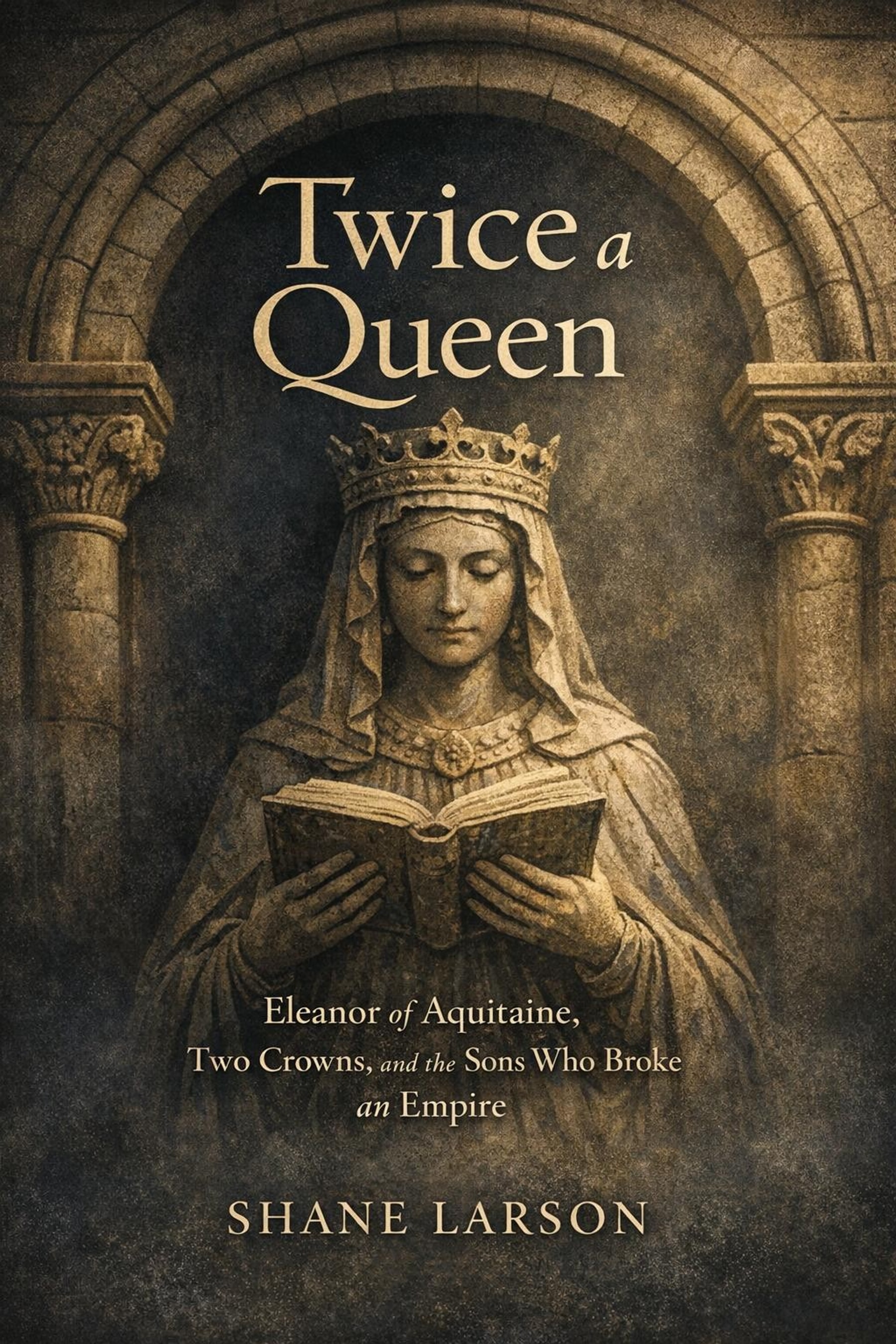
*Twice a Queen: Eleanor of Aquitaine, Two Crowns, and the Sons Who Broke an Empire* is a standalone narrative life on the English medieval shelf. It follows her from the duchy she inherited at about thirteen to the castle where she was besieged at about eighty, and at every turn the sentence names its witness, who wrote it, when, and which way he leaned, so that the reader can tell a report from a rumour. Antioch is one chapter of thirteen; the last fifteen years, when she governed an empire for two sons in turn, are the ones the legends never reach.
Twice a Queen
New posts and releases, straight to your inbox. No spam, unsubscribe anytime.