Rome's Money Died Fifty Years Before Anyone Admitted It — What the Third-Century Currency Collapse Actually Looked Like
August 15, 2026 · 6 min read
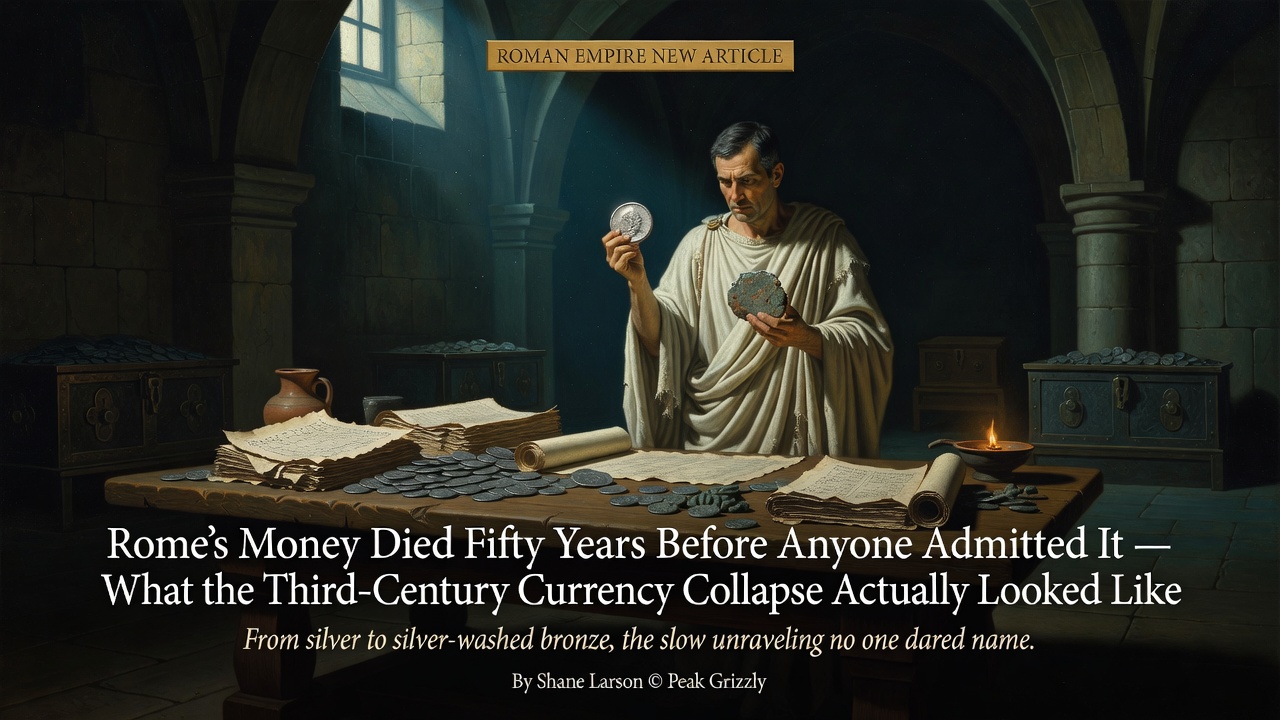
Hold a Roman coin from the year 200 in one hand and a coin of the same denomination from the year 270 in the other, and you don't need a degree in numismatics to see the problem. The first is recognizably silver — worn, maybe, but money. The second is a small bronze slug wearing a silver wash so thin that a few months of handling rubbed it through. Same empire, same denomination system, same radiate portrait of an emperor promising better times. Seventy years apart.
Between those two coins sits the most famous monetary collapse in ancient history, and one of the most cited in all of economics writing. Every essay about modern deficits, every gold-standard argument, every "are we Rome?" thread eventually reaches for it. Almost none of them tell you how it actually worked. The real story is stranger than the morality tale — and the lessons it supports are not quite the ones usually drawn from it.
The slow shave, then the cliff
Start with what the denarius was. For roughly two centuries after Augustus, Rome's standard silver coin held its weight and most of its purity — about 95 percent silver under the early emperors, drifting down to the 80s by the mid-second century. Emperors shaved it occasionally, usually to cover a war or a fire, and the economy barely noticed. A slide of ten or fifteen points of fineness in 150 years is not a collapse. It's rounding error with a mint mark.
The structural break came in 215, and it came as a trick rather than a shave. The emperor Caracalla — who had just raised army pay again and needed to conjure money to cover it — introduced a new coin, the antoninianus. It was tariffed at two denarii. It contained about one and a half denarii worth of silver. The state had previously debased quietly, hoping nobody would check; now it was openly declaring a coin to be worth more than the metal in it, and daring the market to argue.
The market argued. Old, heavier coins started disappearing into hoards — Gresham's law operating exactly as it would be described fourteen centuries later, bad money driving out good. Archaeologists have mapped thousands of Roman coin hoards, and the pattern is unmistakable: hoarding spikes track both invasion routes and debasement steps. A buried hoard that was never recovered usually means an owner who never came back. The hoard maps of third-century Gaul and the Balkans read like seismographs of insecurity.
Then came the cliff. After 238, the empire entered its stretch of maximum chaos — emperors lasting months, multiple simultaneous wars, each new claimant needing an accession donative to buy each new army's loyalty. The only lever that always worked on a timescale of weeks was the mint. Fineness fell from around 40 percent silver to 30, to 15, to 5, and by the reign of Claudius Gothicus in 268–270 the "silver" coinage of Rome was functionally bronze with a memory of silver on its surface. Prices, which had crept for decades, now moved in jumps. The wheat-price series preserved in Egyptian papyri — one of the few places in the ancient world where we can actually watch prices over time — shows rough stability for two centuries, then a roughly tenfold rise across the second half of the third century.
What the state did when its own money failed
Here is the detail that most modern retellings miss, and it's the most revealing one: the Roman state stopped accepting its own coins.
Not officially, and not all at once. But by the later third century, tax collectors in the provinces increasingly demanded payment in kind — grain, hides, horses, labor — or in gold by weight, treating the official silver coinage as what it had become. The army was fed and supplied through requisition rather than pay worth having. An empire that had run for centuries on one of history's most successful monetized economies was sliding, department by department, back toward payment in stuff. When the state itself starts weighing coins instead of counting them, the fiction is over regardless of what the law says.
The Crisis of the Third Century
The emperor Aurelian — the soldier who reunified the fractured empire in five years — tried to repair the coinage in 274. His reform is fascinating precisely because of how honest it was: the new coin carried a mark, XXI, openly declaring its ratio — twenty parts copper, one part silver. No more pretending. Better-made coins, standardized weight, fraudulent old issues demonetized. He even had to fight an actual battle against the Roman mint workers, whose leadership had been skimming on an industrial scale and who rose in armed revolt rather than submit to audit — thousands died in street fighting inside Rome itself, which tells you something about how much money was being made from making bad money.
And here's the punchline: prices in Egypt jumped after the reform. An honest 5 percent coin turned out to buy no more trust than a dishonest one. Confidence in a currency, once spent, could not be restruck. It took Diocletian's wholesale reconstruction of the state — new coinage, new tax census, eventually the famous (and famously failed) Edict on Maximum Prices — and then Constantine's gold solidus a generation later to build a stable monetary system again. The solidus held its standard for seven centuries, which suggests Rome learned the lesson thoroughly. It just took total institutional collapse to teach it.
What the collapse didn't do
Now the part the morality tale leaves out: the currency collapse did not destroy the Roman Empire.
It's worth saying plainly, because the debasement story is so often deployed as a simple arrow — debased money, fallen empire, QED. The chronology doesn't cooperate. The coinage hit bottom around 270. The empire then recovered, reunified, reorganized, and ran for another two centuries in the West. The East — which inflated too, and shared the same third-century monetary system — lasted another thousand years. Whatever killed Rome, it wasn't the antoninianus.
Nor was this hyperinflation in the modern sense. A tenfold price rise over five decades is a catastrophe by ancient standards, but it's an annualized rate that several twentieth-century economies would have envied. The third-century collapse was something more specific: a fiscal-military doom loop, in which a state whose expenses were overwhelmingly soldiers' pay met every emergency by degrading the instrument it paid them with, until the instrument stopped working and the state had to rebuild itself around payment in kind. The debasement didn't cause the crisis. It was the crisis, made visible in metal — the fever chart, not the disease.
That's the honest version of the lesson, and I think it's more interesting than the bumper-sticker one. Money is a promise about the future made by an institution. The third century is what it looks like when the institution making the promise is visibly dying — twenty-six emperors in fifty years, most murdered — and the promise gets discounted accordingly. The coins didn't fail because they contained less silver. They failed because everyone could see that the state issuing them might not exist next year. Restore the state, as Aurelian and Diocletian did, and you could eventually restore the money. It never worked the other way around.
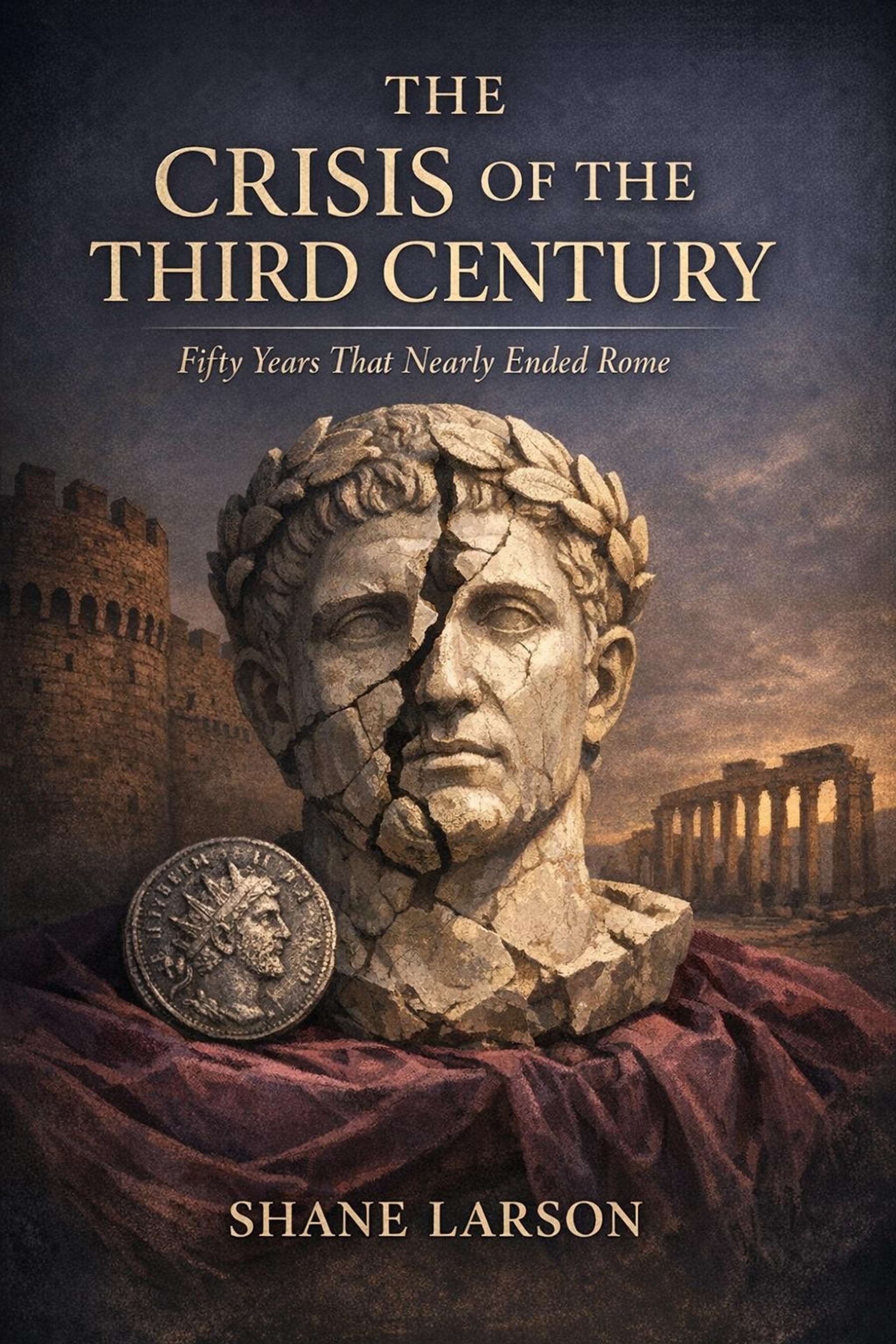
This article draws on material from my book "The Crisis of the Third Century: Fifty Years That Nearly Ended Rome" — Book Ten of the Rome: From Village to Empire series — which tells the whole story of Rome's worst century, from the auction of the empire in 193 to the rise of Diocletian in 284, including a full appendix on the anatomy of the ancient world's most famous inflation.
The Crisis of the Third Century
New posts and releases, straight to your inbox. No spam, unsubscribe anytime.