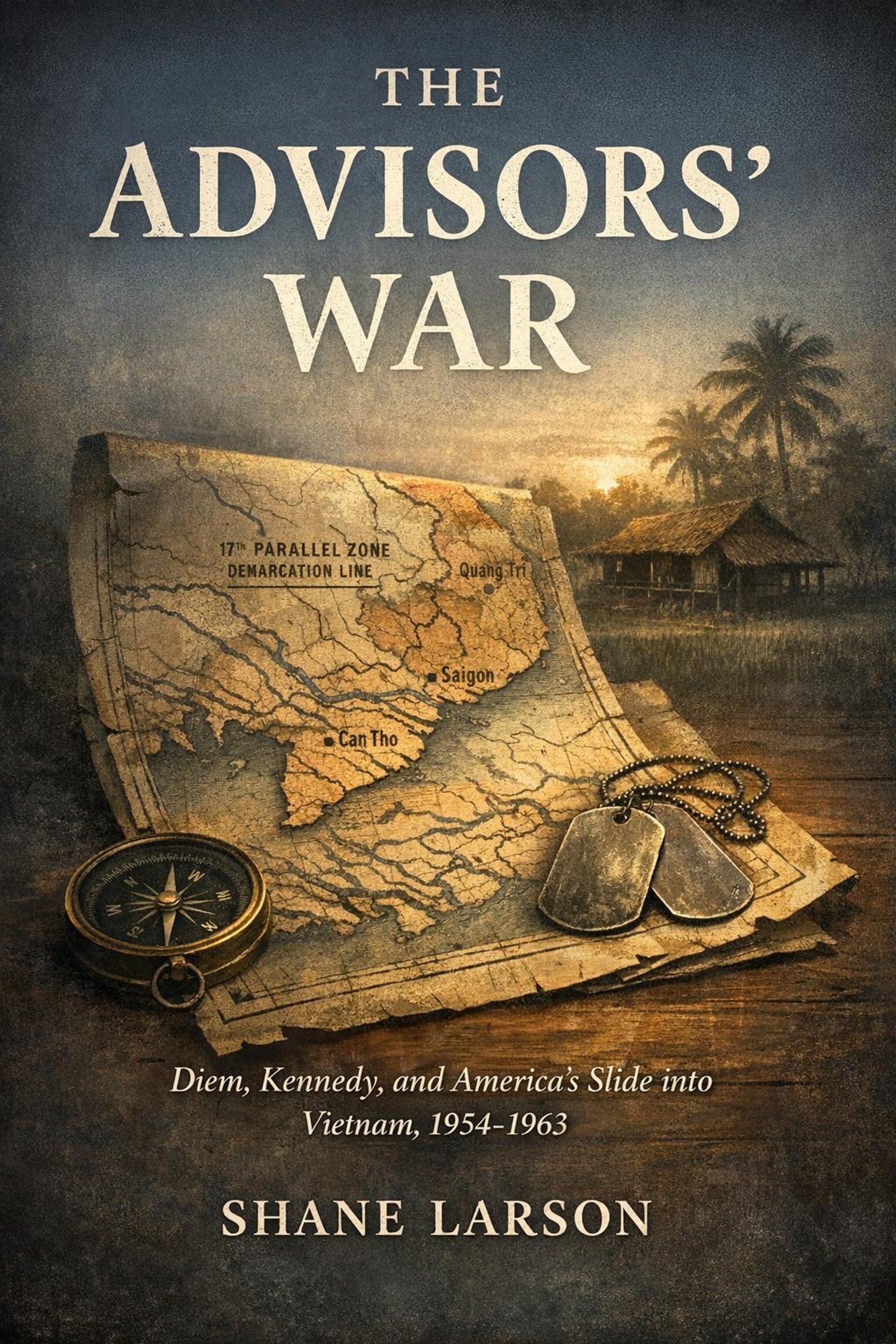
The Advisors' War
Diem, Kennedy, and America's Slide into Vietnam, 1954-1963
By Shane Larson
About This Book
In July 1956, a deadline passed. No government announced its cancellation. No assembly voted on it. No policy paper was ever written with the words "abandon the Geneva settlement" in its title. The date on which Vietnam was supposed to vote itself back into one country — set two years earlier at the conference table in Geneva, complete with an international commission to supervise it — simply lapsed, the way a lease lapses, while every party involved told itself that nothing final had happened.
The reason the vote never took place is on the record, and it came eventually from an American president's own pen. Dwight Eisenhower wrote in his memoirs that if elections had been held during the fighting, Ho Chi Minh might have taken possibly eighty percent of the vote. There are qualifications to that sentence, and the book weighs them — but the essential concession stands, and most American readers have never encountered it. The unheld election of 1956 is where the American Vietnam War genuinely begins: a choice of enormous consequence, made by nobody in particular, in the passive voice.
The whole decade worked that way, and this history sets out to show it.
The Advisors' War covers the nine years between the Geneva partition and the three November weeks of 1963 in which South Vietnam's president and America's president were killed twenty days apart. Its spine is a claim that sounds like an excuse and is actually the indictment: no one in Washington chose a land war in Asia. There were 342 American military personnel in Vietnam at the armistice. By late 1963 there were more than sixteen thousand, flying combat missions and walking with infantry battalions, and American dead were counted in the hundreds. Every increment along the way looked small next to the one that followed it, and every increment made withdrawal more expensive — because the commitment was built out of nation-building rather than war-making, and a country that has supplied another country's constitution, army doctrine, police program, and resettlement scheme has become its part-author. An army can be pulled out. Authorship cannot.
Two genuinely open questions run through the decade, and the book conducts both without settling either. The first is Ngo Dinh Diem, whom the older literature paints as a doomed American client and the newer scholarship as a coherent nationalist whose refusal to take direction was precisely what cost him his life — the evidence for each is laid side by side. The second is where the southern insurgency came from. The State Department's white papers described aggression directed from Hanoi from the outset. The Vietnamese record now available, including the Party's own official histories, describes southern cadres who were being destroyed under Law 10/59 and who spent years petitioning a reluctant Hanoi for permission to fight — permission granted only in January 1959, after the fighting had in effect begun. The gap between those two accounts is not academic. The United States spent the next decade building instruments to stop an invasion, against an enemy the evidence suggests was substantially home-grown.
Why I Wrote This
Across everything I have written about states in trouble, one thing keeps recurring: institutions that possessed the information they needed and could not act on it. This decade is the purest case I have found. Accurate reporting reached Washington the entire time — from General Collins in 1955, from the embassy, from the advisors after Ap Bac, from the Saigon press corps — and none of it changed policy, because the machinery receiving it was built to add up progress and had no channel for reporting its absence. I wanted to trace that mechanism through a single decade, cable by cable.
The chapter that changed my own mind was the Hanoi one. I went in carrying the standard account, that the insurgency was directed from the north from the start. The Vietnamese-language record, now translated, points somewhere else — and following where it points rearranged what I thought this war was.
Frequently Asked Questions
Do I need to read Volume 1 first?
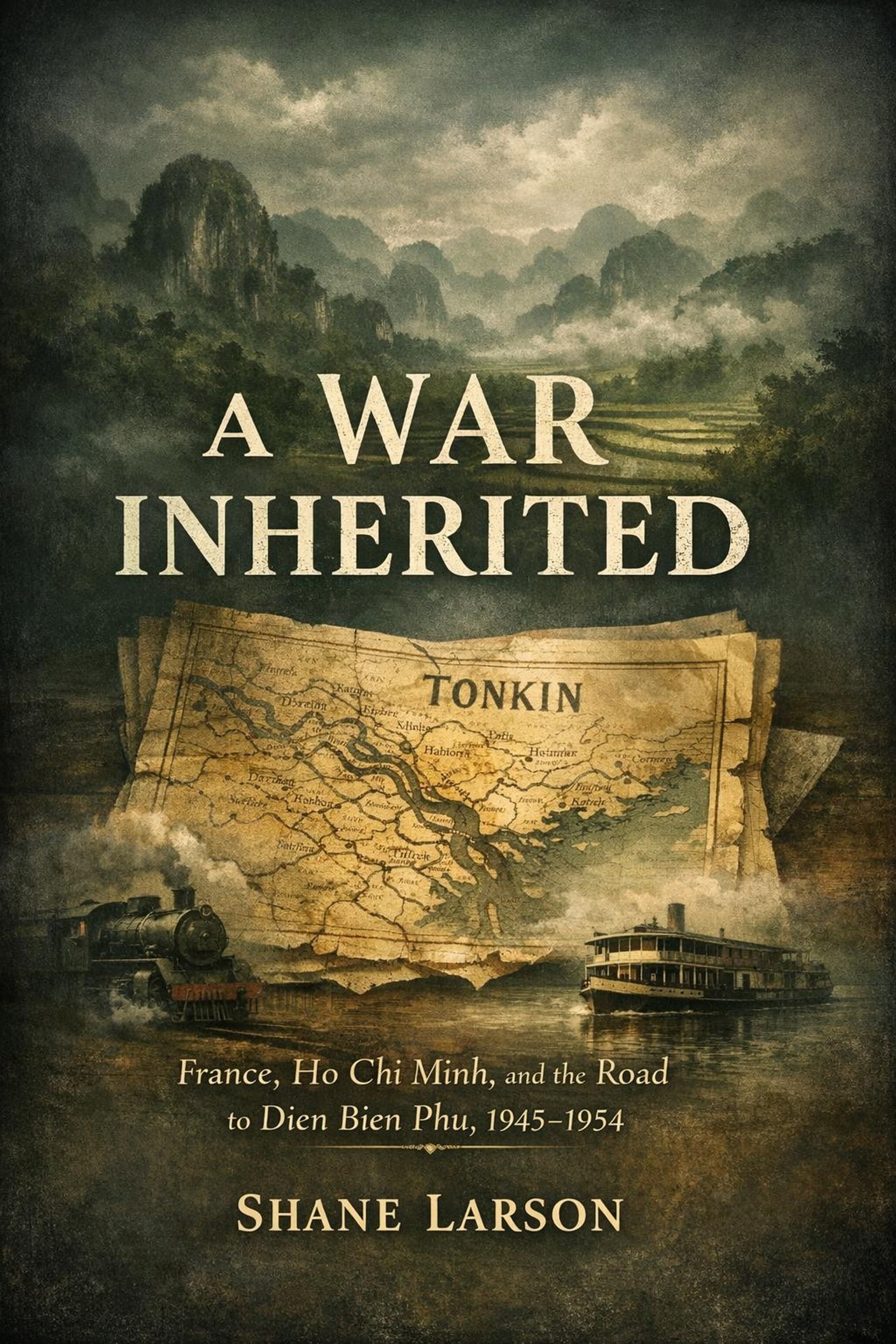
No. The Introduction opens with a compressed account of the French war, from the conquest through Dien Bien Phu and Geneva, written for readers starting here. Volume 1, *A War Inherited*, covers those years in full, but this book stands on its own.
Does this book say the Kennedy administration ordered Diem's murder?
No. The record establishes what Washington authorized, what it knowingly permitted, and what it failed to prevent — three different things. The book lays out Cable 243, the ambiguous signals to the generals, and the promise of safe conduct that was not kept, and leaves the judgment to the reader, because the documents genuinely do not settle it.
Was the Viet Cong controlled by Hanoi from the beginning?
The evidence now available — including the Vietnamese Communist Party's own official histories — points the other way: a southern movement that Hanoi restrained for years and authorized late rather than created early. The book explains why the distinction mattered so much, since a locally rooted rebellion could not be defeated by sealing a border, and much of what America built was built to seal a border.
Is this an academic book or a narrative history?
A narrative history with an academic conscience. Nothing is invented — no reconstructed dialogue, no imagined thoughts — quotation is reserved for primary documents like the Pentagon Papers, and contested numbers appear as ranges with named sources. Where historians disagree, both readings are on the page.
Does the book cover the Buddhist crisis and the self-immolations?
Yes. The events of 1963, including the death of Thich Quang Duc, are covered as the political turning point they were — plainly, factually, with the consequences given full weight and without dwelling on the imagery.
If You Liked This, You Might Like
- The Trung Sisters — Vietnam's first war of resistance against a foreign occupier, two thousand years earlier, and part of the national memory every figure in this book grew up inside.
- The Institutional Collapse Pattern — a systems-level study of how organizations stop being able to hear their own bad news, which is precisely the failure this decade documents cable by cable.
- The Empire Collapse Pattern — how great powers are undone from inside by commitments they cannot examine, the pattern this volume watches forming in real time.
A decade of postponed questions came due in three November weeks, and the man who inherited them had never been asked a single one. Volume 2 of The Vietnam War Chronicles, an eight-volume history of the war from the Japanese occupation of Indochina to the fall of Saigon.
What You'll Learn
- Three hundred days of free movement between the zones, the northern exodus organized and publicized with American help, and the mirror-image fact usually left out: the southern cadres who regrouped north and came back.
- The forgotten achievement — how a leader given months to survive broke the Binh Xuyen crime syndicate's hold on Saigon and faced down the sect armies, against his patrons' advice, and what winning taught him about ignoring Washington.
- A full chapter from Hanoi's side of the war, sourced to the translated Vietnamese record rather than to American accounts of the same decisions — the Politburo's real priorities, the years of refusal, and what Resolution 15 actually said.
- Law 10/59 and the Denunciation campaign, the political prisoner system, and the National Liberation Front's documented program of assassinating village officials — all of it stated factually, with contested figures given as ranges and a named source at each end.
- The strategic hamlet program, its British Malayan pedigree, and the counting problem at its heart: hamlets reported complete versus hamlets actually held.
- The battle of Ap Bac, January 1963 — what happened on the ground, what the advisors said about it, what the Saigon command announced instead, and why one day in the Delta explains the whole reporting failure.
- The Buddhist crisis of 1963, from the flag incident at Hue through the pagoda raids, and the point at which American patience with the Ngo family ended.
- Cable 243 and the coup — what the United States authorized, what it merely permitted, and what the record does and does not establish about the deaths of Diem and Nhu.
Included with Kindle Unlimited — read it free if you're a member.
New Military History releases and free chapters — no spam, unsubscribe anytime.