Why the Code of Hammurabi Was Dug Up in the Wrong Country
September 27, 2026 · 6 min read
The Code of Hammurabi is probably the single object most people picture when they picture ancient Mesopotamia. A block of polished black diorite a little over two metres tall, carved around 1754 BC, it carries nearly three hundred laws of the king of Babylon — the wages of an ox driver, the penalty for a surgeon whose patient dies under the knife, the rules for divorce, the price of hiring a boat. At the top, in relief, Hammurabi stands before Shamash, the sun god, receiving the authority to judge. It appears in every textbook on the ancient world. Thousands of people photograph it in the Louvre on an ordinary day.
Almost none of them ask the obvious question: why was a French museum's prize Babylonian monument never actually in Babylon?
Because it wasn't. The stele was excavated in the winter of 1901 to 1902, in three broken pieces, by a French expedition under Jacques de Morgan — and the dig was nowhere near Babylon, or Sippar, or any city of the Mesopotamian plain. It was at Susa, some six hundred kilometres to the east, across the Tigris and beyond the marshes, in the lowlands of southwestern Iran. Susa was never a Babylonian city. It was the capital of Babylon's oldest enemy.
The most famous legal document in human history was dug up in the wrong country. The explanation is one of the great untold stories of the ancient world.
A king goes shopping in Babylonia
Around 1158 BC — roughly six centuries after the stele was carved — a king named Shutruk-Nahhunte marched an army west out of the mountains and down into Babylonia. He was the ruler of Elam, the kingdom of the lowlands and highlands east of Mesopotamia, and his campaign broke the Kassite dynasty that had governed Babylon for four hundred years.
What makes Shutruk-Nahhunte unusual is not that he won. It is what he chose to take. Conquerors of the period took gold, took captives, took territory. Shutruk-Nahhunte took monuments. His army worked through the cities of the plain removing their most venerable public sculpture — objects that were already ancient when he found them — and hauled the collection home to Susa on carts.
The inventory reads like a museum acquisitions list, because that is effectively what it was. He took the victory stele of Naram-Sin, the great Akkadian conqueror, by then over a thousand years old, and had his own inscription cut into it stating plainly that he had seized it in war and carried it off. He took a monumental statue of the Akkadian king Manishtushu. He took the stele of Hammurabi, most likely from Sippar, the city of the sun god. His son went further still and carried off the cult statue of Marduk — the god of Babylon himself, removed from his own temple and taken east into captivity.
Why steal a stone covered in someone else's laws?
This is the question that turns a raid into a window on how ancient kings thought. A two-metre block of diorite is brutally heavy, and its laws were another king's laws, praising another king's gods. Melted down, it was worth nothing. So why load it onto a cart and drag it six hundred kilometres?
Because monuments were not decoration. In the ancient Near East, a royal monument was a claim — proof in stone that a king had ruled, judged, and been favoured by the gods. To carry off a rival's monuments was to carry off his legitimacy: to demonstrate, in the most public way imaginable, that the gods had transferred their favour. Babylon's history now stood in Susa's temples, which meant Babylon's history now belonged to Susa. Shutruk-Nahhunte understood exactly what the stele meant to the people he took it from. That is precisely why he took it.
Elam
He also left behind one of the most haunting details in ancient art. His masons ground a band of Hammurabi's laws smooth — a prepared surface where the Elamite king's own inscription would be added to the most famous monument of Mesopotamia. The inscription was never carved. The stele has carried that blank panel ever since: a space made for a name, still empty after three thousand years.
Five centuries as a trophy, twenty-five as rubble
The stele stood in Susa for roughly five hundred years, part of what may have been the finest assembly of Mesopotamian art anywhere on earth — six centuries of it, gathered in one enemy capital at spearpoint. Then history caught up with the collectors. In 646 BC the Assyrian king Ashurbanipal, at the end of a long and vicious war, sacked Susa with a thoroughness his inscriptions boast about at length, claiming he had left the land silent of human voices. The city burned, and the stele went into the ground.
It lay in the rubble of Susa's acropolis for nearly two and a half thousand years — under the Persian city that rose on the ruins (Susa became a capital of the Persian Empire, which is its own remarkable story), and under everything that came after. When de Morgan's expedition cut into the mound at the turn of the twentieth century, the excavators were, without quite intending it, opening an ancient king's trophy hall. That is why so much of the celebrated Mesopotamian art in the Louvre's Near Eastern galleries — the Naram-Sin stele among the rest — came out of the ground at Susa rather than anywhere in Mesopotamia. The best museum of Babylonian civilisation was assembled by Babylon's enemy, three thousand years before anyone thought to build museums.
The recovery itself moved at a speed that still astonishes. The stele came up in three pieces; Father Jean-Vincent Scheil, the expedition's epigrapher, read and published all two-hundred-odd laws within the year, and by 1902 the reassembled stele was on display in Paris, where it stands today.
The empire nobody names
Here is the part that deserves to be better known. The kingdom that took the stele — Elam — faced Mesopotamia across the same frontier for roughly three thousand years, from the first tablets written at Susa around 3000 BC to the coming of the Persian Empire. That is longer than Sumer, Akkad, Babylon, or Assyria lasted. Elamite armies sacked Ur and carried off the last Sumerian king. Elamite regents arbitrated between Mesopotamian rulers in the age of Hammurabi. Elamite is a language related to nothing else on earth, and its earliest script has never been deciphered. And when Elam finally fell, it did not quite die: the dynasty that built the Persian Empire came out of Elam's highlands, ruled from Susa, and ran the imperial administration — tens of thousands of surviving tablets deep — in the Elamite language.
Yet ask a well-read person to name the civilisation that took the Code of Hammurabi, and you will almost always get silence. No scripture gave Elam a memorable part; no Greek historian told its story; its language died without descendants. A three-thousand-year power slipped out of human memory for want of an heir.
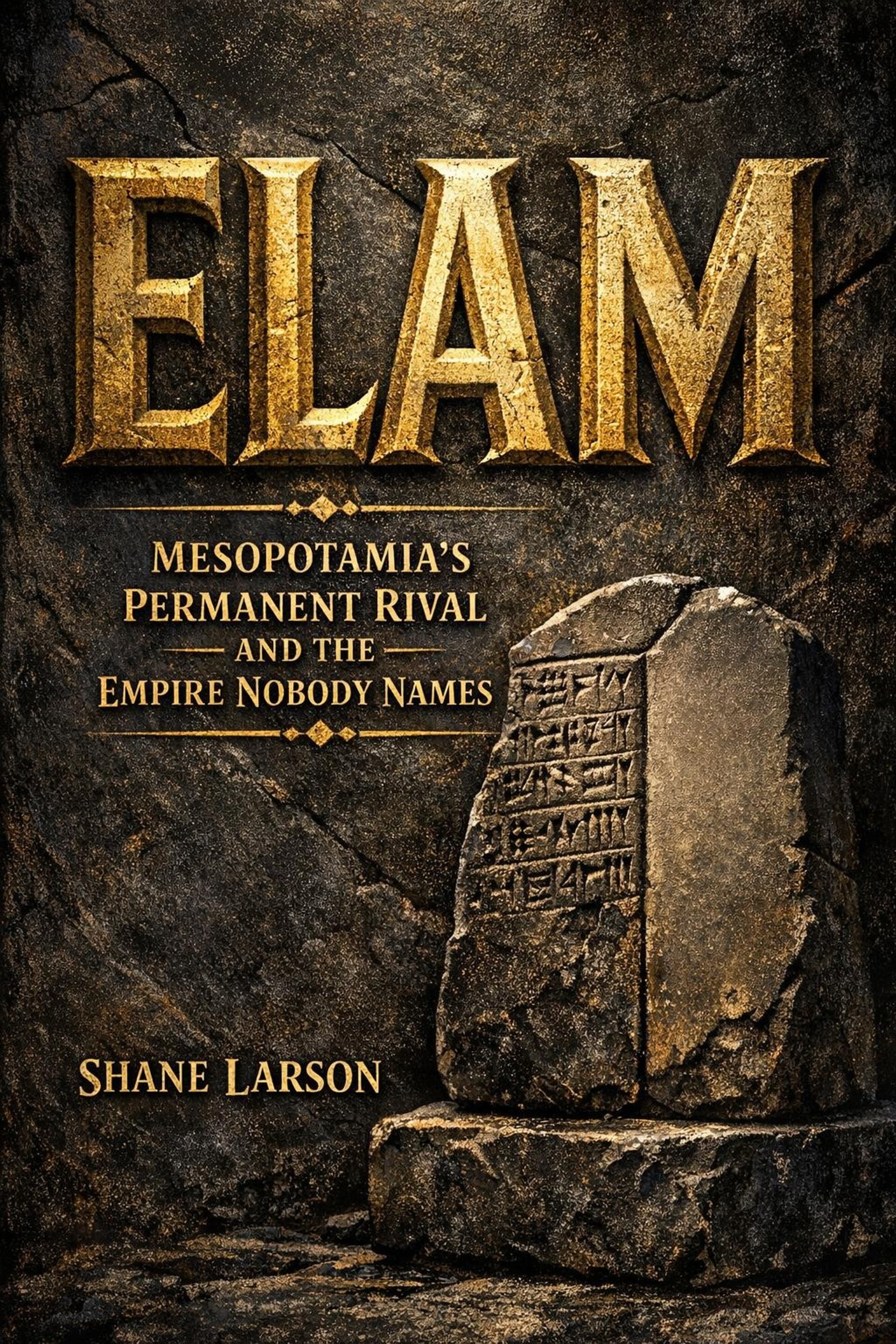
The stele in Paris is the whole story in one object: carved in Babylon, stolen by a forgotten empire, buried with that empire's capital, and raised again bearing a blank panel where its captor's name was never written. If you want the rest of that story — the sack of Ur, the kings who shared a throne with their brothers, the best-preserved ziggurat on earth, and how a vanished kingdom quietly became the machinery of Persia — my new book, *Elam: Mesopotamia's Permanent Rival and the Empire Nobody Names*, follows the thread from the first tablets at Susa to the archives of Persepolis. It begins, of course, in front of the stone.
Elam
New posts and releases, straight to your inbox. No spam, unsubscribe anytime.