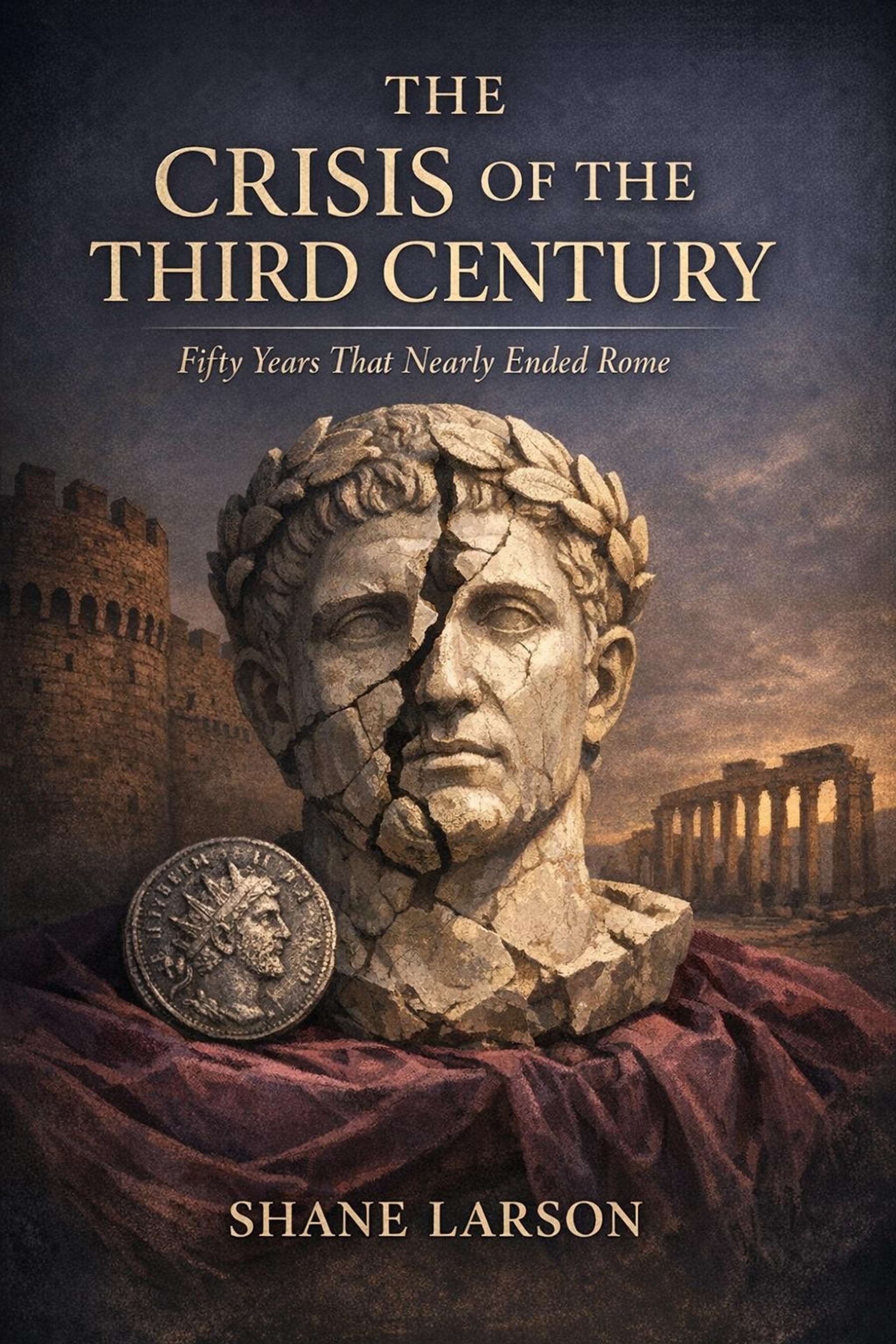
The Crisis of the Third Century
Fifty Years That Nearly Ended Rome
By Shane Larson · Rome: From Village to Empire (Book 10)
About This Book
In the cliffs of southern Iran, a few miles from the tombs of the Persian kings, there is a relief carved into the rock face. A mounted king sits in triumph. One Roman emperor kneels before his horse. Another stands beside him, his wrist gripped in the king's hand — a prisoner. The captive is Valerian, emperor of Rome, who walked into a truce negotiation with Shapur I in the year 260 and spent the rest of his life in Persian captivity. No army came for him. No ransom was paid. The empire that had spent three centuries telling the world it was eternal could not get its own emperor back, and its enemy carved the proof into a mountain.
That is the floor of the story this book tells — the moment the unthinkable became simply another thing that had happened. The Crisis of the Third Century is the name historians give to the decades between the death of Marcus Aurelius in 180 and the rise of Diocletian in 284, and almost everyone has met the phrase somewhere: in accounts of Rome's fall, in economics writing about currency collapse, in every essay asking whether some modern power is repeating Rome's mistakes. What almost nobody has read is the story itself. This book exists to fix that.
The Story
It begins with a father's mistake. Marcus Aurelius, the philosopher-emperor, ended a century of Rome choosing its best man for the throne by leaving the empire to his own son — and Commodus performed as a gladiator while the government rotted around him. His murder set off a chain no one could stop: the Praetorian Guard killing one emperor and openly selling the throne to the highest bidder; civil wars won by a general from Africa who told his sons the only rule that still mattered — pay the army, ignore everyone else; and then, after 235, the bottom falling out entirely. Emperor after emperor rose from the legions and died by them, sometimes within months. Persia resurged under an aggressive new dynasty. Gothic fleets burned the cities of the Aegean, Athens among them. The silver in the coinage fell from half to almost nothing; the papyrus price records of Egypt tell the rest. Plague crossed the empire twice. By 260 the Roman world had fractured into three states — a Gallic empire ruled from Trier, the middle held by a desperately underrated emperor named Gallienus, and the East governed from Palmyra by Zenobia, the most capable woman of her age.
And then, against every expectation, it was rebuilt. The men who did it were not aristocrats. They were career soldiers from the Danube provinces — the sons of Balkan farmers and freedmen, born about as far from privilege as the Roman world allowed — and in a single generation Aurelian recovered Gaul, defeated Palmyra, ringed Rome with the walls that still stand today, and reunified the empire before his own officers were tricked into killing him. Diocletian, a freedman's son from the Dalmatian coast, then rebuilt the Roman state from the ground up into something that would last: harder, more regimented, and profoundly different from what Augustus had made. Rome survived its apocalypse. What it could not do was remain itself — and this book takes both halves of that sentence seriously.
Why I Wrote This
Nine books into this series, I hit the century I had been quietly dreading, because I knew the sources were a disaster — the main narrative history for these decades is partly a forgery, written under fake names, salted with invented documents. Then I started working through what survives instead: the coins, the papyri, a lost history recovered from beneath a later manuscript with imaging technology, a siege excavated so precisely you can reconstruct its final hour. I realized the wreckage of the record was itself the story. This is the century where you can watch historians squeeze truth out of things rather than authors, and nobody had told it to general readers as one continuous narrative. That seemed like a gap worth a year of my time.
Frequently Asked Questions
Do I need to read the earlier books in the series first?
No. Every volume of Rome: From Village to Empire stands alone, and the introduction recaps what the principate was and why its succession had no rule. If you have read Book Nine, this picks up where it ended — but nothing is assumed.
Is this a narrative history or an academic study?
Narrative, start to finish — scenes, people, and consequences, told in order. The scholarship is load-bearing but carried lightly: when a number is inflated or a story comes from a hostile source, the book says so in the prose and moves on. There are no footnotes to wade through.
How is this different from a book about the fall of Rome?
The crisis is the century Rome didn't fall — and understanding why it survived is the point. The empire that emerged in 284 lasted another two hundred years in the West and more than a thousand in the East. The actual fall, and the transformation of the ancient world into the medieval one, is a separate story, and the catalog covers it in its own volume.
Does it cover Zenobia and Palmyra?
Yes — the rise of Palmyra, Odaenathus's campaigns against Persia, Zenobia's seizure of Egypt, and Aurelian's desert war are all here as a major act of the larger story. Her full life has its own book in the catalog, linked below.
How much of what we know about this period is actually reliable?
Less than for any other Roman century, and the book treats that as a feature. One appendix is a working guide to the sources — including the Historia Augusta, antiquity's most notorious forgery — and where the texts fail, coins, inscriptions, and archaeology take over.
If You Liked This, You Might Like
- Zenobia of Palmyra — the full portrait of the queen who appears here at the head of the breakaway East; that book is her life, this one is her war's place in Rome's larger emergency.
- The Fall of Rome — picks up the story where this volume stops, at the empire Diocletian rebuilt, and follows it to the end of the ancient world.
- Marcus Aurelius — the emperor whose death opens this book, and the last ruler of the world this book watches disappear.
- The Founding of Rome — where the series and the city both begin; reading it against this volume brackets the whole thousand-year argument.
- The Sassanids — the other side of the rock relief this book opens with: Shapur's dynasty in full, from Persia's rebirth to the war with Rome that finally exhausted both empires.
A thousand years after a hilltop asylum started turning fugitives into Romans, the empire was saved by the descendants of the people it had absorbed. The Crisis of the Third Century is the tenth and final spine volume of Rome: From Village to Empire, and the completion of that argument.
What You'll Learn
- A century with no narrator — the historians go silent at exactly the wrong moment, so the story is reconstructed the way scholars actually do it: from coins, buried treasure hoards, inscriptions, and archaeology, with the method shown as you go
- The auction of the empire, told in full — how the Praetorian Guard came to sell supreme power from the rampart of their camp, and what the sale revealed about where power had always really lived
- The citizenship edict of 212 — Caracalla makes every free person in the empire a Roman: the endpoint of a thousand years of turning outsiders into citizens, and the moment the old bargain ran out of anything left to offer
- The first empire-wide persecution — read from the actual loyalty certificates that survive on Egyptian papyrus, with names, dates, and countersignatures still legible
- A forensic siege — at Dura-Europos on the Euphrates, archaeologists found a collapsed counter-mine with the defenders still in their mail: the oldest physical evidence of chemical warfare in history, from a fallen city no surviving text ever mentions
- The enemy's own account — Shapur's trilingual inscription lets Persia narrate its wars against Rome for once, weighed against the Roman tradition throughout
- Zenobia and the breakaway empires — treated not as rebellions but as lifeboats: regional Roman states run by people trying to be Rome, which is why reunification was possible at all
- The money — how a world currency actually dies: the mechanics of debasement, the hoard evidence, Aurelian's attempted reform, and an honest appendix on what the ancient inflation does and does not prove about anyone's modern economy
Included with Kindle Unlimited — read it free if you're a member.
New Ancient History releases and free chapters — no spam, unsubscribe anytime.
More in Rome: From Village to Empire
View series →