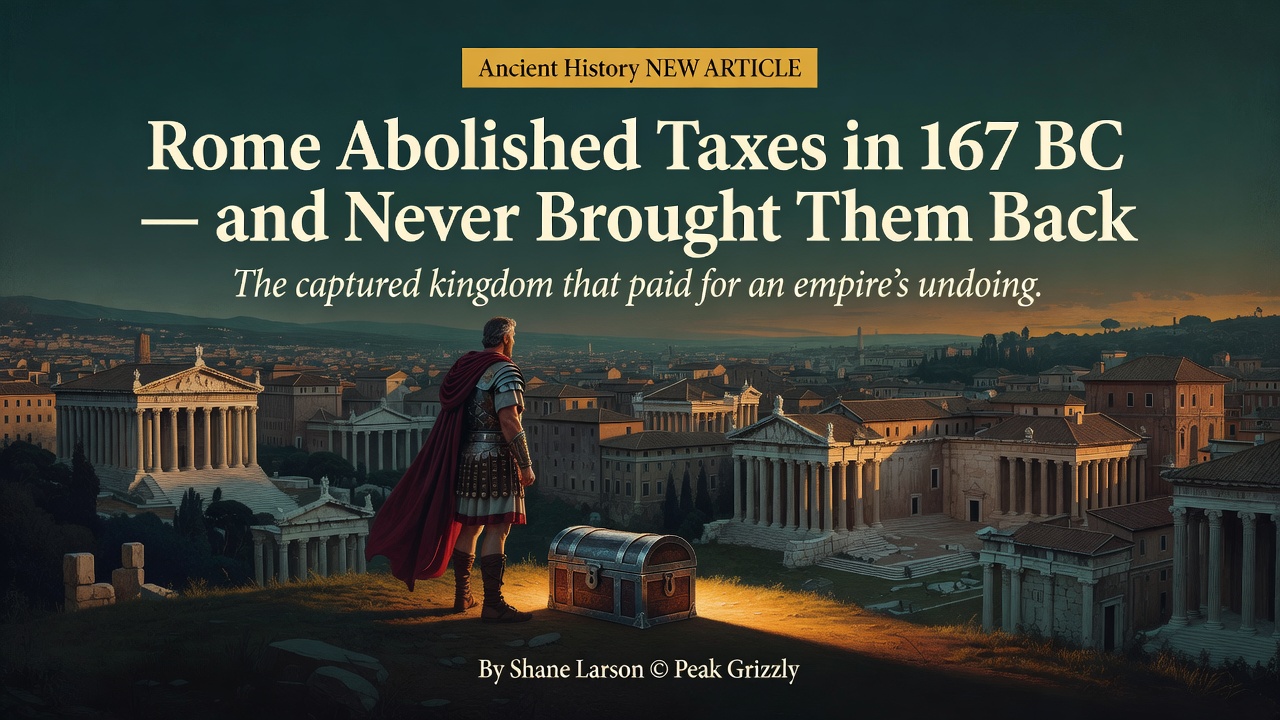
Rome Abolished Taxes in 167 BC — and Never Brought Them Back
August 13, 2026 · 8 min read
For three days at the end of November 167 BC, the wealth of a two-hundred-year-old kingdom was carried through the streets of Rome.
The occasion was the triumph of Lucius Aemilius Paullus, the general who had destroyed the army of Macedon at Pydna the year before, in about an hour of fighting. The procession is one of the best-documented events in Roman history — not because it was beautiful, though it was, but because it was an audit. A triumph was the formal entry of captured assets into the Roman state, and the state kept the receipts. The itemised lists passed from those records into the ancient historians, which is why we can still do the sums.
The first day was art: 250 wagonloads of statues and paintings, dawn to dusk. The second day carried the weapons of the Macedonian army, heaped with theatrical carelessness, followed by 3,000 men carrying coined silver in 750 vessels — each vessel holding three talents, each needing four men to lift it. The third day was the gold, 77 more vessels of it, plus the royal plate of two dynasties, then the deposed king Perseus walking on foot in a dark cloak, behind his own children.
Here is a conversion to hold onto. One of those three-talent jars — one jar, four carriers — held roughly 150 years of a legionary's pay. There were 827 of them. The reported totals for the whole haul disagree with each other, but even the lowest works out to something like a quarter of a million man-years of soldiers' wages, walked through the city in three days, into a treasury that had no category of expenditure large enough to need it.
What Rome did with that money is the hinge of the late Republic, and almost nobody has heard of it.
The tax that never came back
The Roman Republic ran on a direct tax called the tributum: a levy on the assessed property of citizens, graded by the census, collected through the tribes, raised to pay armies. It was not a standing income tax in the modern sense — it was war finance, and in flush years after a victory the state had occasionally even refunded it. But it had been collected, war after war, for as long as anyone living could remember, and it was the fiscal thread connecting the Roman citizen to the Roman state. The census had one logic running through it: the man the censors assessed was the man the treasury taxed and the man the legions drafted. One person, counted once, owing both money and service.
In 167 the treasury absorbed Macedon, and the Senate suspended the tributum.
It was never reimposed in Italy. Not the next year, not the next decade, not for the remaining lifetime of the Republic — a single desperate levy during the civil wars a century later is the exception that measures the rule. From 167 BC onward, the Roman citizen in Italy paid no direct tax at all. The armies, the temples, the games, the grain supply, the city itself: from this year, the provinces paid for Rome.
It is worth being clear about what this was at the time, because it was not a scandal or a blunder. It was the most popular thing a state can do, executed from a position of total strength: the war won, the enemy dismantled, the soldiers paid, the citizens relieved, the treasury full. By every measure available in 167, this was magnificent public finance. Nothing had failed.
That is precisely what makes it worth studying. The abolition of the tributum rewired the Republic in three ways, and nobody voted on any of them.
Three things nobody voted on
First, the citizen's stake in the state's wars was cut. Roman assemblies declared war; that was their constitutional job. Before 167, the men voting for a war were voting, among other things, to tax themselves to pay for it. After 167, they were not. War, for the Roman voter, became a proposition with its costs in other people's provinces and its dividends at home. An electorate with no fiscal skin in the game will approve more of something than an electorate that pays as it goes, and Rome ran that experiment for a century.
Second, the state's income now came from the empire, which meant the state now needed the empire — permanently. A treasury funded by provincial revenue is a treasury that cannot contemplate having fewer provinces. The option of not being an imperial power quietly acquired a price tag that no politician would ever propose paying. Contraction, retrenchment, letting go: these stopped being policies anyone could afford to advocate, because the government's own operating budget was the first thing they would cut.
The Conquest of the East
Third, and most corrosive: in a political culture where public office was unpaid and elections were won by reputation and generosity, the only fortunes large enough to matter were now made abroad — in military commands, in provincial governorships, in the tax-farming contracts that collected the empire's revenue. And those commands, provinces, and contracts were awarded by the same small circle of men who decided where the armies went. A closed loop formed between conquest, private wealth, and political power, and there was no one inside the loop with any incentive to open it. Rome felt the problem almost immediately: in 149 BC it established its first permanent criminal court, and the crime that court existed to try was provincial governors robbing the people they governed.
The Republic's constitution assumed a citizen who paid for the state and a magistrate who served it for honour. After 167 the citizen was a beneficiary and the magistracy was an investment, and the constitution assumed nothing of the kind.
The number that went the wrong way
If this were just an elegant theory, it would belong in a seminar. What makes it history is that you can watch it in the data Rome kept about itself.
Every five years, Roman citizens declared themselves and their property to the censors, and the totals of registered adult male citizens were preserved. The series behaves as you would expect while Italy recovered from Hannibal's invasion: 214,000 registered men in 204 BC, past 258,000 by the end of the 190s, and in 164 BC — the first census after Pydna — 337,022, the highest figure ever recorded to that date.
Then, in the richest generation Rome had ever lived through, the number turns around and goes down. 328,316 in 159. About 324,000 in 154. About 322,000 in 147. By 136, it was 317,933. Four consecutive censuses, a fall of nearly 20,000 registered men — while the treasury swelled, the city built, and the enslaved population of the Italian countryside grew by every indication we have. The same wars that filled the treasury had flooded Italy with captives (150,000 people were enslaved in Epirus in a single coordinated day in that same year, 167, as a demobilisation bonus for the troops), and the slave-worked estates they went to were absorbing exactly the smallholdings whose owners qualified for the legions.
Some of the fall was evasion rather than ruin — and the evasion is itself evidence. After 167, registering with the censors cost a citizen nothing in tax and could cost him everything in the levy, because Spain had become a posting a man might serve six unbroken years in and not come home from. Either way, the state was measuring the same fact: the men it drafted were becoming scarcer while everything else Roman became more abundant.
The Republic's response is the driest and most damning number series of the whole period. Legionary service required a minimum property qualification — the logic of a citizen militia was that a man fought for a stake he owned. Tradition put the threshold at 11,000 asses. By the time Polybius described the system at mid-century, it stood at a figure equivalent to about 4,000. By the late Republic, the books said 1,500. The dates of the individual cuts are nowhere recorded, but the direction is beyond doubt: rather than ask why the qualified citizen was disappearing, the state redefined poverty downward, again and again, so that the muster rolls could be filled. When your most important metric declines for thirty years, and your response is to lower the definition until the number works, you have not solved the problem. You have written it down.
In 133 BC, a tribune named Tiberius Gracchus — who had ridden through Etruria and seen a countryside worked by imported slaves, with the free farmers gone — proposed to enforce a land law that had sat unapplied on the books for generations. He was beaten to death in the street by senators, the first political killing in Rome in more than three and a half centuries. Everything that follows in Roman history follows from that.
None of it required a villain. The tax cut of 167 was rational. The estates were legal. The census evasion was prudent. The threshold cuts filled the legions. Every individual decision was sound, and the sum of them removed the cost of empire from the only people in a position to direct it. A machine with the brakes taken off does not need a wicked driver to end up where this one ended.
This article draws on material from my book "The Conquest of the East: How Winning Broke Rome" — Book Five of the Rome: From Village to Empire series — which follows the sixty-seven years in which Rome conquered the Greek world, and the money, the slaves, and the unending wars that conquest shipped home.
The Conquest of the East
New posts and releases, straight to your inbox. No spam, unsubscribe anytime.