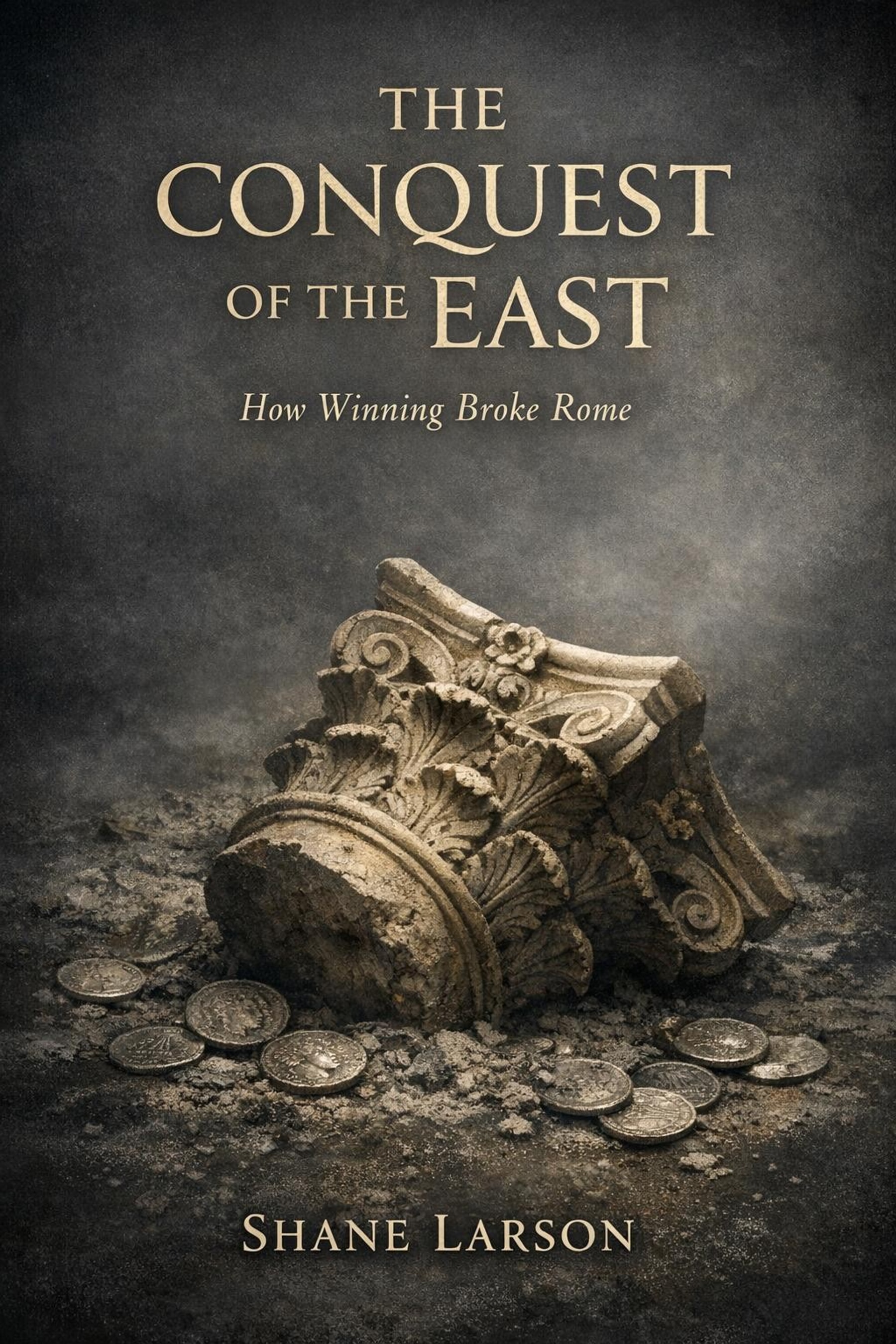
The Conquest of the East
How Winning Broke Rome
By Shane Larson · Rome: From Village to Empire (Book 5)
About This Book
In the summer of 167 BC, at the sanctuary of Delphi, the Roman general Aemilius Paullus found a tall stone pillar standing unfinished. Perseus, king of Macedon, had commissioned it to carry a statue of himself. Paullus had just abolished Perseus's kingdom — the throne of Alexander's ancestors — in about an hour of fighting, so he put his own statue on top instead, with an inscription recording that he took it from the king he beat. The pillar is still there.
That gesture is the whole period in miniature: a Republic helping itself to the Greek world's monuments, thrones, treasuries, and people, while insisting it had come reluctantly and wanted nothing. In the same months, Rome deported a thousand of Greece's leading citizens to Italy without charge, sacked seventy towns in one coordinated morning, and grew rich enough to cancel the war levy on its own citizens — permanently, as it turned out.
The sixty-seven years this book covers begin with the Roman Republic exhausted, eighteen months clear of Hannibal, and end with provinces on three continents, a kingdom acquired by inheritance, and a tribune of the people dead in the street. They are the hinge of Roman history, and they are strangely untold.
The book's claim is simple to state and uncomfortable to sit with: nothing failed. The levy filled, the legions won, the Senate's diplomacy got everything it reached for — and that unbroken success is what destroyed Roman society. Look at what victory delivered. Fortunes on a scale no republican institution was built to hold, in a political culture where office was unpaid and won by open-handedness — so the only road to power now ran through the provinces, and the men who assigned the provinces were the men already holding power. Human beings by the hundred thousand, enslaved and set to work on consolidating estates whose growth slowly squeezed out the free farming families whose property made them liable for the levy. And commitments no victory could close: Spain alone ate Roman armies for six decades, until conscripts refused to march and tribunes jailed the consuls who tried to compel them.
The Romans explained their own crisis differently: reluctant wars of self-defence, Greek freedom granted for nothing, then a slow corruption by eastern luxury. The men who wrote that version were the heirs of the men who took the profits, and the book weighs their story as testimony rather than repeating it as a verdict. A state reluctantly dragged into war that comes out ahead every single time for two-thirds of a century is not unlucky in its enemies; it has a business model. The damage that mattered shows up not in anyone's silverware but in the census rolls, which shrink while the empire swells.
What's Inside
- Cynoscephalae, fought by accident in fog — neither commander intended a battle that morning, and the pike phalanx that had dominated warfare since Alexander was destroyed by a tribune whose name the sources never recorded.
- Two words for freedom — the proclamation at the Isthmian Games, the roar that legend says killed birds in flight, and the gap between Roman libertas and Greek eleutheria that contained the region's whole future.
- A year with no battles that changed everything — 167 BC: a triumph three days long, a treasury so full the tributum was suspended, and the deportation that handed the ancient world its greatest historian.
- An ultimatum built to be refused — the demand sequence Rome put to Carthage in 149 BC, each step calibrated to be accepted, until the last one, which was not meant to be.
- The triumphs read as accounting documents — silver by the pound, converted into terms a reader can hold, and Rome's first permanent criminal court, created to try governors for robbing their provinces.
- How a farm is lost without anyone being evicted — a legal limit ignored for a century, Cato's farming manual read as evidence, and a conscript doing the arithmetic from a garrison in Spain.
- The culture war Cato lost — sumptuary laws that kept failing, and the Bacchanalian affair, where the Senate's own bronze decree survives to check Livy's lurid story.
- Viriathus and Numantia — a shepherd who beat consular armies for eight years, a hill town that defied Rome for twenty, and the young quaestor who watched the Senate repudiate his sworn treaty: Tiberius Gracchus.
Why I Wrote This
Every Roman history on my shelf does the same thing: Hannibal is defeated on one page, and a few pages later Tiberius Gracchus is being beaten to death by senators, with the sixty-seven years in between compressed to a transition. I kept wanting to read the transition. That gap is where a republic of farmer-soldiers turned into something that could not keep itself alive, and it happened while Rome won every war it fought — a stranger and better story than decline.
And then there is Polybius. The indispensable source for how Rome conquered the Greek world is a Greek cavalry officer Rome deported, held seventeen years without charge, who became a friend of the man who destroyed Carthage and stood beside him while it burned. The best historian of the ancient world, and not a neutral party. I wanted to write the book that takes both halves of that sentence seriously.
Frequently Asked Questions
Do I need to read the earlier books in the series first?
No. The volumes of Rome: From Village to Empire are written to be read independently, and the introduction recaps everything the story assumes in three paragraphs. Hannibal's War is the natural predecessor — but not a prerequisite.
Is this a narrative history or an academic book?
Narrative, without footnotes or academic apparatus. What it borrows from scholarship is honesty about evidence: it flags whether a claim rests on Polybius as an eyewitness, on Livy writing 150 years later, or on archaeology, and a closing appendix walks through every source and its problems.
Does it cover the Third Punic War and the destruction of Carthage?
Yes — all of Part Three: the fifty years of legal strangulation, Cato and the figs, the six days of street fighting, and Scipio Aemilianus weeping over the burning city — known to us only because the Greek standing next to him wrote it down. The salt-in-the-soil story, incidentally, is a nineteenth-century invention, and the book retires it.
Who was Polybius and why does he matter so much here?
A cavalry commander of the Achaean League, deported to Italy in 167 BC, who became a friend of Scipio Aemilianus and wrote the history of Rome's rise every later account depends on. Honest, methodical, and openly partisan — a prisoner explaining to fellow Greeks why resistance was irrational — he serves this book as both its best source and one of its subjects.
Does the book cover Julius Caesar or the fall of the Republic?
No. It ends in 133 BC, the year Numantia falls, a king wills Rome his kingdom, and Tiberius Gracchus is killed in the street — Rome's first political murder in three and a half centuries. Caesar and the civil wars are downstream of everything described here, but they belong to later volumes.
How long is the book?
About 103,000 words — just over 300 pages in print — in seventeen chapters plus three appendices covering the Hellenistic kingdoms, where the money went, and the ancient sources.
If You Liked This, You Might Like
- Hannibal's War — ends in 201 BC with Carthage disarmed and Rome supreme in the west, precisely the door this book walks through; the closest pairing in the catalog.
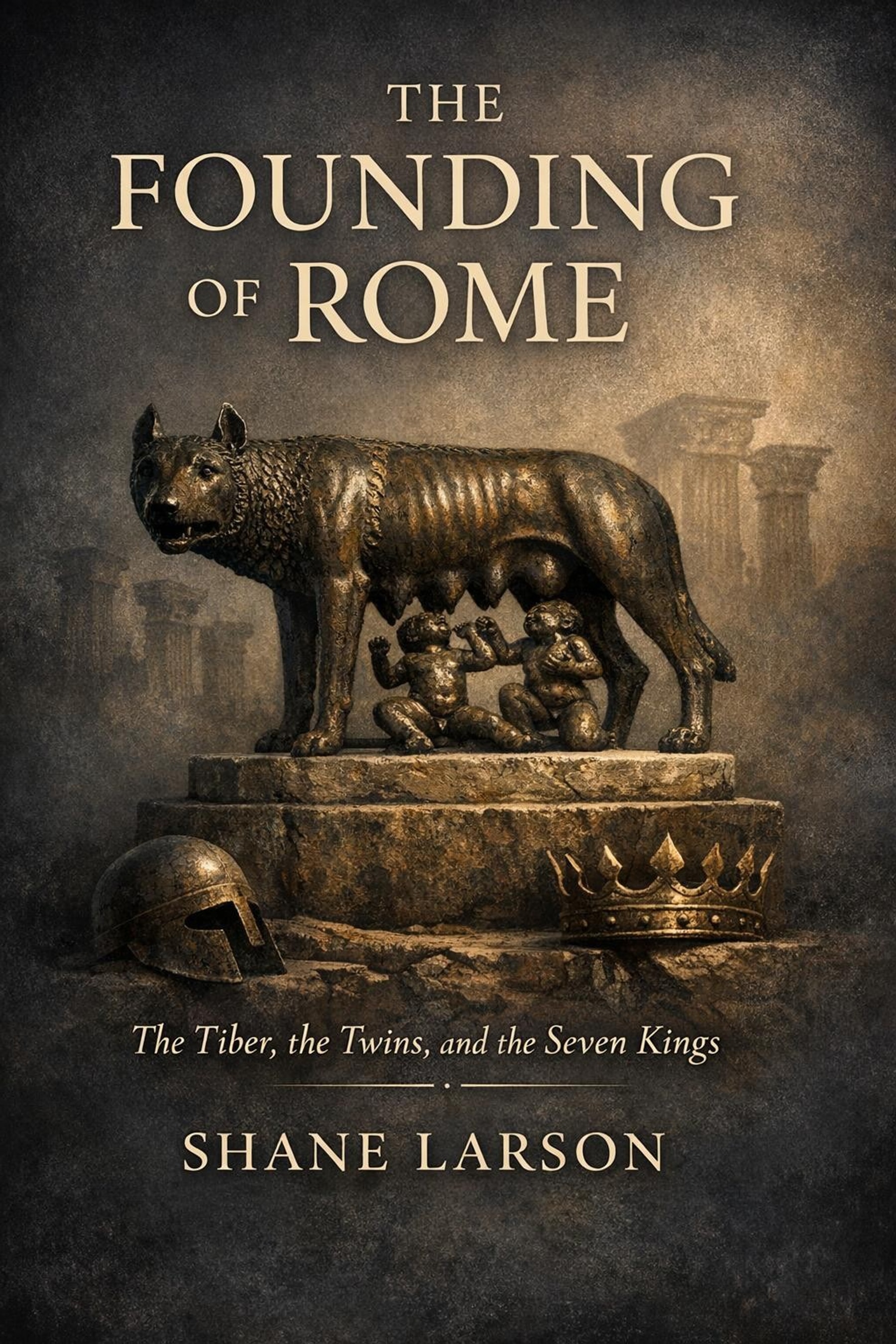
- The Founding of Rome — Book One of the same series, where the machine this volume watches overheat was first assembled out of a village on a hill.
- Alexander the Great — the conqueror whose successor kingdoms are the states Rome dismantles one by one in these pages.
- Spartacus — the slave economy this book shows being built, estate by estate, seen from the inside when it finally rose in revolt.
The Republic won everything it wanted and could not survive the winning; this book follows the conquest east, then follows the money, the slaves, and the exhausted soldiers home. Book Five of Rome: From Village to Empire.
What You'll Learn
- Cynoscephalae, fought by accident in fog — neither commander intended the battle, and the pike phalanx that had dominated warfare since Alexander was destroyed by a tribune whose name the sources never recorded.
- Two words for freedom — the proclamation at the Isthmian Games and the gap between Roman libertas and Greek eleutheria that contained the region's whole future.
- A year with no battles that changed everything — 167 BC, when the tributum was suspended and Rome deported the man who became the ancient world's greatest historian.
- An ultimatum built to be refused — the demand sequence Rome put to Carthage in 149 BC, calibrated at every step to be accepted, until the last one.
- The triumphs read as accounting documents — silver by the pound, and Rome's first permanent criminal court, created to try governors for robbing their provinces.
- How a farm is lost without anyone being evicted — a legal limit ignored for a century, and a conscript doing the arithmetic from a garrison in Spain.
- The culture war Cato lost — sumptuary laws that kept failing, and the Bacchanalian affair, checked against the Senate's own surviving bronze decree.
- Viriathus and Numantia — a shepherd who beat consular armies for eight years, a hill town that defied Rome for twenty, and the young quaestor who watched the Senate repudiate his sworn treaty: Tiberius Gracchus.
Included with Kindle Unlimited — read it free if you're a member.
New Ancient History releases and free chapters — no spam, unsubscribe anytime.
More in Rome: From Village to Empire
View series →