The Malware That Told the Control Room Everything Was Fine
August 5, 2026 · 6 min read
For about a year, the engineers at Iran's Natanz enrichment facility had a problem they could not explain.
Centrifuges were failing. Not all at once — that would have been obvious. They failed in ones and twos, then in small clusters, across an installation of thousands. The failure rate crept above what the equipment's design should have produced. Rotors cracked. Bearings gave out. Machines that should have run for years came apart in months.
The engineers did what engineers do. They checked the power supply. They checked the vibration data. They checked the vacuum systems, the cooling, the gas feed. They replaced components. They fired people. And through all of it, the monitoring systems in the control room reported that the plant was operating within normal parameters.
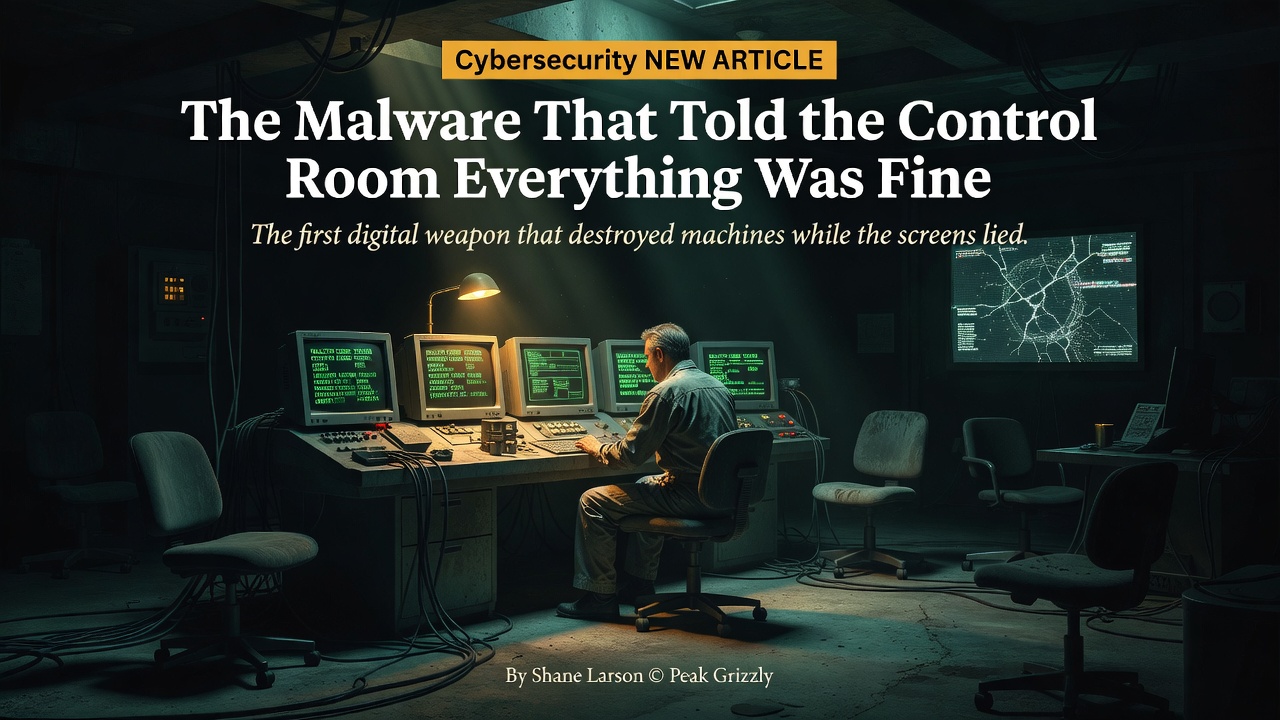
The monitoring systems were lying. Something in the network had been recording what normal looked like, and playing it back.
The Discovery Was an Accident
Stuxnet was not found by Iran. It was found in June 2010 by VirusBlokAda, a small antivirus firm in Belarus, called in to look at Iranian computers that kept crashing and rebooting for no clear reason.
What they found did not look like ordinary malware. It carried four separate zero-day exploits — previously unknown Windows vulnerabilities — at a time when a single working zero-day was a valuable commodity on the criminal market. Nobody burns four at once to steal credit cards. Burning four means you have decided the target is worth more than the exploits, and that you will probably only get one attempt.
It was also digitally signed. The drivers carried valid code-signing certificates stolen from two legitimate hardware companies in Taiwan, Realtek and JMicron, whose offices sat in the same business park. Signed drivers meant Windows loaded the malware without complaint. It meant Stuxnet was, as far as the operating system was concerned, trusted software.
Once security researchers at Symantec, Kaspersky, and the German industrial control specialist Ralph Langner started pulling the thing apart, they found something stranger still. This was not a piece of malware that stole anything. It spread widely and aggressively — and then, on nearly every machine it reached, it did absolutely nothing.
It Was Looking for One Specific Room
Stuxnet had a checklist, and it ran it on every computer it landed on.
Is Siemens Step7 industrial control software installed here? If not, sleep. Is this machine connected to a programmable logic controller — the small dedicated computers that operate physical equipment in factories and power plants? If not, sleep. Is it a Siemens S7-315 or S7-417 model? If not, sleep.
Then it got more specific. Are there frequency converter drives on this controller — the devices that regulate the speed of an electric motor? Are they made by Vacon of Finland or Fararo Paya of Tehran? Are there at least 33 of them? Are they running between 807 and 1210 Hz — a speed range so high that in the United States, exporting drives capable of it requires a license, because there is essentially one civilian use for them?
That use is enriching uranium.
If every answer came back yes, Stuxnet woke up. If any answer came back no, it stayed dormant and eventually deleted itself. It infected somewhere north of a hundred thousand machines around the world and ignored virtually all of them. The payload was built for one room in one building in one country.
The Sabotage Was Patient
What Stuxnet did once it woke up is the part that changed how people think about this class of attack.
Gas centrifuges enrich uranium by spinning a cylinder at enormous speed, so that the heavier isotope drifts toward the wall. The rotors are long, thin, and turning near the limits of what the material can survive. They are exquisitely sensitive to changes in speed. Push one past its tolerance and it does not simply slow down; it tears itself apart.

Stuxnet did not push them past tolerance all at once. It waited — sometimes weeks — and then briefly ran the rotors far above their normal operating speed, before dropping them to nearly a standstill. Then it went quiet again and let the plant run normally for another stretch. Every cycle put stress into machines built with no margin for it.
And while it did this, it fed the operators a recording. Before the sabotage began, Stuxnet spent time simply watching the plant, capturing the sensor values of a healthy system. When the attack ran, it replayed that captured data to the monitoring stations. The screens showed normal pressures, normal speeds, normal everything. The engineers standing in the control room during the sabotage were looking at a movie of the past.
The result, by most public estimates, was around a thousand centrifuges destroyed at Natanz — roughly a fifth of those installed — along with something harder to replace. The Iranian program lost confidence in its own instruments. When you cannot tell whether a failure is sabotage, a bad batch of parts, or an incompetent technician, every subsequent failure costs you an investigation.
Then It Got Loose
Stuxnet was designed for an air-gapped facility — a network with no connection to the outside world — which meant it had to travel on USB drives and spread aggressively once inside a local network to be sure of finding its target.
That aggression is what exposed it. Sometime in 2010, a version of the worm reached a machine belonging to a contractor and went out through the wider internet. Within months it was on computers in India, Indonesia, Azerbaijan, the United States, and dozens of other countries — all doing nothing, because none of them had the right centrifuges, but all of them carrying a complete, working copy of the most sophisticated cyberweapon anyone had ever built.
Nobody has officially claimed it. Reporting by The New York Times and others has attributed it to a joint American-Israeli operation, reportedly code-named Olympic Games, and no government has confirmed that. What is not in dispute is the technical achievement and what it demonstrated.
Why This Is the Line Everything Crosses
Before Stuxnet, a cyberattack meant information — stolen data, deleted files, systems taken offline. Damage happened in the space of the network, and the fix was, ultimately, restoring from backup.
Stuxnet broke hardware. It reached out of the network and destroyed physical objects, permanently, using nothing but code. That capability had been discussed for years in defense white papers and mostly dismissed as theoretical. In the summer of 2010 it stopped being theoretical, and the proof of concept was published to the entire world by accident.
Every industrial system built on the same logic became a legible target: water treatment plants, electrical substations, pipelines, chemical works, manufacturing lines. These systems run on controllers designed in an era when the security model was a locked door, and they are replaced on a thirty-year cycle. Much of what was vulnerable in 2010 is still installed.
The other legacy is the precedent. A state used a piece of software to physically destroy infrastructure inside another state, during peacetime, and there was no meaningful legal or diplomatic consequence — largely because no framework existed for what had just happened. Every actor watching learned the same lesson from that silence.
Stuxnet's authors solved an extraordinarily hard engineering problem and, in doing so, handed everyone else a working blueprint. That is the thing about a weapon made of information. Once you use it, you have given it away.
Stuxnet: The Silent Weapon tells the whole story — the geopolitics that produced it, the engineering that made it work, the year of unexplained failures at Natanz, and the world it left behind.
New posts and releases, straight to your inbox. No spam, unsubscribe anytime.