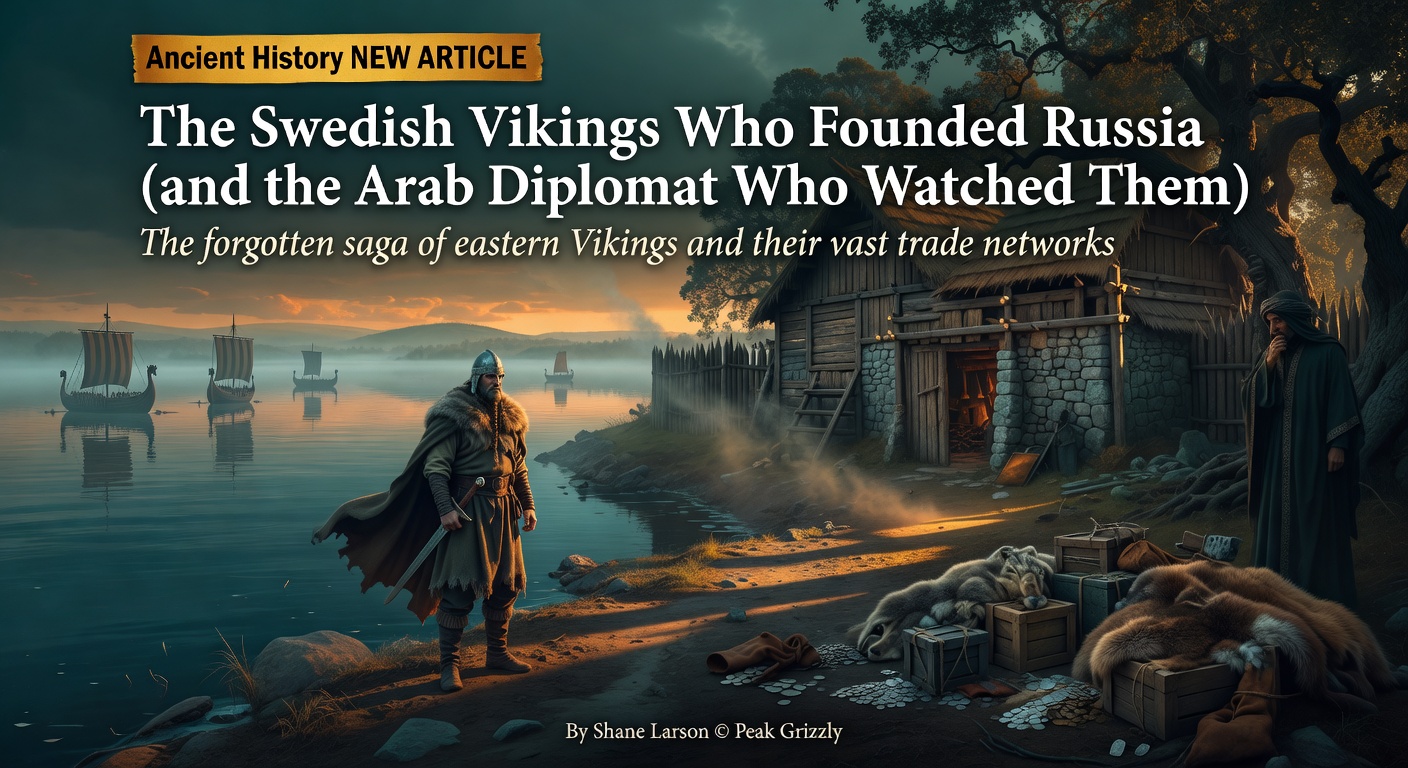
The Swedish Vikings Who Founded Russia (and the Arab Diplomat Who Watched Them)
April 4, 2026 · 11 min read
When most people think of Vikings, they picture longships sailing west — raiding English monasteries, besieging Paris, settling Iceland. This is roughly half the story, shaped by tales of fire and plunder that have dominated history books for centuries, often drawing from sources like the Anglo-Saxon Chronicle or Icelandic sagas. Yet, this focus overlooks the equally ambitious ventures that unfolded in the opposite direction, driven by the same spirit of exploration and profit but adapted to a different landscape. The other half went east, where Swedish Vikings navigated uncharted territories, forging networks that linked distant cultures and economies in ways that reshaped the medieval world.
While Danes and Norwegians were terrorizing Western Europe, Swedish Vikings were pushing into the vast river systems of what is now Russia, Ukraine, and Belarus. They established fortified trading posts along waterways that stretched from the Baltic Sea to the Black Sea and the Caspian, creating a web of commerce that connected the fringes of Scandinavia to the heart of the Byzantine and Islamic worlds. They traded furs, wax, honey, and slaves for Arab silver on a scale so massive that over 80,000 Arabic coins have been found in Swedish hoards alone, with similar hoards discovered in sites like Gotland and Birka, underscoring the volume of wealth flowing northward. They attacked Constantinople repeatedly, extracting trade treaties from the Byzantine Empire at swordpoint, tactics that mirrored their Western raids but aimed at long-term economic gain rather than mere destruction. And the state they built — Kievan Rus — became the political and cultural ancestor of Russia, Ukraine, and Belarus, influencing everything from legal systems to religious practices in a region that would later become a crossroads of East and West.
Three modern nations with a combined population of over 200 million people trace their origins to Swedish adventurers who paddled into the forests of eastern Europe looking for a trade route to Constantinople, blending their warrior ethos with local customs to lay the foundations of enduring societies.
Rivers as Highways: The Geography That Made It Possible
The eastern expansion only makes sense when you understand the geography, which served as both a barrier and a bridge in a landscape that demanded ingenuity from any traveler.
Eastern Europe in the ninth century was a vast expanse of forest, marsh, and steppe, thinly populated by Slavic, Baltic, and Finnic peoples who lived in small, scattered communities without the fortified towns or Roman roads that characterized the West. This environment lacked the centralized political authority seen in places like Charlemagne's empire, making it a patchwork of tribes and alliances that shifted with seasons and conflicts. But there were rivers — extraordinary rivers that cut through the wilderness like veins of opportunity, offering navigable paths for those skilled in boat craft.
Two routes defined the eastern Viking world, each a lifeline for trade and conquest. The Dnieper Route ran from the Baltic south through Lake Ladoga to Novgorod, then down the Dnieper to the Black Sea and Constantinople — "the road from the Varangians to the Greeks," as the Norse called it, a name that highlights their role as the primary users of this corridor. This path spanned over 1,000 miles, requiring not just sailing but also portaging around obstacles, a technique the Vikings had honed from their fjord-hopping origins. The Volga Route ran east from Lake Ladoga to the upper Volga, then south to the Caspian Sea and the Islamic world, tapping into the Abbasid Caliphate's vast markets. At the southern ends of those routes lay the two wealthiest civilizations on Earth: the Byzantine Empire, with its opulent capital of Constantinople boasting aqueducts, hippodromes, and a population nearing half a million, and the Abbasid Caliphate, centered in Baghdad, where scholars preserved ancient knowledge and merchants dealt in luxuries from spices to silks.
For people who had spent centuries building shallow-draft vessels that could navigate rivers, be portaged overland between waterways, and still handle open water, this was an invitation written in water, one that turned geographical challenges into strategic advantages. The Norse established fortified trading posts at strategic points — for instance, Staraya Ladoga, where archaeological excavations reveal Scandinavian artifacts like iron tools and runestones alongside Slavic and Finnic material from the mid-eighth century, indicating a melting pot of cultures. Novgorod, commanding the Volkhov River, grew into a bustling hub with wooden streets and markets that facilitated the exchange of goods, while Kiev, controlling the middle Dnieper and the southern approach to Constantinople, became a key stronghold that blended Norse defensive architecture with local Slavic building techniques.
These were not colonies in the way Iceland was a colony, where Norse settlers established self-contained communities on uninhabited land. The Norse were always a minority — a ruling and trading elite among a much larger Slavic population, often numbering in the tens of thousands compared to the Norse hundreds. They came as warriors, traders, and organizers, imposing themselves on existing communities through alliances, marriages, and occasional force, which helped stabilize regions prone to raids from nomadic groups like the Pechenegs. Over time, they merged with local populations, adopted Slavic languages and customs — such as the use of birch bark manuscripts for record-keeping — and became something new: neither fully Scandinavian nor fully Slavic, but a hybrid the sources call "Rus," as evidenced by the evolving styles in artifacts like jewelry and weapons found in burial sites.
The Byzantine Emperor Constantine VII, writing around 950 AD in his administrative manual De Ceremoniis, described the annual Rus trade fleet that assembled at Kiev each spring, emphasizing the meticulous preparation involved in such expeditions. His most vivid passage covers the Dnieper Rapids — seven cataracts near modern Zaporizhzhia where the river was impassable by boat, forcing traders to haul their vessels over rocky terrain for six miles. This chokepoint not only exposed them to Pecheneg raiders, who exploited it for ambushes, but also required coordinated efforts that blended Norse seamanship with Slavic knowledge of the local environment. Constantine records both the Rus and Slavic names for each rapid, and linguists have confirmed that the Rus names are Scandinavian — one of many pieces of evidence, such as the presence of runic inscriptions on stones in the region, establishing the Norse origins of the Rus elite and highlighting how language served as a tool of cultural integration.
The Arab Who Watched the Vikings Trade and Die
In 921 AD, an Arab diplomat named Ahmad ibn Fadlan was sent by the Abbasid caliph on a mission to the king of the Volga Bulgars, a journey aimed at strengthening diplomatic ties and resolving disputes over trade routes amid the caliphate's internal challenges. Along the way, he encountered a group of Rus traders camped on the Volga, and he wrote what became one of the most extraordinary documents of the Viking Age, his Risala, which offers a rare outsider's perspective on a culture often romanticized in its own lore.
The Viking Expansion
Ibn Fadlan described the Rus with the ethnographic curiosity of an anthropologist and the moral judgment of a devout Muslim, shaped by his background in a sophisticated Islamic court where cleanliness and decorum were highly valued. He admired their physicality — "I have never seen more perfect physical specimens, tall as date palms, blond and ruddy" — a description that echoes other accounts from the period, like those in the Norse sagas, but adds a layer of wonder from an Eastern viewpoint. Yet, he was horrified by their hygiene, detailing how they washed their hands and faces each morning from a communal basin into which each person blew his nose and spat, the basin passed from one to the next, a practice that likely stemmed from the practicalities of life on the road but clashed with Islamic purity rituals.
His most famous passage is his eyewitness account of a Rus ship burial — the funeral of a chieftain whose body was placed on a ship with grave goods and a sacrificed slave woman, then burned — a ritual that Ibn Fadlan observed with a mix of fascination and revulsion. The account is detailed, disturbing, and invaluable, providing the most vivid first-person description of the Viking ship burial ritual that survives, including specifics like the preparation of the body with perfumes and the role of a "angel of death" figure in the ceremony. This practice, while known from Scandinavian graves like those at Oseberg, gains new depth through Ibn Fadlan's narrative, which underscores the human toll: the treatment of the slave woman is documented in unflinching detail that strips away any romanticism about what Viking elite culture actually cost the people at the bottom of its hierarchy, such as the women and captives from Slavic tribes who were often commodified in these rituals.
Ibn Fadlan provides something the Norse sagas never do: the view from outside, from someone with no reason to heroicize what he saw, offering a counterpoint to the self-glorifying tales in sources like the Ynglinga Saga. His account confirms the scale and sophistication of the eastern trade network, which involved not just goods but also ideas, as Arab silver coins bore inscriptions that influenced Norse art, while making viscerally clear the human cost embedded in it — particularly the slave trade that was one of its major commercial pillars. For example, the Slavic captives transported down the Volga and sold in Caspian slave markets gave us a grim etymological legacy: the word "slave" itself derives from "Slav," a term that originated from the ninth-century trade and reflects how economic demands shaped language and perceptions. In return for furs, slaves, wax, and honey, the Norse received silver — Arabic dirhams that flowed northward in such quantities that Gotland, the Swedish island that served as a trade hub, has yielded more Arabic silver coins than any other site in Europe, with estimates suggesting over 100,000 coins buried in hoards as a form of wealth storage.
From Raiders to State-Builders
The Rus did not just trade with Byzantium; they repeatedly challenged its might, using force as a negotiating tool in a world where military prowess often preceded diplomacy.
They attacked Constantinople in 860, again around 907, and again in 941, each assault a calculated risk driven by the allure of the city's riches, which included not only gold but also advanced technologies like Greek fire — a napalm-like substance that would later prove devastating to their fleets. Each time, the outcome followed the same pattern: military force applied to extract commercial access to the richest market in the world, where Byzantine workshops produced silks and ivories that commanded high prices. The 907 treaty, negotiated by Prince Oleg, gave Rus merchants extraordinary privileges in Constantinople — free lodging, free baths, and duty-free trading rights — benefits that effectively turned the city into a protected marketplace and set a precedent for future interactions, as seen in similar agreements with other powers.
The relationship was built on violence and commerce in roughly equal measure, a dynamic that echoed the Norse interactions in the West, where raids on monasteries often led to payoffs or alliances. And it worked, fostering a stability that allowed Kievan Rus to flourish as a trade empire. When Igor's fleet was devastated by Greek fire in 941 — a weapon that spewed flames across the water, turning ships into infernos — he simply came back three years later with a bigger force, perhaps drawing on reinforcements from upriver strongholds, and negotiated a new deal that refined the earlier terms, demonstrating the Rus' adaptability in the face of technological setbacks.
The pivotal transformation came in 988 when Prince Vladimir converted to Orthodox Christianity and ordered the mass baptism of his subjects, a move influenced by his marriage alliances and exposure to Byzantine culture during trade missions, which helped legitimize his rule and align Kievan Rus with a powerful religious network. The Rurikid dynasty — tracing its lineage back to the Scandinavian leader Rurik, who established control over Novgorod in the mid-ninth century by forging coalitions with local leaders — would rule Russia in an unbroken line for over seven hundred years, until 1598, shaping institutions like the veche assemblies that blended Norse assembly traditions with Slavic governance.
The question of whether the Rus were "really" Scandinavian or Slavic became an enormous political controversy called the "Normanist debate" that has raged since the eighteenth century, with figures like German historian Gerhard Schröder arguing for strong Norse influence based on linguistic evidence, while Russian scholars like Mikhail Lomonosov countered with nationalist interpretations emphasizing indigenous development. Russian nationalists resist the idea their state was founded by foreigners, viewing it as a slight to their heritage, but this overlooks how the Norse contributed organizational structures like fortified towns. Western scholars have sometimes overemphasized the Norse contribution, perhaps due to biases in early archaeology, but the archaeological evidence — from sword styles to burial practices — makes clear the truth is somewhere in the middle: Scandinavians played a decisive role in organizing trade routes and establishing political authority, but they did so within a predominantly Slavic population and quickly assimilated, as seen in the gradual shift of place names and customs.
The Viking expansion was never just about raiding; it was about trade, settlement, state-building, and the capacity to adapt to whatever environment the Norse found themselves in — from the frozen volcanic landscape of Iceland, with its geysers and glaciers, to the river highways of eastern Europe teeming with wildlife and hidden dangers, to the glittering courts of Constantinople filled with mosaics and intrigue. The eastern story is the half that Western education usually leaves out, often because historical narratives have favored the dramatic clashes in the Atlantic over the quieter, yet transformative, exchanges in the East. It is arguably the half that mattered most, as it laid the groundwork for the cultural and economic ties that persist today.
The Viking Expansion
New posts and releases, straight to your inbox. No spam, unsubscribe anytime.