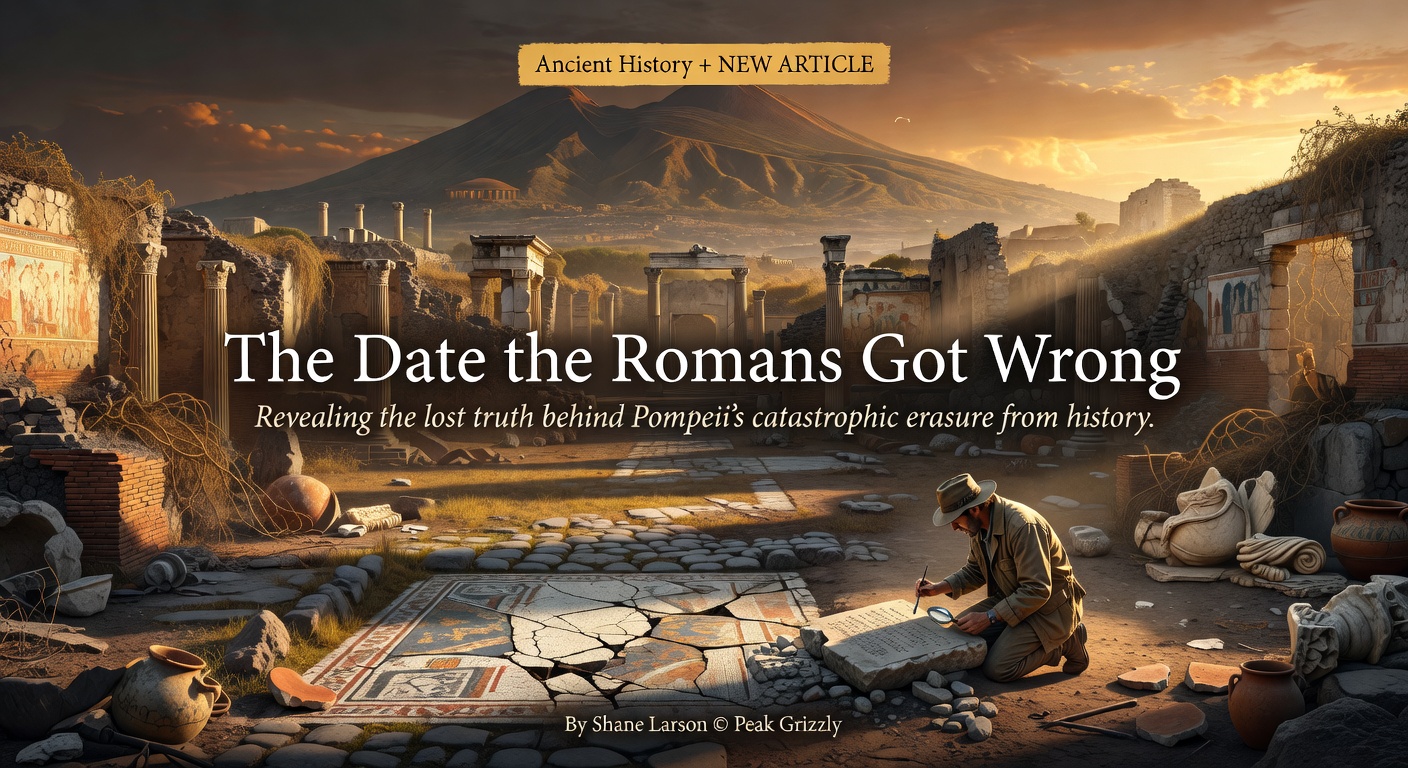
The Date the Romans Got Wrong
April 30, 2026 · 9 min read
A companion post to Pompeii: The Day Vesuvius Buried a Roman City
For most of two thousand years, everyone agreed on the date. Mount Vesuvius erupted on August 24, 79 CE. Pliny the Younger said so. Or rather, the surviving manuscripts of his letters to the historian Tacitus said so, and we trusted them, because they were the only contemporary account of the eruption we had. These letters, penned by a young man who witnessed the catastrophe from across the Bay of Naples, offered a rare firsthand glimpse into the chaos, describing the massive ash column and his uncle's heroic but fatal voyage. Generations of schoolchildren learned the date as a fixed point in history, memorizing it alongside other iconic events like the fall of Rome or the birth of Christ. Tour guides at Pompeii recited it with the confidence of tradition, weaving it into tales of daily life in the ancient city, while documentaries opened with dramatic reenactments, using it to anchor their narratives. It was one of the small handful of dates from antiquity that almost everybody knew, a testament to how a single piece of ancient testimony could shape our collective understanding of the past.
Then, in the autumn of 2018, a team of archaeologists working in a section of Pompeii called the House of the Garden — a property that had been unfinished and partly under restoration when the eruption hit — pulled away a layer of plaster from a wall in a back room. This house, located in the bustling Regio V district, was more than just a dwelling; it was a snapshot of mid-first-century Roman life, with its partially completed frescoes and tools left behind in the haste of evacuation. Underneath the plaster was a small piece of charcoal scrawl. Charcoal, being highly perishable, survives in ancient deposits only under exceptional conditions, such as rapid burial that shields it from oxygen and moisture, which in this case meant the thick layer of volcanic ash acting as a natural preservative. This particular line had survived because it had been laid down on fresh plaster, perhaps by a worker or resident jotting a quick note, and then almost immediately the plaster had been buried by ash and sealed for nearly two thousand years, preserving it as a fragile time capsule.
The graffito read: XVI K NOV. In the Roman calendar shorthand, that meant the sixteenth day before the Kalends of November — counted inclusively, in the Roman way, which involved backward counting from key dates like the Kalends (the first of the month) — which works out to October 17. And it was dated within weeks of the eruption itself, likely inscribed by someone aware of the impending seasonal changes or routine events. The story made international news. The director of the Pompeii Archaeological Park, Massimo Osanna, announced the find at a press conference, highlighting how such discoveries challenge long-held assumptions and keep the site relevant in modern scholarship. Within a few weeks, the question of whether the eruption had really happened in August had moved from a fringe scholarly debate to the front page of the Italian papers, sparking conversations in academic circles and popular media alike. A correction nearly two thousand years overdue was suddenly making the rounds, reminding us that history is not static but evolves with each new uncover.
The interesting thing is that the correction had been coming for a while. Archaeologists working at Pompeii had been building a case for an autumn date for decades, piecing together clues from the ground up in a field where patience and cross-verification are key. The evidence was mostly material, drawn from the everyday artifacts that make Pompeii such a vivid archaeological treasure. The carbonized food remains in the city's pantries included pomegranates and walnuts, both of which ripen in October in the Mediterranean climate, not the height of summer when figs and grapes would dominate; for instance, walnuts require cooler nights to develop their full flavor, pointing to the seasonal shift. The dolia — the great storage jars — in several wineries had been sealed for the must, the freshly pressed grape juice that was fermented into wine, the way they would be just after the autumn vintage, not weeks before it, as vintners prepared for the winter storage of the previous year's reserves. Some of the victims of the surges, when their casts were studied, were wearing thicker wool clothing than you would expect for a Mediterranean August, such as tunics and cloaks made from heavy fabrics typically donned to ward off the chill of fall evenings, suggesting they were bracing for cooler weather rather than the sweltering heat. Charcoal braziers were in use in several houses, implying that residents were already lighting fires for warmth, a practice more common in October when temperatures drop and the days shorten, though this could vary by microclimate in the region. None of these clues was decisive on its own, as environmental factors or individual preferences might skew interpretations, but together, they told a story, forming a cumulative argument that aligned with other seasonal indicators like the state of gardens and markets.
Pompeii
The literary evidence was harder to dismiss. The Younger Pliny's letters had been copied and recopied through the medieval manuscript tradition, and the date in the surviving copies was consistent, serving as a cornerstone of historical records. But manuscript transmission is imperfect, prone to errors as scribes worked by candlelight, often abbreviating Roman numerals like "VIII Kal. Sept." which could easily be miscopied as "XVI Kal. Nov." due to faded ink or visual similarities. Words drift, and numbers especially — Roman numerals, abbreviated with bars over them to denote thousands — are exactly the sort of thing that scribes get wrong, as seen in other ancient texts where dates shifted across versions. There were a few medieval witnesses with slightly different dates, October dates among them, perhaps reflecting earlier, more accurate copies that had been altered over time. Most editors had treated those as scribal errors, dismissing them as anomalies in a chain of transmission that favored the majority, but after 2018, they began to look like the surviving traces of the original, prompting a reevaluation of how we handle textual variants in historical sources.
What does the corrected date change? More than you might think. It changes our reconstruction of the wind patterns on the day of the eruption — for example, October winds in the Bay of Naples often blow from the northwest, carrying ash toward different towns like Herculaneum compared to the southeasterly August breezes that might have spared certain areas, altering which communities faced the brunt of the fallout. It changes our reading of the agricultural disaster; the 79 CE eruption, falling just after the harvest when granaries were full, would have destroyed the year's stored crops of grain and produce, not merely the year's standing fields of ripening wheat and olives, potentially leading to a more prolonged famine across the region. It changes the political timing — the autumn was the season when the Roman Senate had recessed and the imperial court was traveling, as emperors often moved to cooler retreats, which affects how quickly the news reached Rome and how the imperial response was organized; for instance, Titus, the new emperor (he had succeeded Vespasian only two months earlier, amid his own consolidation of power), made his first visit to the disaster zone almost immediately, a move that in October would have required navigating rainy weather and rougher seas, making the speed of his response more impressive and highlighting his hands-on leadership style. And it changes how we read the most famous lines in the Pliny correspondence. The Younger Pliny describes the column rising over the bay and his uncle, the great encyclopedist Pliny the Elder, ordering the warships out from Misenum, a naval base buzzing with activity. The light fell across the bay in a particular way — Pliny says the cloud's underside was lit by the burning city beneath it, which suggests the eruption began in afternoon light and continued past sunset into a long, lurid evening; in October, with the sun lower on the horizon and days shorter by about an hour compared to August, the contrast between the fiery glow and the encroaching darkness would have been more pronounced, adding a layer of dramatic intensity to the scene. Small adjustments to our visualization, but real ones that enrich our mental picture of the event.
This kind of correction is the rule, not the exception, in archaeology, a discipline where each layer uncovered can upend previous certainties, much like how earlier excavations at sites like Troy or the pyramids have revised timelines based on new evidence. The site of Pompeii has never stopped giving us new evidence, with its preserved streets and buildings offering a continuous dialogue with the past. The 2018 graffito is one of dozens of finds from the recent excavations at Regio V — a corner of the city that had been left unexcavated for decades and was reopened under Osanna's directorship, partly due to advances in preservation techniques and funding from international partnerships. In the same region, archaeologists found a fully-painted snack bar (a thermopolium) with the fresco of a rooster and a duck still vivid above the serving counter, depicting everyday scenes that reveal the culinary habits of Romans, such as the preparation of street food like stews and wine. They found a slave bedroom in the villa at Civita Giuliana, with the indentations of three iron-strapped beds preserved in the ash, alongside tools and personal items that hint at the restricted lives of those who labored there, underscoring the social hierarchies of the era. They found a chariot, four wheels and a chassis, parade-grade, in another part of the same villa, complete with decorative elements that suggest it was used for festivals or processions, adding to our understanding of elite displays of wealth. They found the Black Room, a dining room with mythological frescoes on jet-black walls, where the dark background enhanced the colors of scenes from Greek myths, indicating a sophisticated aesthetic that influenced later Roman art. Each find shifts the picture by a small increment, not overturning everything but refining it, much as a historian might cross-reference ancient texts with physical artifacts to correct biases.
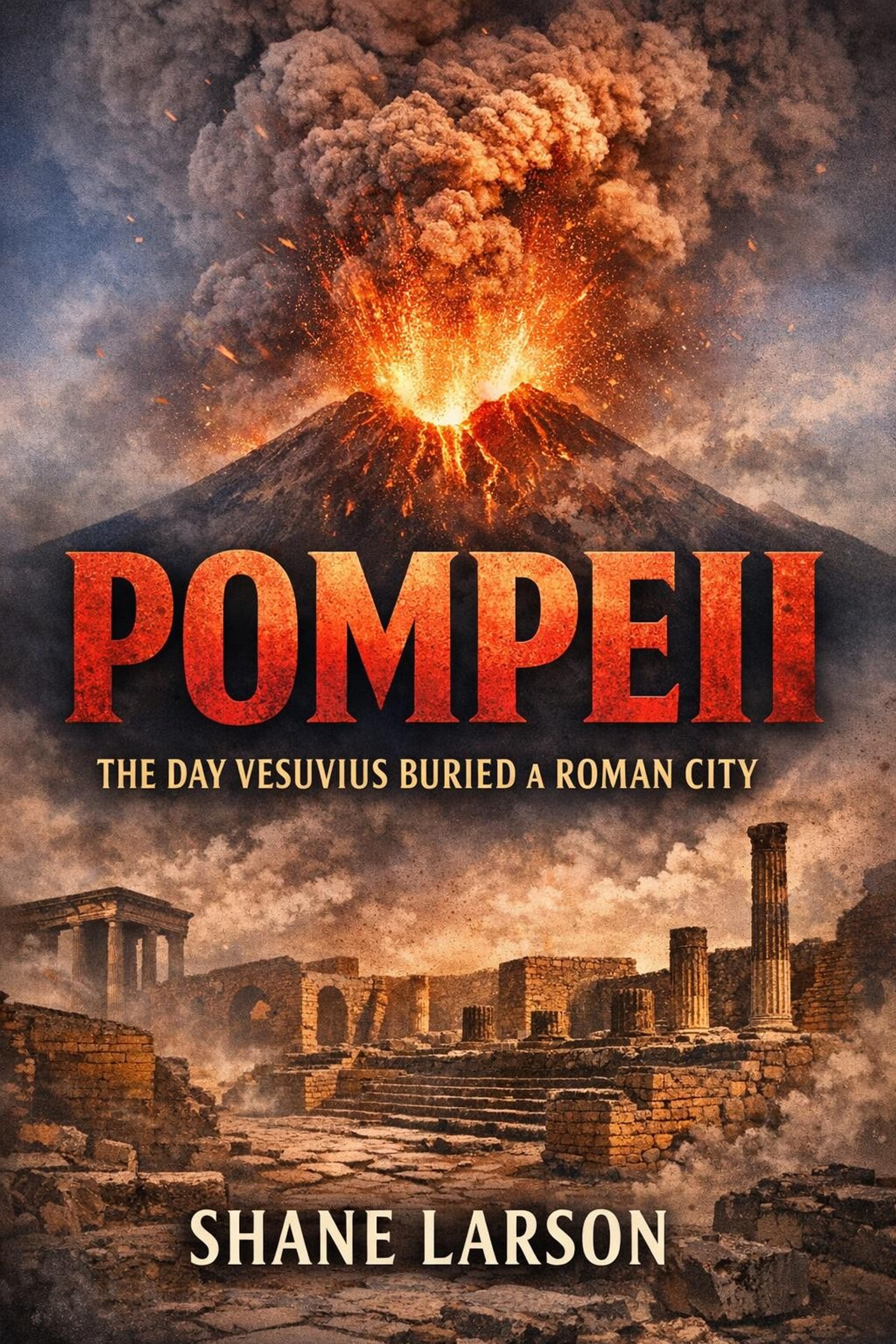
The new book, Pompeii: The Day Vesuvius Buried a Roman City, opens with the date question because it is the cleanest available illustration of how the past is recovered. We do not get the past in one piece; instead, it emerges gradually, much like the painstaking process of excavating Pompeii itself, where layers of ash must be carefully removed to reveal underlying truths. We get it in fragments, over generations, with corrections that arrive without warning, on a piece of charcoal under a layer of plaster, two thousand years after they were written, each one building a more accurate mosaic of history.
The book is out now on Kindle. It tells the full story — the bay before the eruption, the city as a living Roman town, the eruption itself in hour-by-hour detail, the deaths of Pliny the Elder and the unnamed thousands, and the seventeen-century rediscovery that gave the world back its clearest single window into the Roman past.
Pompeii
New posts and releases, straight to your inbox. No spam, unsubscribe anytime.