The Farmer Who Accidentally Found the Founder of China
April 30, 2026 · 9 min read
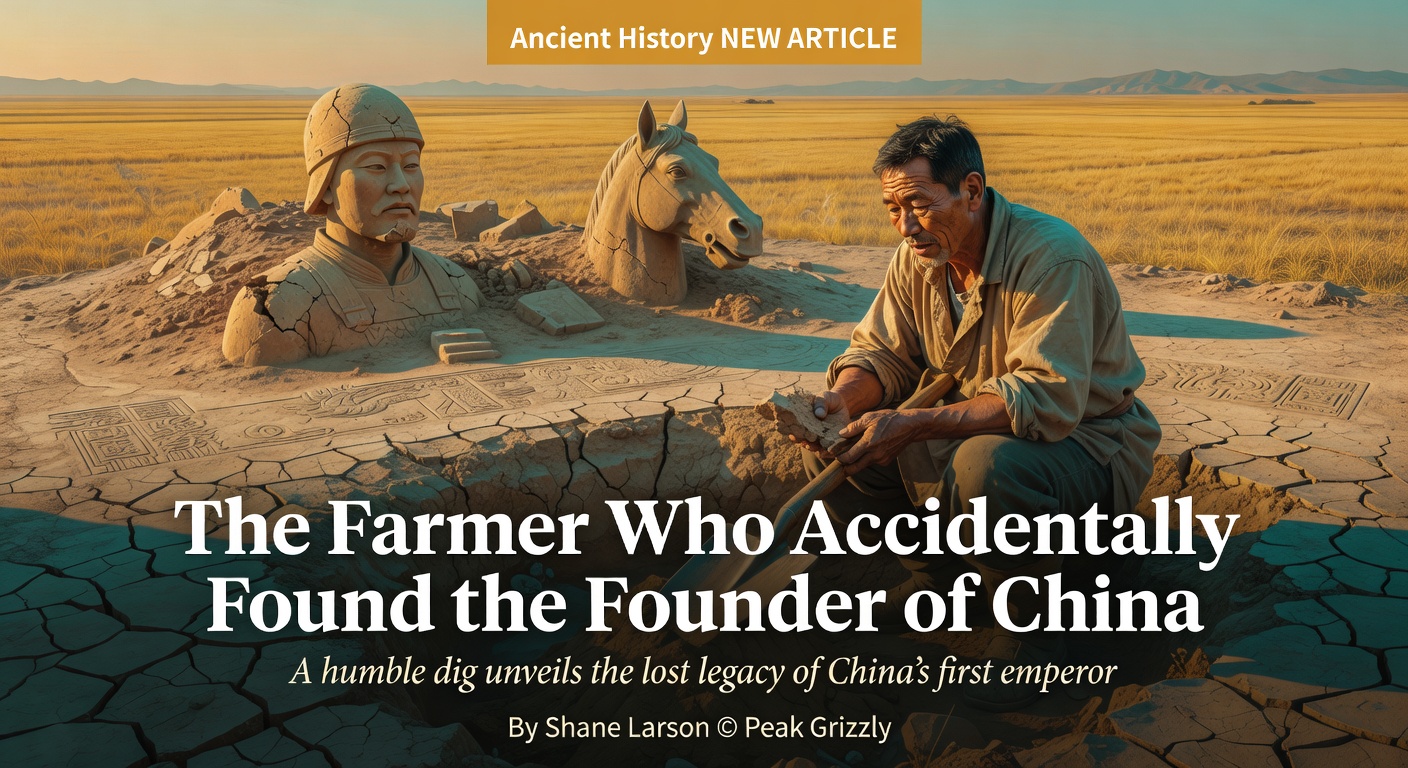
In March of 1974, a man named Yang Zhifa was digging a well outside the city of Xi'an, in central China.
The summer rains had failed. The water table had dropped. The village's irrigation needs were not being met. Yang and three of his brothers had been hired by the local commune to dig a new well in a dry field at the edge of the village. They were down about four meters, working through hard yellow loess soil, when Yang's shovel struck something that was not a stone.
He pulled up a fragment of fired terracotta. It was a piece of a head. A human head, life-size, with one staring eye and part of a hairline. Yang and his brothers were not antiquarians. They had grown up among the Buddhist shrines and old village graves that dot Shaanxi province. They assumed they had broken into a temple ruin. They tossed the fragment in a cart with the rubble and kept digging. By that evening they had pulled up several more pieces — an arm, part of a torso, the back of a helmet — and stacked them in a corner of the courtyard.
What Yang Zhifa did not know — and could not have known — was that he had just rediscovered the buried army of the First Emperor of China.
What Was Underneath
It took weeks for the local cultural-relics bureau to take Yang's find seriously. By the time archaeologists arrived in Lintong county in the summer of 1974, several more terracotta fragments had emerged from the well-digging. A test pit was dug. Then a larger pit. Then a much larger pit. By the end of that summer, the archaeologists understood that they were looking at something without precedent in the history of the discipline. Beneath that field, in three pits arranged in battle formation, stood roughly eight thousand life-size clay soldiers, horses, and chariots — the buried guardians of a tomb that had been sealed for two thousand two hundred years.
The pits, when they were finally fully mapped, would be designated Pit 1, Pit 2, and Pit 3. Pit 1 alone, the largest of them, contained around six thousand infantry figures, arranged in eleven corridor-rows, facing east in battle order. Pit 2 was smaller and held the cavalry, the kneeling crossbowmen, and the chariot units. Pit 3 was a small command headquarters with sixty-eight figures, including officers and a chariot. Every face was different. Every uniform showed gradations of rank. Every weapon — bronze spears, halberds, crossbows, daggers — was real. Some of the bronze weapons, when first uncovered, were still sharp.
Beyond the pits, eastward, lay a great earthen mound. It is approximately fifty-one meters high today, originally taller, and covers nearly seventy-six hectares. Beneath that mound, no archaeologist has ever excavated. According to ancient sources, the chamber inside contains rivers and seas of liquid mercury simulating the great waterways of China; a ceiling of pearls representing the constellations; models of palaces and pavilions; automatic crossbows set to fire on intruders; and the body of the man who, in 221 BCE, had unified the warring kingdoms of China and declared himself Shi Huangdi — First August Emperor.
Modern soil chemistry has confirmed at least part of this. Sampling of the soil above the central mound has detected mercury concentrations approximately one hundred times higher than the surrounding earth — consistent with significant mercury inside the chamber. Ground-penetrating surveys have confirmed an enormous underground structure. The descriptions in the ancient sources are not myth. They are, at least in part, fact.
The chamber has not been opened. It probably will not be opened for some time. The reasons are practical (the warriors' painted lacquer began flaking off within minutes of exposure to air; modern preservation techniques are still not adequate), political (the symbolic founder of China is not a casual archaeological subject), and ethical (modern archaeology has moved away from excavating well-preserved sites unless they are under immediate threat). The mound sits today as it sat then. Tourists climb it. Buses run from Xi'an. The chamber, whatever it contains, waits.
Who He Was
The man buried inside was named Ying Zheng. He was born in 259 BCE, the son of a minor Qin prince held hostage in the rival kingdom of Zhao, where his mother was the consort of the merchant who had engineered his father's path to the throne. He inherited the throne of Qin at the age of thirteen. By thirty-eight, he had conquered all six rival states.
What he did next is the part that interests me. He didn't just rule. He invented.
He standardized the Chinese script — the regional variants of the seven warring states had drifted into mutually unintelligible forms over the previous two centuries. He standardized the currency, the weights and measures, the gauges of cart axles. (The cart-axle decree was practical: the dirt roads of the empire had ruts so deep that wagons had to fit them or they could not travel.) He divided the empire into thirty-six commanderies, each governed by an imperial appointee rather than a hereditary lord. He linked the existing northern walls — built by the previous warring kingdoms separately, against each other and against the Xiongnu nomads — into a single continuous defensive line. The Great Wall as we know it today is medieval Ming construction; what Qin Shi Huang built was the ancestor.
He also did things that were not, by any measure, admirable. He ordered the burning of the books of the old schools — the Confucians, the Mohists, the Daoists, anyone whose texts he viewed as competing with state ideology. (What was actually destroyed was less than the surviving sources claim, but it was substantial.) According to the hostile tradition, he ordered the burying alive of four hundred and sixty Confucian scholars; the truth here is contested but the broad direction is correct. He built his tomb with a reported seven hundred thousand conscript laborers, many of whom died on the project. He launched massive military campaigns into what is now Vietnam to expand the empire south. He demanded total mobilization of the population for state purposes.
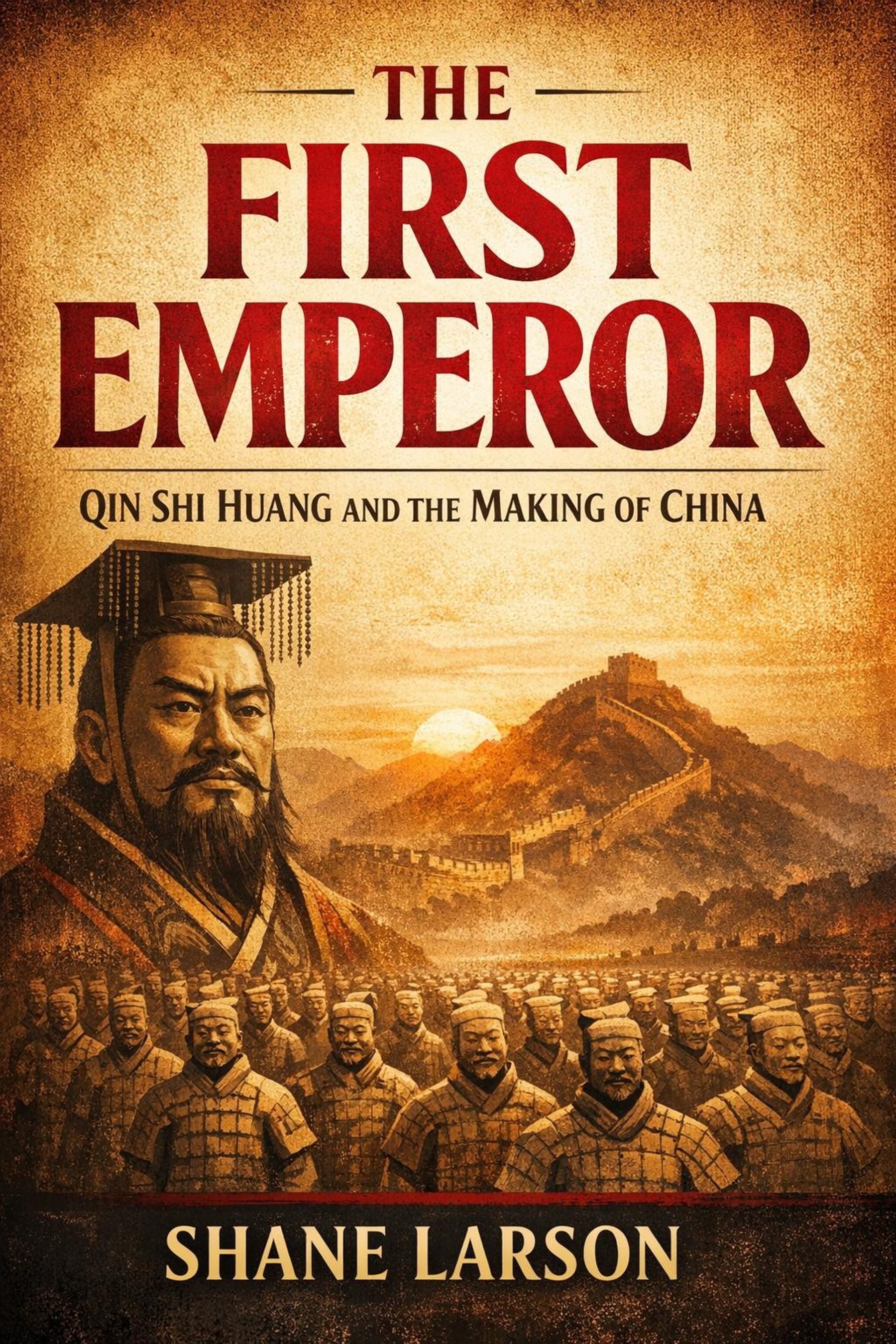
The First Emperor
He also became obsessed with not dying. He sent expeditions east across the sea in search of the islands of the immortals. He drank elixirs compounded from cinnabar — that is, mercury — believing they would extend his life. The consensus of modern scholarship is that the elixirs probably killed him. He died on the road in 210 BCE during an inspection tour.
His chief minister, Li Si, and his chief eunuch, Zhao Gao, concealed the death so completely that the imperial procession returned to the capital with carts of rotting fish positioned next to the imperial carriage to mask the smell of the corpse. They forged a succession decree. The crown prince Fusu, who had been exiled to the northern frontier for opposing the book burnings, was ordered to commit suicide. The younger son Huhai was elevated as Second Emperor. Within two years, Li Si himself had been executed by the Five Punishments. Within four years of the First Emperor's death, the dynasty he had built to last ten thousand generations had collapsed in civil war. The Han who succeeded him kept almost everything he had built and spent the next four hundred years insisting that he had been a monster.
The Pattern
I have come to think, after writing the book, that Qin Shi Huang's reign is one of the cleanest case studies in ancient history of a recurring pattern: the empire that hates its founder while keeping his machinery.
The Han denounced the Qin. They restored some hereditary fiefdoms. They permitted the resurgence of the Confucian schools. They wrote histories that condemned the First Emperor as a tyrant. And then, having denounced him for four hundred years, they kept his administrative system, his road network, his standardized currency, his commandery and county structure, and his core principle of imperial appointment. They had no choice. There was nothing else that worked at that scale.
The same pattern applies elsewhere. The Roman Empire denounced Caesar's tyranny while keeping the principate that grew out of it. The Soviet Union denounced Stalin while keeping his industrial base. The American Republic was full of admiration for the Republic of Rome and very careful to copy as little as possible of how Rome actually worked, which is also a kind of denunciation-while-keeping. Every successor regime needs to delegitimize its predecessor in order to legitimize itself, and every successor regime needs the predecessor's machinery in order to govern. The denunciation and the inheritance happen simultaneously, by the same people, in the same documents.
This is one of the reasons I think Qin Shi Huang is worth writing about now. Not because he is admirable. Not because he is monstrous. Both readings have been tried, by smart people, and both miss what is structurally interesting about the reign. The interesting thing is the pattern: how the founders of durable systems become the cautionary tyrants of those systems, and how the system absorbs their methods while disowning their names.
The Han did this. The Tang did this. The Ming did this. The People's Republic, in important structural respects, has done this. The Terracotta Army that Yang Zhifa accidentally rediscovered was guarding a tomb whose occupant had been the official enemy of orthodox Chinese political memory for two thousand years. He still is, depending on whom you ask. He also still is the founder of the system that asks.
Why This Book
There is, frankly, no current narrative-driven, accessible book about Qin Shi Huang aimed at general readers on Kindle. The academic monographs are expensive and specialized. The popular treatments are either dated or focused narrowly on the Terracotta Army as a tourist attraction. Readers who wanted the full story, told as a coherent narrative, with the source problems handled honestly — Sima Qian wrote his account a century after the events, under the dynasty that had defined itself by overthrowing the Qin — did not have a book to point to.
I wanted to write that book. I wanted to write it with the same narrative drive that defines the best contemporary popular history — Mary Beard, Tom Holland, Adrian Goldsworthy, Jonathan Clements. I wanted to take the source problems seriously. I wanted to follow the story all the way from the Warring States background through the conquests, the standardization decrees, the tomb construction, the cover-up, the Han reaction, and the long afterlife — through to the 1974 discovery and the unopened mound that is still there today.
The book is called The First Emperor: Qin Shi Huang and the Making of China. It is available now on Amazon Kindle. If you have read Sargon: Rise of Akkad or Ramesses the Great, you already know the kind of book this is. If you have not, this is a reasonable place to start — and it opens up the rest of the catalog if you find yourself wanting more.
Yang Zhifa is still alive, by the way. He is in his eighties. He works occasionally at the museum that grew up around his discovery. The Chinese state pays him a pension. Foreign tourists ask him to autograph copies of guidebooks; he obliges, when he feels like it. He is, in a small and ironic way, the most consequential well-digger in the history of archaeology.
The chamber is still unopened.
The First Emperor: Qin Shi Huang and the Making of China is available now on Amazon Kindle. [Link]
Shane Larson is the author of more than a dozen books on ancient history, including Sargon: Rise of Akkad, Ramesses the Great, and Boudica. He lives in Alaska.
The First Emperor
New posts and releases, straight to your inbox. No spam, unsubscribe anytime.