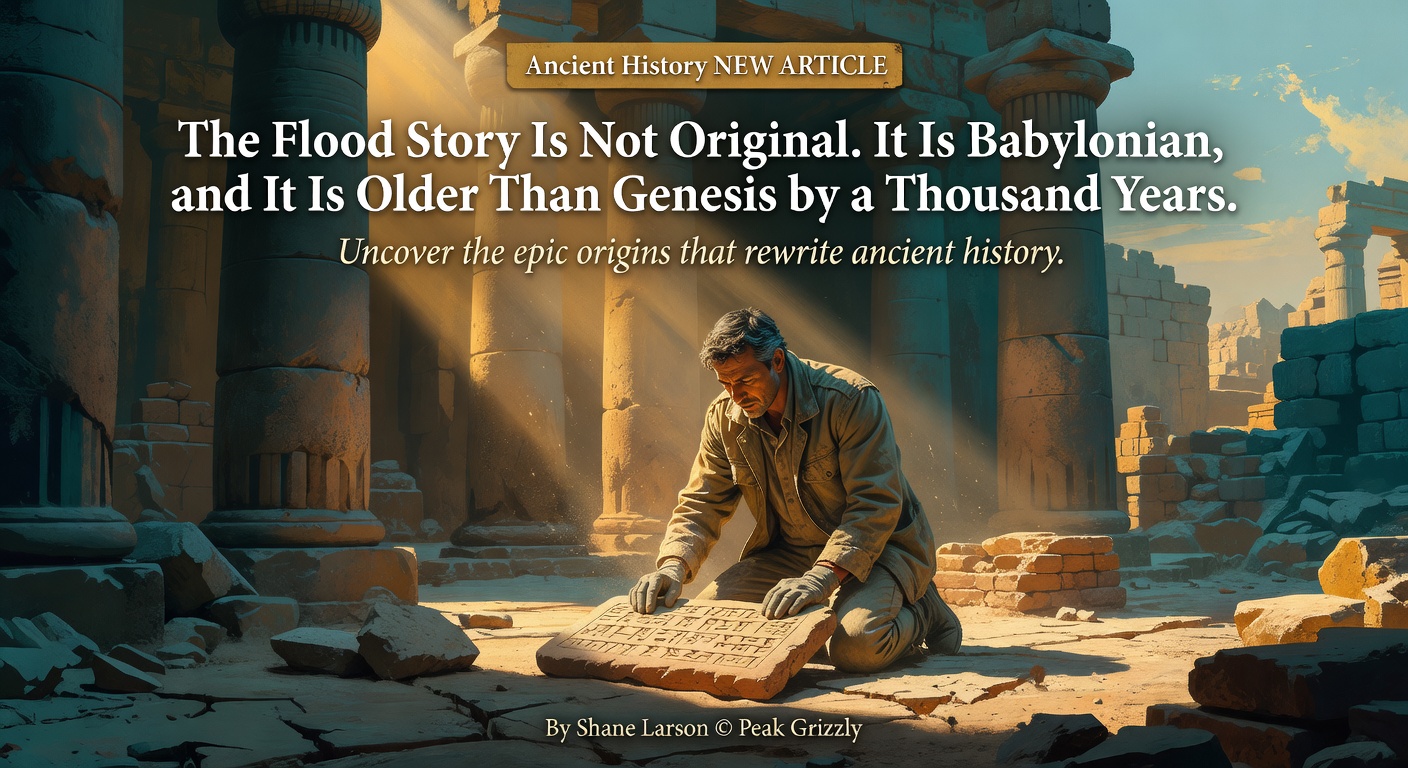
The Flood Story Is Not Original. It Is Babylonian, and It Is Older Than Genesis by a Thousand Years.
May 10, 2026 · 13 min read
On the afternoon of December 3, 1872, a thirty-two-year-old engraver named George Smith stood up in a hall in London and read aloud from a fragment of clay. The hall belonged to the Society of Biblical Archaeology, an organization dedicated to exploring the ancient roots of biblical texts through rigorous excavation and translation, which had become a hub for scholars and dignitaries unraveling the mysteries of the Near East. The audience included the Prime Minister of Great Britain, William Gladstone, whose presence underscored the event's political and cultural weight in an era when Britain's imperial reach was reshaping historical knowledge. The fragment in Smith's hand had been pulled out of a ruin mound in northern Iraq nearly twenty years earlier and forgotten in the basement of the British Museum, where it lay amid thousands of other artifacts from the Assyrian capital of Nineveh, waiting for someone with Smith's keen eye and self-taught expertise in cuneiform to bring it to light.
What Smith read aloud was a story about a great flood — a tale of divine warning, survival, and renewal that echoed the familiar rhythms of Genesis but with striking differences in detail and tone. It spoke of a man warned by a god, a boat loaded with animals, birds sent out to find dry land, and the survival of humanity on the slopes of a mountain, all woven into a narrative that felt both ancient and alive. This account wasn't just another myth; it was a window into how early civilizations grappled with the chaos of natural disasters, using storytelling to impose order on the unpredictable floods that regularly devastated their river valleys. It was not Genesis. It was older than Genesis by more than a thousand years, predating the Hebrew text by an era when Mesopotamia was a cradle of early writing systems, including cuneiform, which allowed these stories to be inscribed and preserved on clay.
That afternoon was the day the modern world found out that the Bible's flood narrative was not original, challenging long-held assumptions about the uniqueness of scriptural stories in a time when religious texts were often seen as divinely inspired and isolated from broader cultural influences. The story Smith read came from a clay tablet that had been written down in Babylon around 1200 BCE, drawing on older Akkadian versions from about 1800 BCE, which in turn built upon Sumerian flood traditions dating back to approximately 2100 BCE, all stemming from an oral tradition that likely stretched back even further into prehistory. These layers of transmission highlight how stories evolved across generations, with scribes adapting them to reflect changing societal needs, such as explaining the gods' capriciousness or the fragility of human existence. The Hebrew scribes who composed Genesis 6–9 were not inventing out of whole cloth; they were drawing on a flood story that had circulated across the ancient Near East for more than a thousand years before they put pen to scroll, adapting it within their own cultural and religious framework.
This was not, in 1872, a comfortable thing for Victorian England to find out, as it threatened to erode the era's firm belief in the Bible's historical primacy amid growing scientific scrutiny of religious texts. Smith's reading was front-page news in The Daily Telegraph the next morning, sparking widespread debate that rippled through society, from academic circles to church pulpits. Within a few years, it had touched off the long German "Babel und Bibel" controversy, where scholars like Friedrich Delitzsch argued that much of the Old Testament borrowed from Babylonian sources, leading to public sermons, academic lectures, legal battles over blasphemy, and even diplomatic complaints to the Kaiser that highlighted the tension between emerging archaeology and established faith. The argument has long since been resolved in scholarly circles, with mainstream biblical studies accepting for over a century that the Genesis flood narrative draws on the older Mesopotamian tradition, supported by evidence from numerous excavated tablets and comparative linguistic analysis. But the discovery still has the power to surprise people who have not heard of it, which is most people, especially in an age where digital access to ancient texts remains limited and misconceptions about biblical originality persist.
So what did the original flood story actually say?
The Babylonian Original
Tablet XI of the Standard Babylonian Version of the Epic of Gilgamesh is narrated in the first person by a man named Utnapishtim — the Babylonian Noah, a figure whose name means "he who found life," symbolizing humanity's enduring quest for immortality amid mortality. He is the only human being to whom the gods ever granted eternal life, and he lives at the end of the earth, where the rivers meet the sea, in a remote and mythical realm that served as a boundary between the civilized world and the unknown. Gilgamesh, the epic's hero and a historical king of Uruk around 2700 BCE whose legends were embellished over centuries, is broken by the death of his friend Enkidu and has crossed the perilous Waters of Death to find him, driven by a universal human desire to conquer death itself, making this encounter a pivotal moment in one of the world's oldest literary works.
Utnapishtim's story goes like this. He lived in the city of Shuruppak, on the Euphrates, a bustling Sumerian settlement known for its trade and vulnerability to the river's annual floods, which could destroy crops and communities in a single night. The gods, led by Enlil, the storm god and enforcer of divine order, decided to wipe out humanity in a great flood, a decision rooted in the accumulated frustrations of immortal beings dealing with mortal chaos. (In the older Atrahasis epic that fed into Tablet XI, the reason is that human beings had become too noisy and were disturbing the gods' sleep — a wonderfully un-pious motive that humanizes the deities as flawed entities, much like the Greek gods, and underscores ancient Mesopotamians' observations of overpopulation and environmental strain; the Hebrew scribes, perhaps seeking a more moral framework, did not retain this element.) Ea, the god of fresh water, wisdom, and craftsmanship, was a friend to humans, often depicted as a benevolent trickster figure who shaped the world from primordial chaos. He could not openly defy the divine assembly's decision, so he whispered the warning through a reed wall, a clever method that allowed him to aid humanity covertly, reflecting the theme of divine subterfuge common in Mesopotamian myths.
Utnapishtim built a boat, a massive structure whose design Tablet XI describes in meticulous detail, emphasizing the practical knowledge of ancient shipbuilders: a cube measuring 200 cubits on each side, seven decks high, with reinforced walls to withstand the deluge, showcasing the era's advanced engineering in a flood-prone region. (Genesis, by contrast, opts for a more practical-minded rectangular vessel, perhaps adapted for a different audience familiar with seafaring in the Mediterranean.) Utnapishtim loaded the boat with his family, his craftsmen — including skilled workers essential for rebuilding society — and "all the animals of the field" of every kind, a phrase that likely encompassed domesticated livestock and wild creatures, symbolizing the preservation of biodiversity in a world reset by catastrophe. The storm came — six days and seven nights of howling wind and torrential rain that turned the landscape into a churning abyss, evoking the real floods that periodically submerged Mesopotamian plains. The gods themselves cowered in heaven, weeping at what they had done, with even Ishtar, the goddess of love and war, crying out like a woman in childbirth, her lament capturing the emotional toll of divine regret and the moral complexities of creation myths across cultures. When the rain stopped, the boat had grounded on the slopes of Mount Nimush, a real peak in the Zagros Mountains that anchored the story in the geography of the region. Utnapishtim sent out birds to find dry land — first a dove that returned, indicating no safe haven; then a swallow that also returned, showing the waters still dominated; and finally a raven that did not return, its absence signaling the return of life and the cycle of renewal.
After emerging, Utnapishtim made a sacrifice, releasing the aroma of roasted meat and incense that drew the gods like flies to a feast, highlighting the reciprocal relationship between humans and deities in ancient religion, where offerings sustained the divine. Enlil was furious that anyone had survived, his anger stemming from the breach of the flood's intent, but Ea defended his action, rebuking Enlil for the flood's disproportionate violence and advocating for mercy, a counterpoint that introduces themes of justice and balance in the epic. In a kind of compromise, Enlil granted Utnapishtim and his wife eternal life, settling them at the mouth of the rivers, where they remained as eternal guardians of wisdom, echoing other ancient tales of immortal figures like the Greek Titans. That is the Babylonian flood, a narrative that was written down in some form by 1800 BCE and circulated widely, with versions adapted into Akkadian, Sumerian, and Hittite languages, as evidenced by tablets unearthed in sites like Babylon, Ugarit, Megiddo, and Hattusa, illustrating how trade routes facilitated the spread of stories across empires.
Gilgamesh
What the Hebrew Scribes Did with It
The parallels between the Babylonian and Genesis flood stories are dense and specific, reflecting a shared cultural heritage in the ancient Near East where scribes exchanged ideas along caravan routes and diplomatic channels:
- Both begin with divine displeasure with humanity, portraying the gods or God as responders to human failings, a motif that appears in other myths like the Greek tale of Deucalion's flood, where Zeus punishes wickedness.
- Both involve a chosen man warned in advance by a deity, emphasizing the theme of divine favor and human agency in the face of doom.
- Both involve a great boat loaded with animals, a practical element that symbolizes the preservation of life and order from chaos.
- Both involve sending out birds to find dry land, a methodical test of survival that draws on observable bird behavior in flood aftermaths.
- Both end with a sacrifice and a kind of covenant, forging a new relationship between the divine and human worlds.
The differences are also specific, and they are theologically interesting, as they reveal how the Hebrew scribes selectively reshaped the story to align with their monotheistic worldview. The Babylonian version is polytheistic, depicting multiple gods in conflict, with the flood as the result of one faction's decision and survival as the result of another's pity, a dynamic that mirrors the political intrigue of Mesopotamian city-states; Genesis, however, collapses this into a single God, who is internally divided in his motivations — grieving yet resolute — but unified in agency, streamlining the narrative for a theology centered on one supreme being. The Babylonian Utnapishtim is a lucky man saved by the favor of a friendly god, his survival more a matter of chance and alliance; Genesis's Noah is presented as righteous in a world that has become wicked, his story infused with moral judgment, as if drawing on earlier Hebrew legal traditions to make survival a reward for piety. The Babylonian flood lasts just six days and seven nights, a duration that might reflect the actual flooding patterns of the Tigris and Euphrates; the Genesis flood extends to forty days and forty nights, a number rich with symbolic meaning in Hebrew literature, representing completeness or trial. The Babylonian gods feel guilt and gather for offerings, exposing their vulnerabilities; the God of Genesis establishes a rainbow as a covenant, a promise of restraint that underscores themes of mercy and eternal order, countering any notion of divine caprice.
These differences are how the Hebrew scribes transformed an inherited Mesopotamian narrative into a story that fit their own theology, a process evident in other ancient adaptations, such as how Egyptian myths influenced Israelite cosmology. They did not delete it or deny it; they reshaped it, preserving the core structure while infusing it with new purpose, much like how later Christian interpreters would adapt Old Testament stories for their own contexts. This is, on reflection, what nearly all the foundational stories of every major religious tradition do, as seen in the evolution of Indian epics like the Mahabharata from older Vedic tales or the way Norse myths were rewritten in the Eddas; they are syntheses of older material, where the shape of the underlying story is preserved, but the meaning is rewritten to address contemporary spiritual needs. The Mesopotamian flood becomes the Hebrew covenant, turning a tale of divine whim into a testament of divine fidelity; the Sumerian descent of Inanna becomes the Greek descent of Demeter, each adaptation reflecting how cultures repurpose narratives to explore themes of loss and renewal; the cult of Mithras becomes part of Roman Christianity, blending mystery religions into a new faith.
Why It Matters
The recognition that Genesis draws on older Mesopotamian sources does not, in any responsible reading, undermine the Bible, as it simply places these texts within the vibrant tapestry of ancient literary exchange, much like how scholars trace the influences of African oral traditions on American blues music. It situates the Bible as a product of its time, where the Hebrew scribes were not transcribing dictation from heaven but engaging in a creative process common to all great literary traditions: working with the material they inherited, transforming it for their own purposes, and producing something whose meaning transcends its origins, as evidenced by comparative studies of texts like the Egyptian Book of the Dead. The Iliad, for instance, draws on a thousand years of Bronze Age oral tradition, incorporating historical battles and heroic ideals; the Aeneid draws on the Iliad, reworking Trojan themes for Roman identity; the Divine Comedy draws on Virgil, blending classical and Christian elements; Paradise Lost draws on Genesis and the Aeneid, creating a epic of rebellion and redemption. Every great text descends from earlier ones, a pattern confirmed by archaeological finds like the Amarna letters, which show cross-cultural borrowing in the Near East. The Bible is no exception: Genesis 6–9 was a Hebrew theological reworking of a Mesopotamian flood tradition that the rest of the ancient Near East had been telling itself for at least a thousand years, adapting it to emphasize ethical monotheism over polytheistic chaos.
What the Babylonian flood story tells us, taken on its own terms, is what literature has always been for: making sense of catastrophe by providing a framework for reconciling divine will with human survival, a role it shares with other flood narratives like the Hindu story of Manu or the Australian Aboriginal Dreamtime floods, each rooted in real environmental threats. It asks why some live when most do not, probing questions of fate and justice through Utnapishtim's survival, and produces the language we use to think about it, such as the metaphor of the ark as a vessel of hope. The flood is one of the oldest narrative motifs in human storytelling because flood is one of the oldest catastrophes in agricultural civilization, as seen in the sedimentary layers of ancient Mesopotamian sites that reveal repeated inundations; this region was a flood-prone alluvial plain whose people, reliant on the Euphrates for irrigation, knew exactly what an unrestrained river could do to a year of grain, turning fertile fields into wastelands and inspiring stories that doubled as warnings and coping mechanisms. Their flood story was not abstract; it was a lived reality, encoded in rituals and texts to foster resilience.
The fact that we have it now is one of the more improbable transmissions in the history of literature, a chain of events preserved through human curiosity and accident. The Assyrian library that held the most complete copy, assembled by King Ashurbanipal in the 7th century BCE as a repository of knowledge, was burned in 612 BCE during the fall of Nineveh — and paradoxically preserved by the fire, which baked the unfired clay tablets into durable artifacts, a process that mirrors how volcanic ash preserved Pompeii. They sat in a ruin mound at Kuyunjik for two and a half millennia, buried under layers of earth that shielded them from erosion, before being unearthed in the 1850s by British excavators amid the colonial rush for antiquities. They sat in a London basement for another twenty years, overlooked in the vast collections of the British Museum, until George Smith, a self-taught engraver with a passion for ancient languages, pieced together the fragments like a detective solving a mystery. And then, on the afternoon of December 3, 1872, he revealed the story, bridging millennia of silence and connecting modern readers to their ancient past.
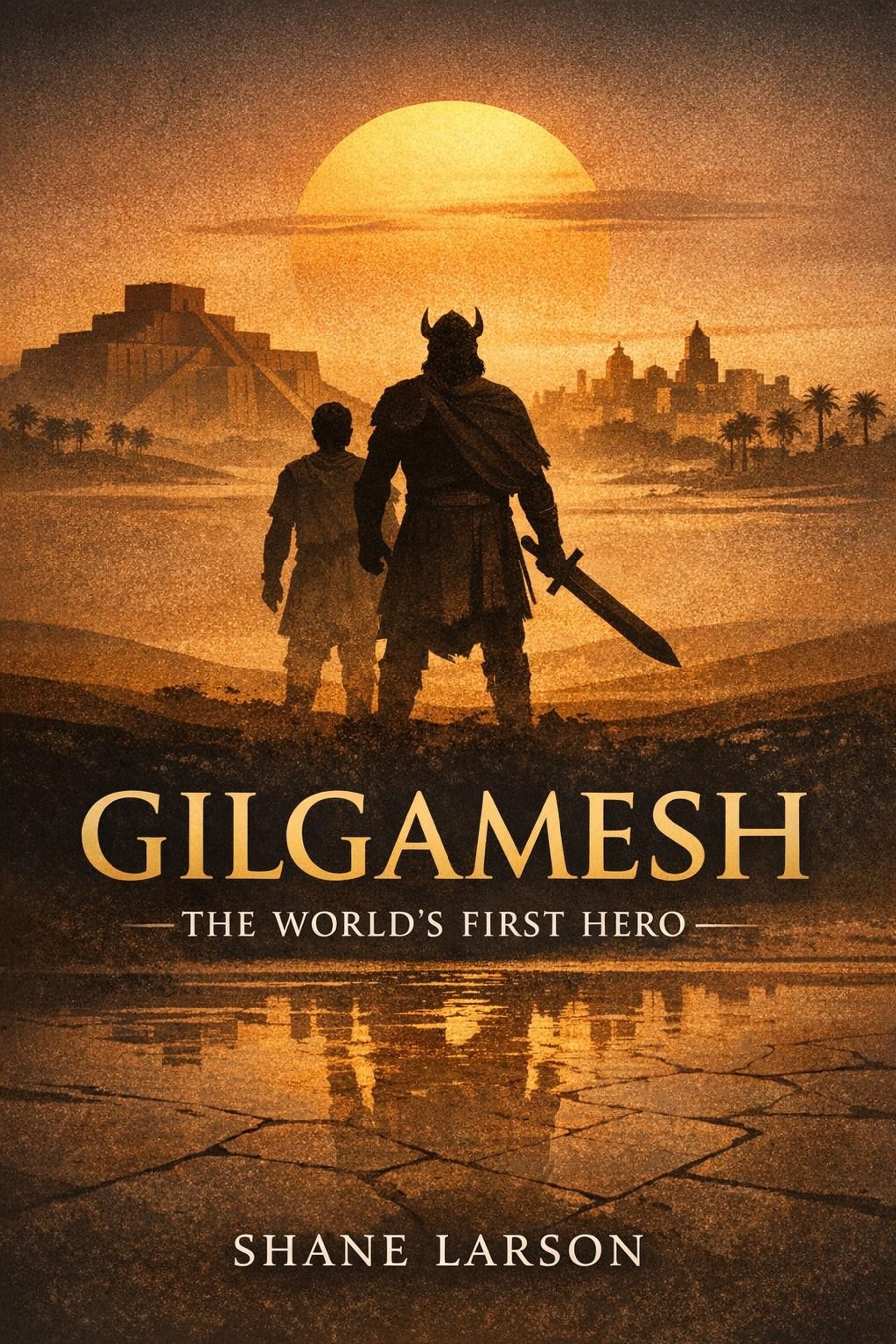
If you want to read it, Andrew George's 2003 Penguin edition is the place to go. If you want the broader context — the historical king, the literary epic, the dramatic recovery story, and the four-thousand-year accident of preservation that made all of this possible — that is the book I have just published.
Gilgamesh: The World's First Hero is available now on Amazon Kindle. The flood story is in chapter 11. The story of George Smith and the recovery is in chapter 13. The story of why a four-thousand-year-old poem still finds its readers is in all of them.
The walls of Uruk still stand. The tablets are in London. The story has come home.
Gilgamesh
New posts and releases, straight to your inbox. No spam, unsubscribe anytime.