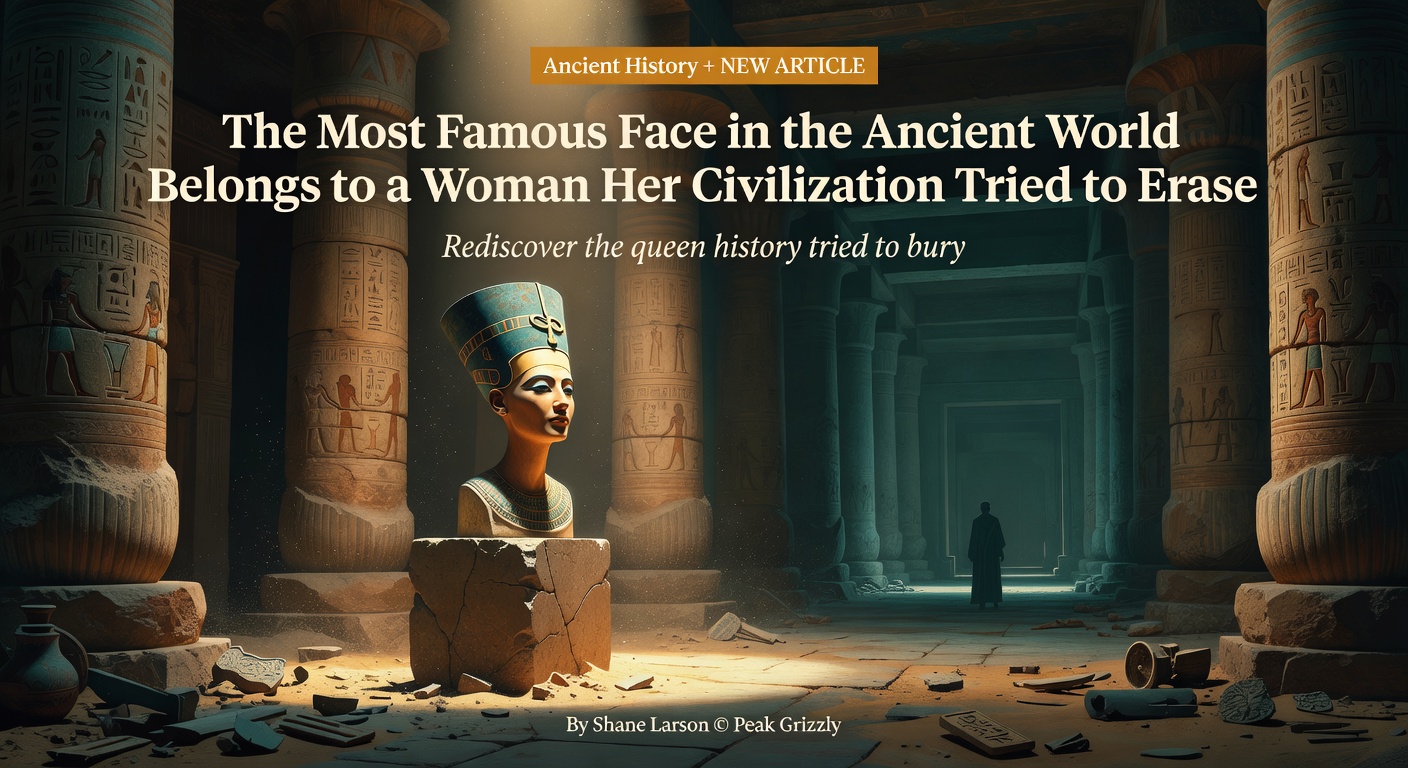
The Most Famous Face in the Ancient World Belongs to a Woman Her Civilization Tried to Erase
May 10, 2026 · 11 min read
The Most Famous Face in the Ancient World Belongs to a Woman Her Civilization Tried to Erase
Meta description: The Nefertiti bust is one of the most recognized images on earth. The woman it depicts was nearly erased from history. The story of how she came back.
Target keywords: nefertiti, ancient egypt history, amarna period
Suggested URL slug: nefertiti-most-famous-face-erased-history
The painted limestone sculpture of Nefertiti — about half a meter tall, sitting behind glass in a quiet room in Berlin's Neues Museum — is one of the most recognized objects in human history. It has been reproduced on book covers and postcards and stamps and museum gift-shop merchandise for almost exactly a century. It is the image most people picture when they think about ancient Egypt. It is more recognizable, in many parts of the world, than Tutankhamun's gold death mask or the Great Pyramid at Giza.
Almost everything most people think they know about the woman the bust depicts is wrong.
The conventional image is of a beautiful queen — a glamorous consort, standing decoratively beside her more famous husband Akhenaten, decoratively presiding over a court that was eccentric but ultimately marginal to Egyptian history. This conventional image is wrong in nearly every particular. The woman the bust depicts was a co-ruler at the center of the most radical religious revolution in pharaonic history. She helped found a new capital city in the desert. She presided over an artistic program that transformed Egyptian visual culture in a single generation. She accumulated political and religious authority unmatched by an Egyptian queen in living memory. There is now strong evidence — disputed but strong — that after her husband's death she ruled Egypt in her own right as pharaoh, under a name and a throne that her successors would later try, very hard, to scrub from the record.
Then she vanished. And the story of how she vanished, and how she came back, is one of the strangest accidents of historical preservation we have.
The Erasure
Her name was Nefertiti, which in Egyptian means "the beautiful one has come." She was the wife and co-ruler of the pharaoh Akhenaten — formerly Amenhotep IV. She lived in Egypt in the middle of the fourteenth century BCE, during the latter half of the 18th Dynasty. The Egypt she inherited was at the height of its imperial power, ruling a Bronze Age crescent from the Nubian gold mines in the south to the Levantine ports in the north. Its religion, a sprawling polytheism organized through wealthy temple priesthoods, had been the engine of the Egyptian state for fifteen hundred years.
She and Akhenaten attempted to replace all of it. In a decade-long experiment that has come to be called the Amarna Period — named for the modern village near the ruins of the capital they built — they shut down the temples of Amun and the other great gods of Thebes, redirected the ritual and economic life of Egypt toward a single god (the Aten, the visible disk of the sun), and installed themselves as that god's sole intermediaries with humanity. For about a decade, they succeeded. Then it collapsed.
The collapse, in itself, would not be especially remarkable. Bronze Age religious experiments fail all the time. What is remarkable is the speed and the thoroughness with which Nefertiti's successors set out to make sure she was forgotten.
Within ten years of Akhenaten's death, the court had moved back to Thebes. The Aten temples were closed. The Amun priesthood was restored. The boy-king Tutankhamun — almost certainly Akhenaten's son but probably not Nefertiti's biological son, born to a different woman of the royal household — was groomed by older officials to dismantle his parents' work. Tutankhamun changed his name from Tutankhaten ("Living Image of the Aten") to Tutankhamun ("Living Image of Amun"). The Restoration Stela he set up at Karnak declared that the gods had been neglected and the new king was repairing the damage.
Within twenty years, the city Nefertiti and Akhenaten had built — Akhetaten, "Horizon of the Aten" — was being abandoned. The court returned to Memphis and Thebes. The workshops shut down. The temple stones were carted away.
Within thirty years, under the pharaoh Horemheb — a general who had risen through the army during Tutankhamun's reign and seized the throne after the brief reign of the court official Ay — the erasure became state policy. Akhenaten and Nefertiti and Tutankhamun and Ay were written out of the official king lists. Horemheb listed his own reign as beginning at the death of Amenhotep III, as if the entire Amarna period had never happened. Akhenaten's name was hammered out of monuments and replaced with the term "the Enemy from Akhetaten." Nefertiti's name was systematically removed from every surface where it appeared. The capital they built was dismantled stone by stone, with the smaller building blocks (called talatat) carted away to be used as filler in the foundations of new monuments at Karnak. Their tombs were looted. Their bodies — if they were still in their tombs — were probably moved and the original burials disrupted.
The Egyptian religion took the magical erasure of names with absolute seriousness. To erase a person's name was to deny them access to the afterlife. To erase a pharaoh's name was to deny that they had ever been a pharaoh at all. The people who erased Nefertiti were not just refusing to remember her. They were trying to ensure that she would, in the cosmic sense, cease to exist.
The Return
They very nearly succeeded. For something like 3,300 years, almost no one outside a small scholarly community knew that Nefertiti had existed. The Greek and Roman writers who visited Egypt and wrote about its history never mentioned her. The medieval Coptic and Arab Egyptians who lived alongside the ruins of Amarna had no idea what city had stood there or who had built it. The early European explorers and antiquarians who began mapping Egyptian sites in the eighteenth and nineteenth centuries treated the Amarna ruins, when they noticed them at all, as a curious set of low mounds of no special importance.
She came back through the dirt.
In 1887, a peasant woman at the Amarna site was digging in the ruined mudbrick for sebakh — decomposed mud-brick used as fertilizer — and broke through into a buried room. The room contained clay tablets. They were covered in cuneiform writing. She sold them to dealers, and the tablets made their way through the antiquities market into European museums. They turned out to be the Amarna Letters: the diplomatic archive of Akhenaten and his predecessors, written in Akkadian (the lingua franca of Late Bronze Age diplomacy), and preserved at Amarna because the foreign-language archive had been outside the religious erasure pattern that the Egyptian-language records had suffered.
The Amarna Letters alone revolutionized the study of ancient Near Eastern history. They opened up the international correspondence of an entire Bronze Age system that scholars had previously seen only fragmentarily. They named foreign kings (Tushratta of Mitanni, Suppiluliuma I of Hatti, Burna-Buriash II of Babylon) and Egyptian vassals (Rib-Hadda of Byblos, Abdi-Heba of Jerusalem) who had previously been only names or rumors. They put a sudden new spotlight on the strange Egyptian pharaoh who had received them — Akhenaten.
Nefertiti
In 1891 the British archaeologist Flinders Petrie began systematic excavation at Amarna. Over the following decades, several major archaeological projects worked at the site: Petrie's work in the early 1890s, Norman de Garis Davies's documentation of the nobles' tombs in the 1900s, the German expedition under Ludwig Borchardt from 1907 to 1914, the British work under John Pendlebury in the 1930s, and the long-running ongoing project under Barry Kemp since 1977. Each phase added pieces of the picture. By the early 20th century the basic outline of the Amarna revolution was clear, though many details remained obscure.
The bust came out of the ground in 1912. Borchardt's German team was excavating in what had been the workshop of a sculptor named Thutmose — the abandoned studio of an Amarna master, left behind when the city was evacuated. Inside the workshop, buried in the rubble of the collapsed mudbrick walls, were dozens of plaster face molds, training pieces, and unfinished sculptures. Among them was a painted limestone bust of an Egyptian queen, fifty centimeters tall, almost completely intact except for one missing eye inlay.
Borchardt declared the find on the inventory but described it ambiguously, and the Egyptian government's inspector at the time (the French Egyptologist Gustave Lefebvre) signed off on the German team retaining it as part of the standard finds-division. The bust was shipped to Berlin in 1913. It was kept in private hands for about a decade. It went on public display in 1924, and overnight Nefertiti became the most famous face in the ancient world.
The repatriation argument began immediately. Egypt's government has demanded the bust's return since 1925. Germany has consistently refused. In 1933, when there was a possibility that the Weimar government might agree to a return, Adolf Hitler personally vetoed the decision: "It is my queen. I will not give her up." The bust spent World War II in a salt mine. It came out in 1945, was held by American forces, and was returned to West Berlin. Today it sits in the Neues Museum's James Simon Gallery, behind glass, looking out at a constant flow of visitors. The Egyptian government continues to request its return. Germany continues to refuse.
What Survived Anyway
The deepest irony of the whole story is that the erasure preserved her.
When Horemheb's regime dismantled the Aten temples and recycled the talatat blocks as filler in the new construction at Karnak, those blocks were sealed inside the new pylons for the next three thousand years. The standard Egyptian-language inscriptions on the surfaces of monuments — the kinds of inscriptions that recorded names, reigns, and ritual acts — were the ones that the erasure campaign was able to reach. The blocks buried inside walls were not. When 20th-century archaeologists began dismantling the later pylons at Karnak for restoration, they recovered tens of thousands of Amarna talatat with their original paint still intact. The Akhenaten Temple Project (Donald Redford, Ray Smith, beginning in 1965) has reassembled vast portions of the early Amarna iconography from these recovered blocks. Some of the most important images of Nefertiti — including the smiting scenes that established her as a co-ruling figure of pharaonic stature — come from this reassembled material.
The workshop of Thutmose survived because the workshop was abandoned, not destroyed. When the court evacuated Akhetaten in the years after Akhenaten's death, the workshop was simply walked away from. The roof eventually fell in. The mudbrick walls eventually dissolved. The sculptures inside were buried in the rubble. They sat there for thirty-three centuries until Borchardt found them. The bust survived because Thutmose's apprentices were not allowed to take their master's master-models with them, and the master-models stayed behind.
The Amarna Letters survived because they were in the wrong language for the erasure campaign to bother with. The Egyptian scribes of the post-Amarna restoration could not read cuneiform; they were not aware of what the tablets said. The archive stayed in its abandoned room, broke up gradually, and was rediscovered eventually by a peasant looking for fertilizer.
The Royal Tomb at Amarna was looted in antiquity. But large portions of its decoration survived, and they include the mourning scenes for Princess Meketaten that constitute one of the most affecting documents of royal grief in the ancient world. Akhenaten and Nefertiti are depicted bending over the body of their dead daughter in a way that no previous Egyptian royal couple had ever been depicted. The image is preserved because the tomb was robbed, not systematically erased — the Horemheb regime was more interested in defacing the royal monuments at the new capital than in the rock-cut tomb in the cliffs.
In all of these cases, what was meant to destroy her — the dismantling of the city, the abandonment of the workshop, the looting of the tomb — became, by accident, the mechanism of her preservation. The successors who tried hardest to erase her ended up burying her instead. And burying, as the archaeologists know, is one of the most reliable forms of preservation.
What She Did
If you ask what the historical Nefertiti actually did — beyond surviving — the honest answer is that we are still figuring it out. The Reeves theory of 2015 (that Nefertiti's tomb is hidden behind the painted walls of Tutankhamun's tomb in the Valley of the Kings) has not been confirmed by radar; the multiple scans of KV62 between 2015 and 2018 produced inconclusive results. The DNA studies of New Kingdom mummies in the late 2000s identified Tutankhamun's biological mother as the "Younger Lady" of KV35 — almost certainly not Nefertiti. Various candidates for her own mummy have been proposed; none has held up to scrutiny.
What we can say is what the public record shows. She was named on every boundary stela of the new capital, jointly with Akhenaten. She is depicted in temple reliefs in poses previously reserved for the pharaoh. She made solo offerings to the Aten without Akhenaten present. Her name was changed to embed her in the theology. She wore a tall blue crown that no previous Egyptian queen had worn. Her face was the subject of the most accomplished portrait surviving from ancient Egypt. After her husband's death, she probably reigned briefly as pharaoh under the name Neferneferuaten. Her successors tried to make sure none of this could be known.
Most of it can be known anyway, three and a half millennia later. We have her face. We have her city, or what is left of it. We have the diplomatic archive of her court. We have her workshops, her temples, her boundary stelae, her religious hymns, her family portraits. We have, in many ways, more material to work with than we have for almost any other ancient Egyptian queen. We do not have her body. We may never have her body. The fact that we do not have her body is not, in the end, the most interesting thing about her.
The most interesting thing is what she tried to do, and the fact that her enemies failed to make sure we would never know about it.
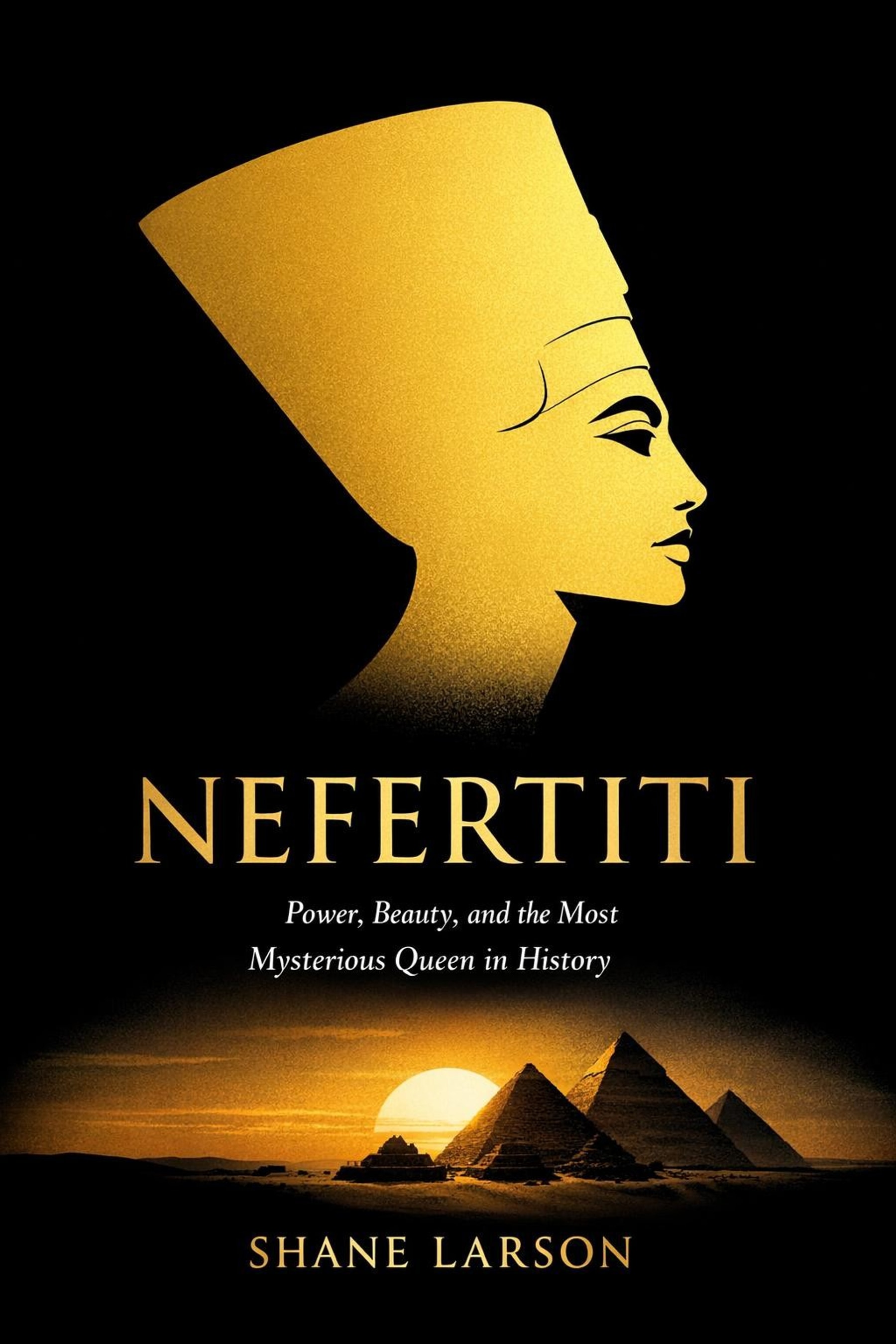
If this resonated, my new book Nefertiti: Power, Beauty, and the Most Mysterious Queen in History goes much deeper — into the world before the revolution, the theological program itself, the evidence for her co-rulership and possible reign as pharaoh, the Dahamunzu Affair, the post-Amarna erasure campaign in detail, the modern archaeological recovery from the 1880s to today, the politics of the Berlin bust, and the unresolved questions that the next generation of Egyptologists will keep working on.
Nefertiti: Power, Beauty, and the Most Mysterious Queen in History is available now on Amazon Kindle.
Nefertiti
New posts and releases, straight to your inbox. No spam, unsubscribe anytime.