The Wild West Was a Product Before It Was a Memory
July 7, 2026 · 6 min read
Picture the Wild West. Go ahead — it takes no effort at all. A lone gunfighter steps into a dusty street at high noon. A noble outlaw robs the railroad and gives to the poor. A buckskin scout reads a trail no one else can see. A showdown, a sunset, a six-gun.
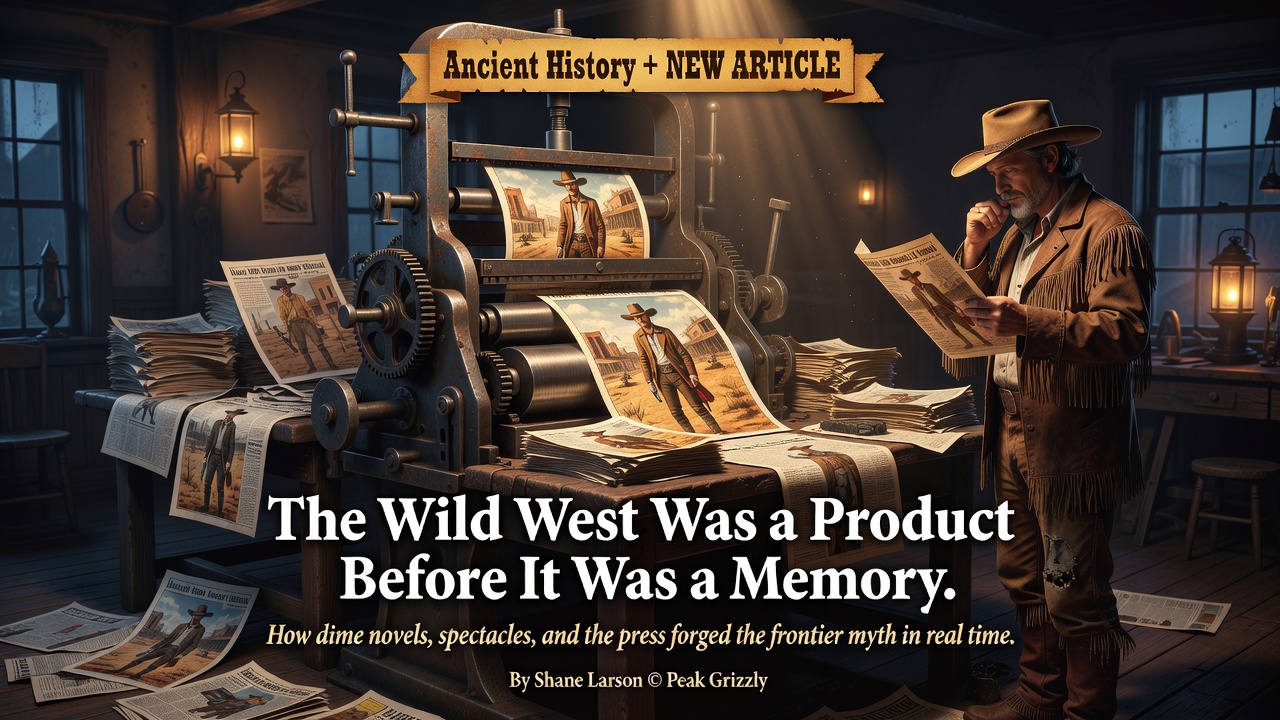
Here is the strange part. Almost none of that picture came from the frontier itself. It came from a machine — an apparatus of cheap print, traveling spectacle, and newspaper sensation that manufactured "the Wild West" as a product and sold it to the public in real time, while the actual frontier was still being settled. The legend wasn't assembled in hindsight by Hollywood. It was built on deadlines, by hack writers and showmen who understood something we usually credit to the digital age: a good story, repeated often enough, beats the truth every time.
This is the story of that machine.
It started with a ten-cent paperback
In 1860, the New York publishing firm of Beadle & Adams launched Beadle's Dime Novels: cheap, mass-produced, ten-cent paperbacks aimed at a newly literate working-class readership and a market starving for adventure. The timing was perfect. Literacy was spreading, printing was getting cheaper, and the railroads could distribute a pamphlet coast to coast. What Beadle & Adams created, in effect, was the first mass-media content engine — and the Western quickly became its highest-performing genre.
The economics demanded volume, and volume demanded formula. Hack writers turned out interchangeable tales of scouts, gunfighters, and noble road agents at industrial speed. One writer, Prentiss Ingraham, is credited with something like two hundred Buffalo Bill stories alone. The plots were recycled, the heroes were nearly identical, and the quality was, charitably, uneven. But the formula was powerful precisely because it didn't bother to stay fictional. It took real names and real places — Hickok, Cody, Deadwood, Dodge City — and inflated them into mythology that millions of people consumed while the events themselves were still unfolding.
The man who invented Buffalo Bill on a deadline
If you want a single scene that captures the whole machine, go to Fort McPherson, Nebraska, in July 1869.
A hard-drinking, self-promoting writer named Edward Zane Carroll Judson — who published under the pen name Ned Buntline — had come west looking for a hero to sell. His first choice was Wild Bill Hickok. He never connected with him. Instead, at Fort McPherson, Buntline met a twenty-three-year-old Army scout and buffalo hunter named William F. Cody.
Within months, Buntline had published Buffalo Bill, the King of the Border Men, a serialized adventure only loosely attached to anything Cody had actually done. And here is the crucial thing: the real man and the printed legend began to diverge immediately — and the printed legend won. Cody would spend the rest of his life performing a version of himself that had been invented, on a deadline, by a writer he barely knew. The legend didn't follow the man. The man learned to follow the legend.
How the press built the gunfighters
Buntline wasn't alone, and the dime novel wasn't the only printing press at work.
In 1867, two years before Cody got his pamphlet, a writer named George Ward Nichols published a profile of Wild Bill Hickok in Harper's New Monthly Magazine that inflated his exploits — and especially his body count — into something no human being could have achieved. The number grew with every retelling. Hickok, for his part, did not rush to correct the record. A reputation as the deadliest gunman alive was good for a man who lived by being feared.
The Dime Novel West
The same machinery rehabilitated outright criminals. In postwar Missouri, a newspaperman named John Newman Edwards recast the bank-and-train robber Jesse James as a kind of Robin Hood — a noble rebel persecuted by Northern interests, robbing the railroads on behalf of the common people. It was political mythmaking with a circulation motive, and it worked so well that we still half-believe it. "Billy the Kid" became a household name the same way. And then the genre took its logic to the natural conclusion and stopped needing real men at all: Edward Wheeler's wildly popular "Deadwood Dick" was pure invention, a hero with no flesh-and-blood original behind him.
The feedback loop: page becomes stage
The real genius of the system was the loop between the printed page and the live arena.
In 1883, Cody launched "Buffalo Bill's Wild West," an enormous outdoor spectacle of riders, sharpshooters, staged buffalo hunts, and mock attacks on the Deadwood stage. It toured the United States and Europe for three decades. It made Annie Oakley — "Little Sure Shot" — an international celebrity. And for one extraordinary season in 1885, it featured Sitting Bull, the Hunkpapa leader who had defeated Custer at the Little Bighorn just nine years earlier, riding around an arena for paying audiences.
The show did something the dime novels alone never could. It certified the myth. Audiences who had read about Buffalo Bill could now watch him in the flesh, performing deeds adjacent to the ones they'd read. The line between history and entertainment didn't just blur — it dissolved. When the show sailed to England and performed for Queen Victoria and the crowned heads of Europe, the American frontier myth became a global brand, exported and sold abroad even as it was still being manufactured at home.
Mythologized at the moment it vanished
In 1893, at the World's Columbian Exposition in Chicago, a young historian named Frederick Jackson Turner stood up and delivered a paper called "The Significance of the Frontier in American History." His thesis: the frontier had shaped the American character, and according to the census, the frontier was now closed. It was over.
The irony is almost too neat. As Turner pronounced the frontier dead inside the fair, Buffalo Bill's Wild West was packing in enormous crowds just outside the fairgrounds, selling the frontier's memory harder than ever. The real thing was declared finished and the manufactured version was booming in the same city, on the same day. The West was being mythologized at the precise moment of its disappearance — which is, when you think about it, exactly when a culture most needs its myths.
The machine just changed media
Ten years later, in 1903, Edwin S. Porter made a twelve-minute film called The Great Train Robbery. It put the Western on screen, and the myth machine simply changed media. Hollywood inherited everything: the dime novel's formulas, its iconography, its stock characters, and above all its appetite for legend over fact. The traveling tent gave way to the movie palace, and then to television, and then to the streaming queue — but the West being sold was, and is, recognizably the one Buntline and Beadle & Adams assembled in cheap print a century and a half ago.
That's the unsettling conclusion. When you picture the Wild West, you are not remembering a past. You are remembering a product — one engineered, marketed, and sold in real time, and proven more durable than the history it replaced.
Read the whole story
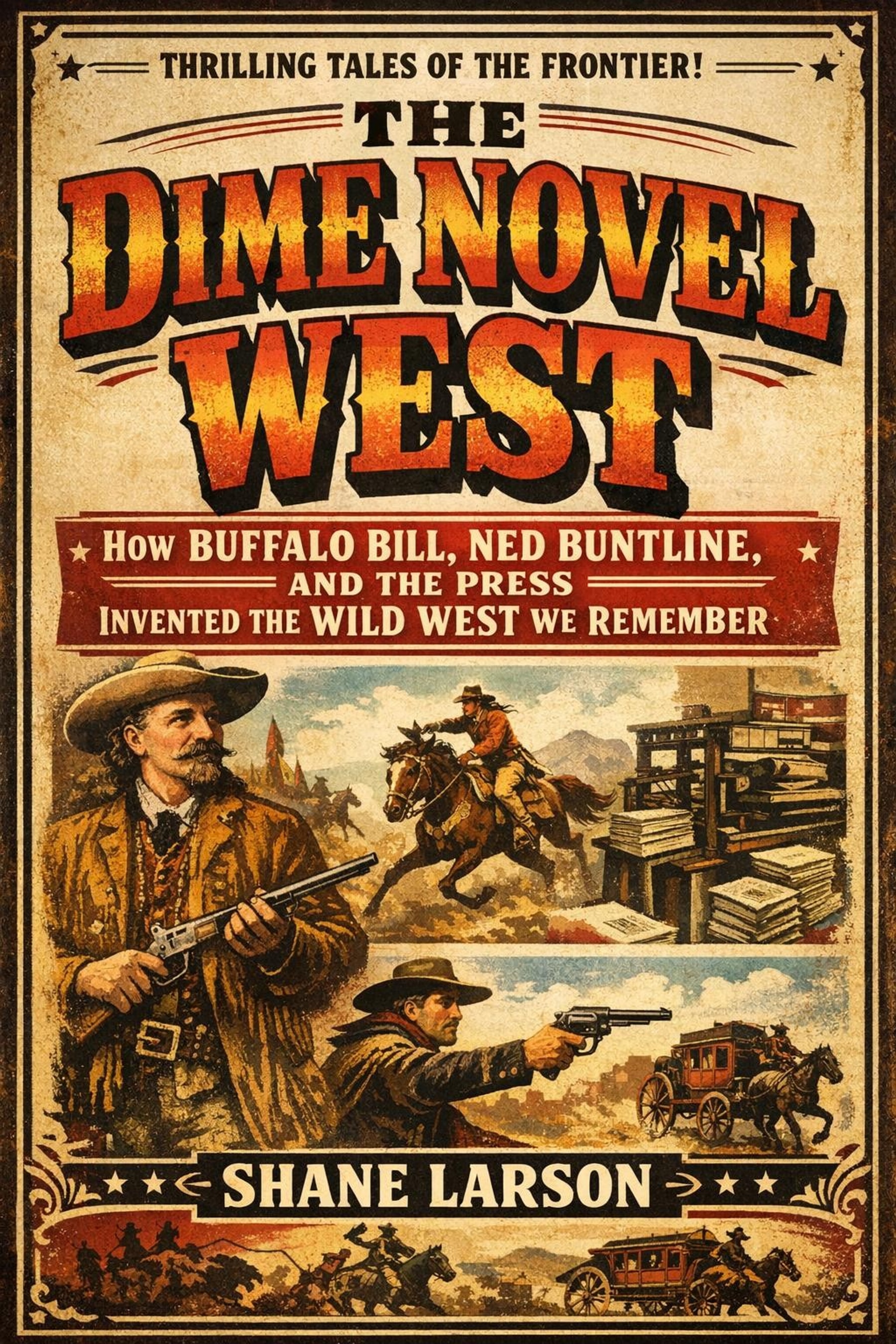
The Dime Novel West: How Buffalo Bill, Ned Buntline, and the Press Invented the Wild West We Remember is the capstone of the 25-volume Wild West series — the meta-book that explains how every other legend in the catalog was made. If you've read the individual titles on Wild Bill Hickok, Wyatt Earp and the O.K. Corral, or Bat Masterson, this is the volume that ties the entire frontier together. It's available now on Kindle for $3.99, and free to read on Kindle Unlimited.
The Dime Novel West
New posts and releases, straight to your inbox. No spam, unsubscribe anytime.