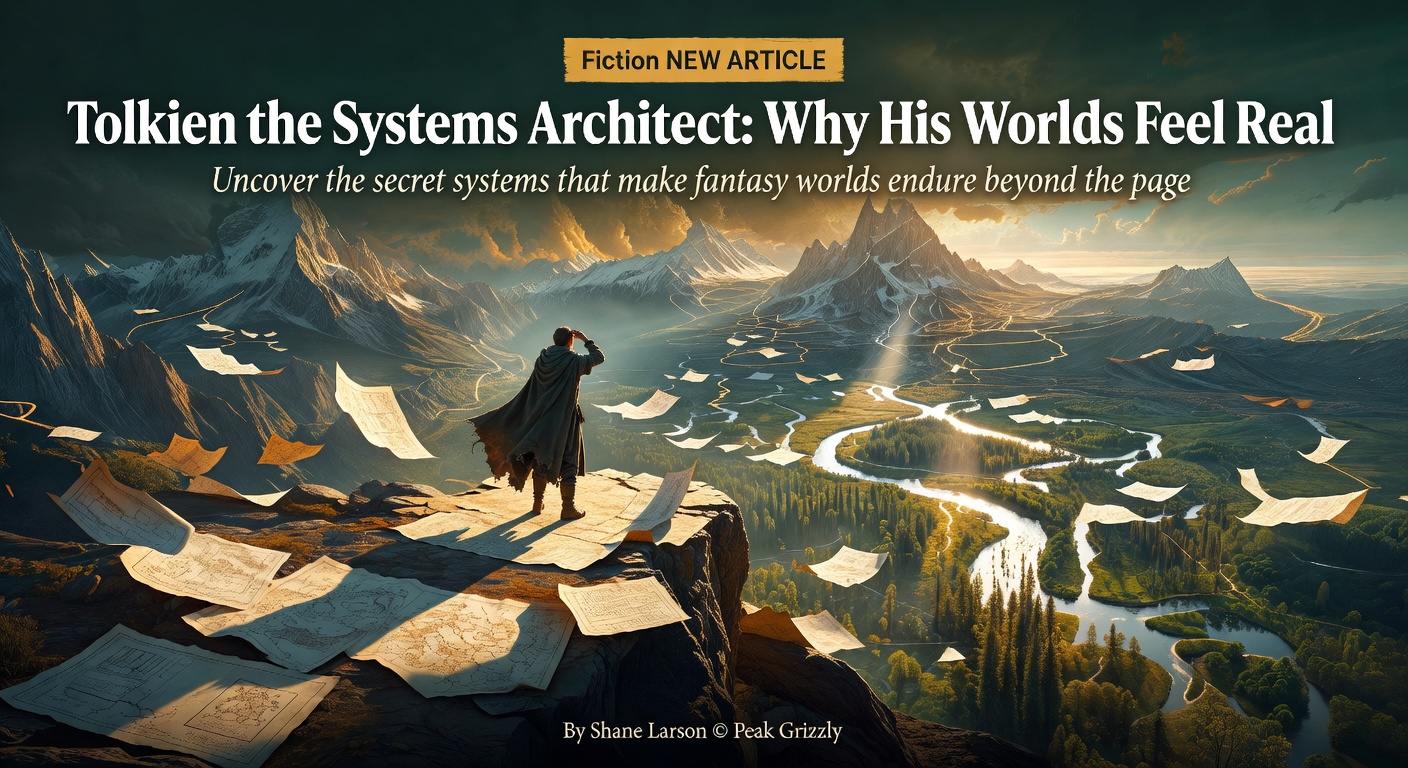
Tolkien the Systems Architect: Why His Worlds Feel Real
April 21, 2026 · 7 min read
When people call J. R. R. Tolkien a genius, they usually mean his imagination. Elves, rings, dark lords — the visible layer, the stuff you see on the movie posters.
That's not what makes the work survive.
The reason Middle-earth still feels alive seventy years later has almost nothing to do with imagination. It has to do with something most writers never attempt:
Tolkien didn't write a story. He engineered a system. The story came out of it.
If you come from any kind of architecture background — software, enterprise, systems design — this is going to look familiar.
Most Fantasy Is UI-First
The standard worldbuilding pipeline for a fantasy novel looks like this:
- Start with a story you want to tell
- Invent some cool-sounding names
- Sprinkle in lore wherever it's needed
- Patch the inconsistencies as you go
It works well enough to sell books. Most published fantasy is built this way. But you can feel the fragility the moment you pay attention:
- Names sound arbitrary, like someone rolled dice on a syllable generator
- History is two chapters deep and then it's turtles
- Cultures don't quite connect to each other — they're costumes on the same underlying archetype
It's a frontend with no real backend. The world exists exactly as long as the story needs it to, and not one step further. Walk off the map and there's nothing there.
Tolkien Built the Backend First
Tolkien inverted the entire process.
Before The Lord of the Rings existed — before even the mythology of Middle-earth had a shape — he was building languages. Not vocabulary lists. Actual languages, with:
- Phonetic rules governing which sounds could appear together
- Grammar and case systems
- Writing scripts (Tengwar, Cirth) designed to be used, not decorated with
- A historical evolution model — meaning words in later ages sounded like descendants of words in earlier ages
He wasn't guessing what names should sound like. He was deriving them.
That's why Quenya and Sindarin don't read as "flavor text." They behave like real languages because the constraints imposed on them were the same constraints real languages operate under.
The Pipeline, In Order
Here's Tolkien's actual creation order:
Language → History → Mythology → Story
He said, more than once, that he invented the languages first and then needed "a world for them to live in." Most people read that as a charming quirk. It's not. It's the single most important thing he ever said about his method.
Inventing a language forces you to answer questions most writers never have to think about:
- Who spoke it first, and what was their environment like?
- How did it change across centuries and continents?
- What migrations, conquests, and isolations caused the dialect splits?
- What cultural events are fossilized inside the vocabulary?
You cannot answer those questions without, accidentally, inventing a history. And you cannot have a history without mythology growing in it. By the time you get around to writing a story, the world already exists — you're just documenting a small piece of it.
Why It Feels Ancient
When you read Tolkien, something strange happens that doesn't happen with other fantasy. It feels less like you're reading a story and more like you're reading a translation of something older that somebody uncovered.
That effect isn't accidental. It comes from three compounding design decisions:
Consistent linguistic evolution. Words in the Third Age feel related to words in the First Age the way French words feel related to Latin. Because the rules that produced them were consistent.
Layered historical timelines. Events reference earlier events, which reference still earlier events. The characters in The Lord of the Rings are standing on top of an archaeological stack thousands of years deep — and they know it.
Cultural continuity. The Rohirrim don't feel like Vikings with the serial numbers filed off. They feel like a people whose language, architecture, and values all descended from the same historical pressures.
This is how real mythologies work. The Epic of Gilgamesh wasn't written — it was accumulated, over centuries, by a civilization that was already old when it started writing things down. Norse mythology wasn't designed. It was the sediment of a long, messy history.
Tolkien replicated the accumulation process deliberately. That's what's doing the work.
Convergent Linguistic Realism
Here's where it gets genuinely interesting.
Readers often notice that Tolkien's names feel related to real ancient words. You see elements like "El-", "-il", "An-", "Ur-" and it tickles some recognition — I've seen this before, haven't I?

The Systems Thinker's Advantage
Sometimes it's specific. Names in Middle-earth can ring a bell for someone familiar with Sumerian (Enlil, Enki) or Hebrew (El, Eloah) or Old English. The resemblance is real, but it's almost never a direct borrowing.
So why does it feel related?
Because Tolkien built his languages under the same constraints that shaped real ancient ones:
- Limited phoneme inventories — humans reuse the same small set of sounds
- Natural sound evolution — certain consonant shifts are statistically likely across every language
- Patterns humans consistently reach for when naming gods, kings, and places
You end up with convergent linguistic realism: independent systems that, because they were built under the same physics, end up sounding like they could belong to the same ancient world. It's the same reason fish and dolphins look alike despite having nothing to do with each other evolutionarily. Same problem, same shape of solution.
The Illusion of Deep Time
Most fictional worlds feel like a stage set. The walls are solid for the camera angles the book needs, and particleboard everywhere else.
Tolkien's world feels like an archaeological site.
When you walk through Middle-earth, you don't just encounter characters and plot. You encounter:
- Ruins of civilizations that fell before the current ones were born
- Names that carry meanings nobody in the story remembers anymore
- Stories that reference older stories that reference still older stories
Númenor isn't a setting. It's a layer in a timeline. Khazad-dûm isn't a dungeon — it's what remains of a dynasty that peaked and ended before the Fellowship was born. The hobbits are walking through somebody else's ancient history and don't realize it.
That's where "deep time" comes from. And you can't fake it. Either the layers are really there or they aren't.
The Cleanest Analogy: Tolkien as a Software Architect
If you're technical, here's the version that will stick:
Tolkien didn't build an app. He built a platform.
- Languages are the protocols
- Mythology is the domain model
- History is the data layer
- Cultures are the services
- Stories are the user interface
Most writers ship a UI and hope nobody looks too hard at what's behind it. Tolkien built the backend, the APIs, the data model — and then exposed a small part of it through narrative.
That's why everything feels internally consistent. That's why nothing feels arbitrary. That's why the world seems enormously larger than anything he actually showed you. Because it was enormously larger than anything he actually showed you. The part in the books is the tip. The iceberg was load-bearing.
Anyone who has ever tried to build a real system instead of a demo knows exactly what this feels like — and why it's so rare.
Why This Still Matters
Tolkien's approach is the reason his work hasn't aged like typical fantasy. It's also why every serious worldbuilder since — in novels, in games, in film — has been working in his shadow. Not because they copied his elves. Because they understood, at least partly, what he did underneath them.
The deeper lesson generalizes past fiction:
If the underlying system is coherent, the surface experience becomes believable.
That sentence is true of software, institutions, businesses, and novels. Pretty much everything people try to build and have come out feeling real.
Final Thought
Calling Tolkien a genius undersells what he actually did. Plenty of people have imaginative ideas. Almost nobody takes the imaginative ideas and then engineers a forty-year consistency model underneath them.
He constructed a reality with internal laws — linguistic, historical, cultural, economic. And when you encounter a name like Elendil or Minas Tirith and it feels somehow older than the page you're reading it on, you're not imagining things.
You're recognizing the fingerprints of a system that was built, from the foundation up, to feel real.
Most fantasy writers try to convince you the world exists.
Tolkien just built the world and let you find out.
Related reading from Peak Grizzly
If the systems-thinking thread in this piece resonated, a few titles from the catalog lean in the same direction:
- The Systems Thinker's Advantage — on why seeing the whole system is the skill that matters most, and the one AI can't replace.
- Designing Solutions Architecture for Enterprise Integration — the practitioner's version of "build the backend first," applied to the systems you actually ship.
- The Ancient World's Greatest Engineers — the real builders who did this with aqueducts and cities instead of languages.
— Shane
The Systems Thinker's Advantage
New posts and releases, straight to your inbox. No spam, unsubscribe anytime.