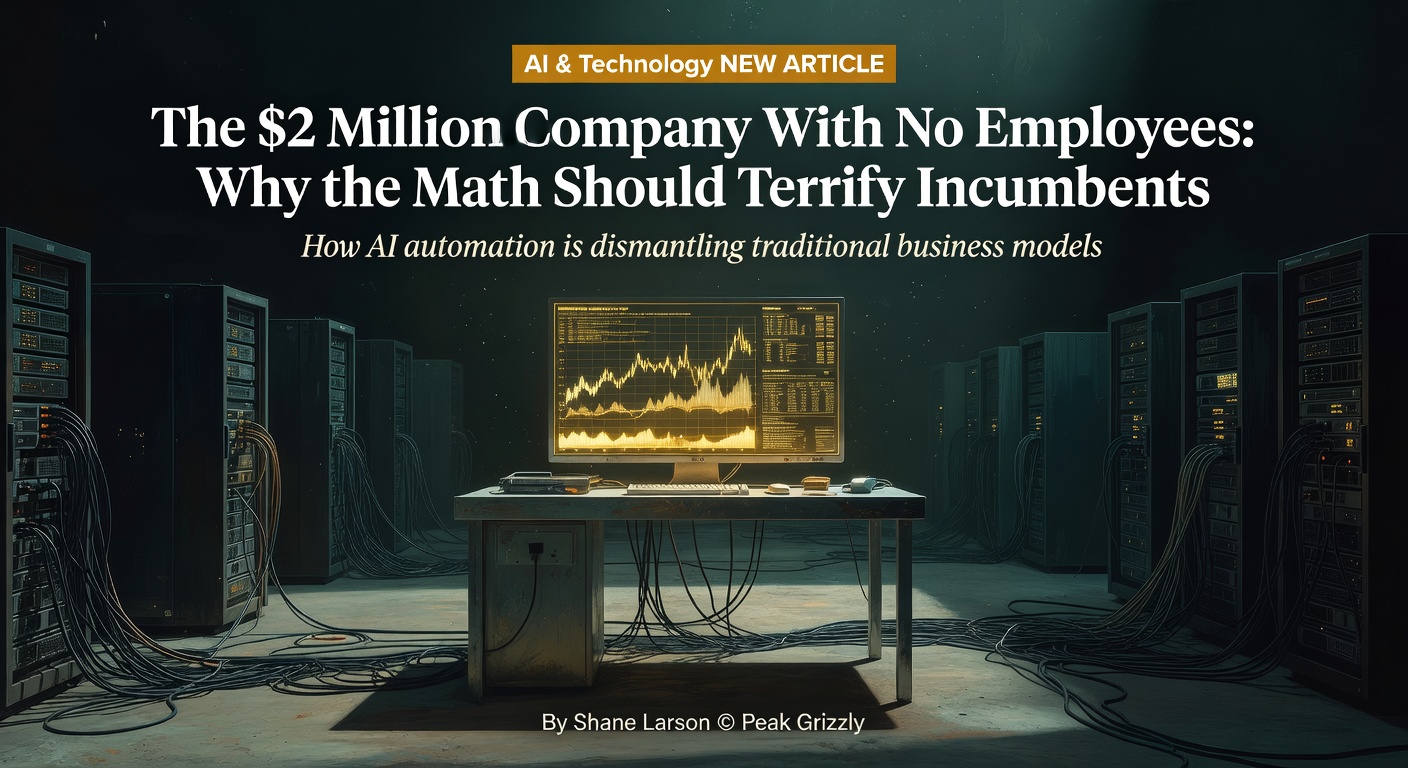
The $2 Million Company With No Employees: Why the Math Should Terrify Incumbents
April 4, 2026 · 9 min read
The most dangerous competitor in any market is the one with a fundamentally lower cost structure. Not marginally lower. Structurally, categorically lower — the kind of cost advantage that makes it impossible for incumbents to compete on price without destroying their own business model. History is littered with examples of this dynamic: think of how the assembly line revolutionized manufacturing in the early 20th century, slashing costs for Ford and forcing rivals to either adapt or fade away, or how cloud computing democratized data storage, allowing startups to undercut established players like IBM without massive upfront investments. In today's landscape, this threat comes from a source that's even more disruptive, as it challenges the very foundation of labor-intensive operations.
That competitor is now a single person with an AI agent stack. And the economics are not even close. This isn't just about efficiency; it's about redefining scalability, where a lone operator can leverage AI to handle tasks that once required entire teams, turning fixed costs into variable ones that shrink over time.
Consider two companies competing in the same B2B SaaS market, both generating $2 million in annual revenue. Company A has 20 employees, each bringing specialized skills but also adding layers of overhead that compound with every hire. Company B has zero employees and one operator, relying on AI to automate core functions like customer support, content generation, and data analysis, allowing for leaner operations from the ground up.
Company A's annual costs break down as follows: $1.8 million in salaries, covering roles from developers to marketers, each with varying expertise but also entailing ongoing training and retention efforts amid a competitive job market. Add $540,000 in benefits, including health insurance and retirement contributions that have risen steadily due to inflation and regulatory changes. Then there's $120,000 for office space, which might include leases in prime locations to attract talent, $60,000 in equipment like computers and software licenses that depreciate quickly, $50,000 in recruiting fees to replace the inevitable turnover, plus hosting, professional services, and miscellaneous overhead such as travel and team-building events. Total: $2.67 million. Net margin: negative $670,000. This deficit explains why Company A often turns to venture capital, diluting ownership to fund what feels like an endless cycle of expenses.
Company B's annual costs, by contrast, are streamlined around AI-driven efficiency: $36,000 in AI API fees, which cover the computational power for tasks like natural language processing and automation, drawing from providers like OpenAI or Anthropic whose services have become increasingly plug-and-play. Add $18,000 in cloud hosting from platforms like AWS, where pay-as-you-go models mean paying only for what's used, $12,000 in SaaS subscriptions for complementary tools that integrate seamlessly with the AI stack, $58,000 in payment processing to handle transactions without the need for a dedicated finance team, $15,000 in professional services for occasional legal or accounting needs, $200,000 as operator compensation to cover the strategic oversight and system tweaks, and $10,000 in miscellaneous expenses like domain renewals or basic marketing. Total: $349,000. Net margin: $1.65 million — an 82.5% margin. This stark difference highlights how Company B transforms what was once a high-overhead operation into a model where the bulk of costs are digital and scalable.
Company A spends $2.67 million to generate $2 million, leaving it vulnerable to any price war. Company B spends just $349,000 for the same revenue, giving it the flexibility to, for instance, slash prices by 60% — perhaps to $800,000 per year — and still maintain profitability, all while forcing competitors to question their sustainability. Company A, however, cannot cut prices at all without accelerating its losses, as even small reductions would erode the already slim buffer for salaries and benefits.
The Salary Line Item Is the Entire Problem
The gap becomes obvious when you isolate the single biggest difference. Company A pays $1.8 million in salaries alone, a figure that encompasses not just base pay but also the ripple effects of employment taxes, compliance with labor laws, and the administrative burden of managing a workforce in an era of rising wage demands. That single line item is more than five times Company B's entire operating cost, including the operator paying themselves $200,000 a year — a disparity that underscores how human labor, while essential, has become an Achilles' heel in industries where AI can replicate routine tasks.
This is not a marginal efficiency gain; it's a structural advantage so large it changes the competitive landscape of entire industries, much like how container shipping in the 1950s reduced global trade costs by 80% overnight, reshaping supply chains worldwide. The root cause lies in the escalating nature of labor costs: in the U.S., average salaries for tech roles have climbed 15-20% over the past five years due to skills shortages and inflation, while AI alternatives continue to drop in price. As a result, Company B can redirect resources from payroll to innovation, investing in better AI integrations rather than headcount.
And the cost curve is moving in one direction. AI API pricing has fallen roughly 90% since GPT-4's launch in early 2023, driven by competition among providers and advances in efficiency; for example, the same AI-driven customer chat function that cost $36,000 annually a year ago might now run on $10,000-15,000 worth of credits, thanks to optimized models and bulk discounts. Cloud hosting continues its decades-long decline, with prices per gigabyte dropping by about 5% annually as infrastructure scales globally. Every quarter, the zero-employee model gets cheaper to run while the traditional model's primary cost — human labor — only gets more expensive, exacerbated by factors like demographic shifts and minimum wage increases. This widening gap means that what starts as a cost advantage today could become an insurmountable barrier tomorrow.
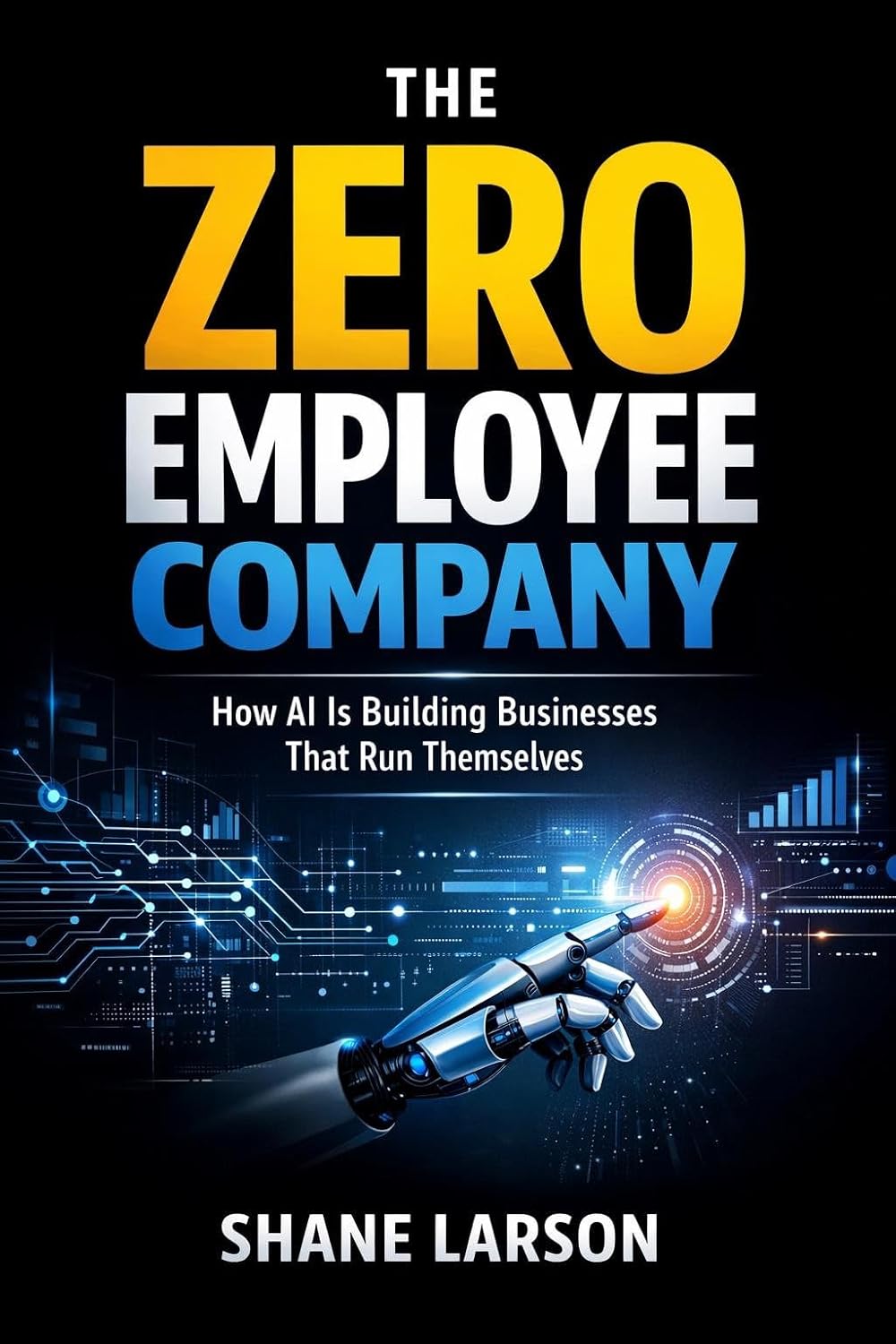
The Zero Employee Company
The margins create compounding strategic advantages as well. A business with 85% margins, like Company B, can weather an 80% revenue drop — say, from a market downturn or increased competition — and still cover its operating costs, perhaps by temporarily scaling back AI usage or pausing non-essential features. Company A, on the other hand, starts laying people off if revenue dips just 10%, triggering a cascade of issues: lost morale, disrupted projects, and the erosion of expertise that takes years to rebuild. In a downturn, Company B tightens its belt with minimal disruption, while Company A enters a death spiral of layoffs, lost institutional knowledge, and declining product quality, as seen in past recessions like 2008, when firms with high fixed costs struggled to recover.
High margins also mean self-funded growth, freeing the operator to experiment without external pressures. For instance, they can allocate surplus cash to marketing A/B tests, rapid product iterations, or entering new markets, all while avoiding the overhead of equity deals. No dilution, no board meetings, no fundraising roadshows — and certainly no investor pushing for aggressive hiring when the core strategy hinges on minimizing it entirely.
What "Zero Employee" Actually Means
The term requires precision, because the most common objection misunderstands it. Critics often assume a zero-employee company implies fully autonomous operations, devoid of human input, but that's not the case; it's about minimizing payroll while maximizing leverage through technology.
A zero-employee company is not a company with no humans involved. It is a company with no one on payroll — no W-2 employees, no job titles, no performance reviews, no management layers that balloon costs through bureaucracy. The company has an operator: the owner who designs the system, deploys the AI agents, monitors performance, and makes the strategic calls that AI cannot yet make reliably, such as interpreting nuanced market signals or handling ethical dilemmas in real-time. This role demands a different skill set — one focused on oversight and optimization rather than execution — and it's why the operator's compensation reflects the value of building a self-sustaining system.
The distinction is more than semantic; it's operational. An employee performs tasks, often in isolation, with their productivity tied to hours worked and personal expertise. An operator, however, designs systems that perform tasks at scale, creating a multiplier effect where one person's decisions amplify output exponentially. An employee's value is measured by their output, which can vary with fatigue or turnover. An operator's value is measured by the output of the system they built, which runs 24/7 without sick days or resignations, as long as the tech holds up.
The operator works on the business, refining the AI architecture and ensuring alignment with goals, while the AI agents work in the business, handling the day-to-day grind. Consider a traditional media company with 50 employees producing 20 articles per day: each piece involves a chain of human touchpoints — a writer brainstorming ideas, an editor polishing drafts, a fact-checker verifying sources, and a publisher scheduling releases — all of which introduce delays and costs. A zero-employee media operation with one operator and an AI agent stack might produce 50 articles per day by automating the pipeline: AI scours news feeds for topics, conducts research from verified databases, generates drafts with customizable styles, cross-references facts against real-time sources, and even handles publishing to multiple platforms. The operator steps in to monitor quality, tweak algorithms for better accuracy, and decide on high-level strategies, like pivoting coverage to emerging trends.
This is already happening across sectors. Y Combinator reported in 2025 that a significant number of their latest batch companies had codebases 80-95% AI-generated, allowing founders to prototype and iterate faster than ever before. Klarna's AI assistant, for example, was handling two-thirds of all customer service conversations — effectively replacing 700 full-time agents — while not only maintaining satisfaction scores but also reducing resolution times from 11 minutes to under 2, thanks to instant data access and personalized responses. Other examples include AI-powered logistics firms that optimize routes in real-time, cutting fuel costs by 20-30% without a fleet of drivers.
The skeptic's objection is always the same: AI is not good enough. It makes mistakes, it hallucinates, it produces mediocre work — points that hold true in specific contexts, like complex creative tasks or high-stakes decisions. Yet, every one of these objections was equally valid about previous transformative technologies at their inflection points: in the 1970s, computers were seen as error-prone and inefficient, yet they paved the way for the PC revolution; by the 1990s, the internet was dismissed as unreliable, but it spawned e-commerce giants. In 1995, e-commerce meant trusting a website you had never heard of with your credit card, and Amazon's revenue that year was just $511,000; fast-forward to 2023, and it topped $574 billion, proving that early imperfections don't halt progress.
The relevant question is not whether AI is perfect today — it's whether it is improving fast enough that betting against it is the riskier position. Based on every available metric — from benchmark performance on tasks like language understanding, which has doubled in accuracy over the past two years, to cost per token dropping from $0.02 to $0.002, capability breadth expanding into areas like video generation, and adoption rates soaring with over 100 million users on AI platforms — the answer is unambiguous. The zero-employee company is not a thought experiment; it is a cost structure that forces incumbents to evolve or face obsolescence. And cost structures determine who wins.
The Zero Employee Company
New posts and releases, straight to your inbox. No spam, unsubscribe anytime.