Sheep in the Field, Mutton on the Plate: Why English Has Two Words for Everything
September 18, 2026 · 6 min read
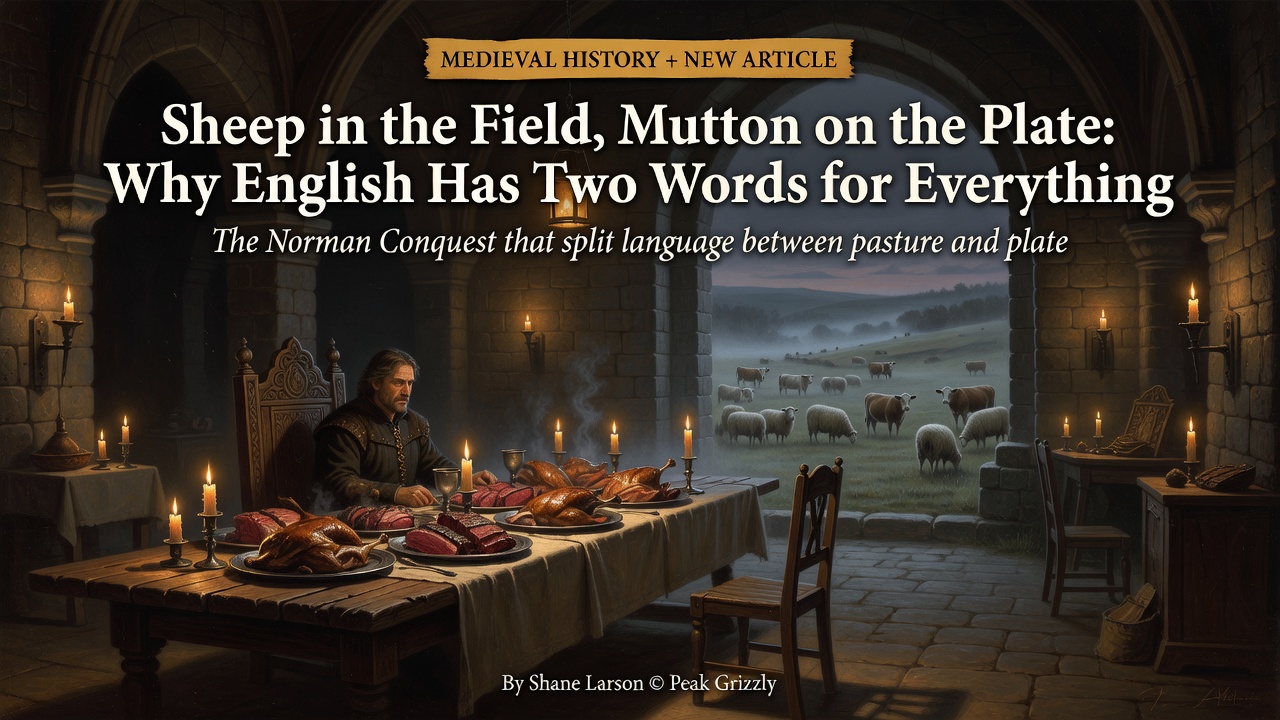
Try this in your own mouth. The animal in the field is a cow; the meat on the plate is beef. The animal is a sheep; the meat is mutton. Pig, but pork. Calf, but veal. Deer, but venison. English does this for nearly every animal a medieval household could eat, and it does it for almost nothing else — the words for the living creature and the words for its meat come from two entirely different languages.
The first set is Old English, the language spoken in England for six centuries before 1066. The second set is French. And the standard explanation, which you may have heard, goes like this: after the Norman Conquest, the people who raised the animals were English peasants, so the beasts in the barnyard kept their English names. The people who ate the animals were French-speaking lords, so the dishes on the table took French ones. The swineherd knew a pig; his master dined on porc. The language of English split along the same line as the society — labor below, consumption above — and the split fossilized into vocabulary we still use a thousand years later.
It is a wonderful story. It is even mostly true. But the honest version is more interesting than the tidy one, and the honest version is worth telling — because what actually happened to English after 1066 is stranger and bigger than a menu.
The story's fine print
Start with what the tidy version skips. The French meat-words are real borrowings from the conquest period's aftermath, but they do not show up in English writing with their modern meanings until around 1300 — more than two centuries after Hastings. And for a long stretch after they arrived, they were not cleanly "meat words" at all: beef and mutton could refer to the living animals too. The neat division — English animal, French meat — settled in gradually, over generations, as French kitchen and table vocabulary sorted itself into the cooking side of the language and the older English words held the farming side.
The tidy version also has a traceable pedigree, and it is not medieval. The scene everyone half-remembers — the Saxon swineherd tending animals with English names that become French the moment they are served in the lord's hall — comes substantially from Walter Scott's novel Ivanhoe, published in 1819, where a jester spells out the joke to a swineherd at length. Scott was dramatizing something genuinely present in the language, and he did it so memorably that his dramatization became the standard account. When you repeat the sheep-and-mutton story, you are, in part, quoting a nineteenth-century novelist.
So is the story false? No — and this is the part worth keeping. The reason French supplied the vocabulary of the kitchen, the table, and the feast really is that for three centuries after 1066, French speakers ran the households that had kitchens worth naming things in. The direction of the borrowing tells you who was cooking for whom. The fine print just moves the timescale: this was not an overnight partition of the dinner table in 1067, but the slow settling of two languages into two social altitudes — which is exactly what happened to English as a whole.
Ten thousand words
Here is the scale of the thing. After 1066, England's new ruling class — a few thousand people in a country of perhaps two million — spoke Norman French. There was no policy of language replacement; nobody ordered the English to stop speaking English, and they never did. What happened instead was displacement upward. French took the top of the language and English kept the ground. Charters and law courts abandoned English within a generation or two; the courts then ran in French for some three hundred years. English essentially vanishes from writing between roughly 1100 and 1250 — a language of two million people, with a literary tradition centuries old, going almost silent on parchment.
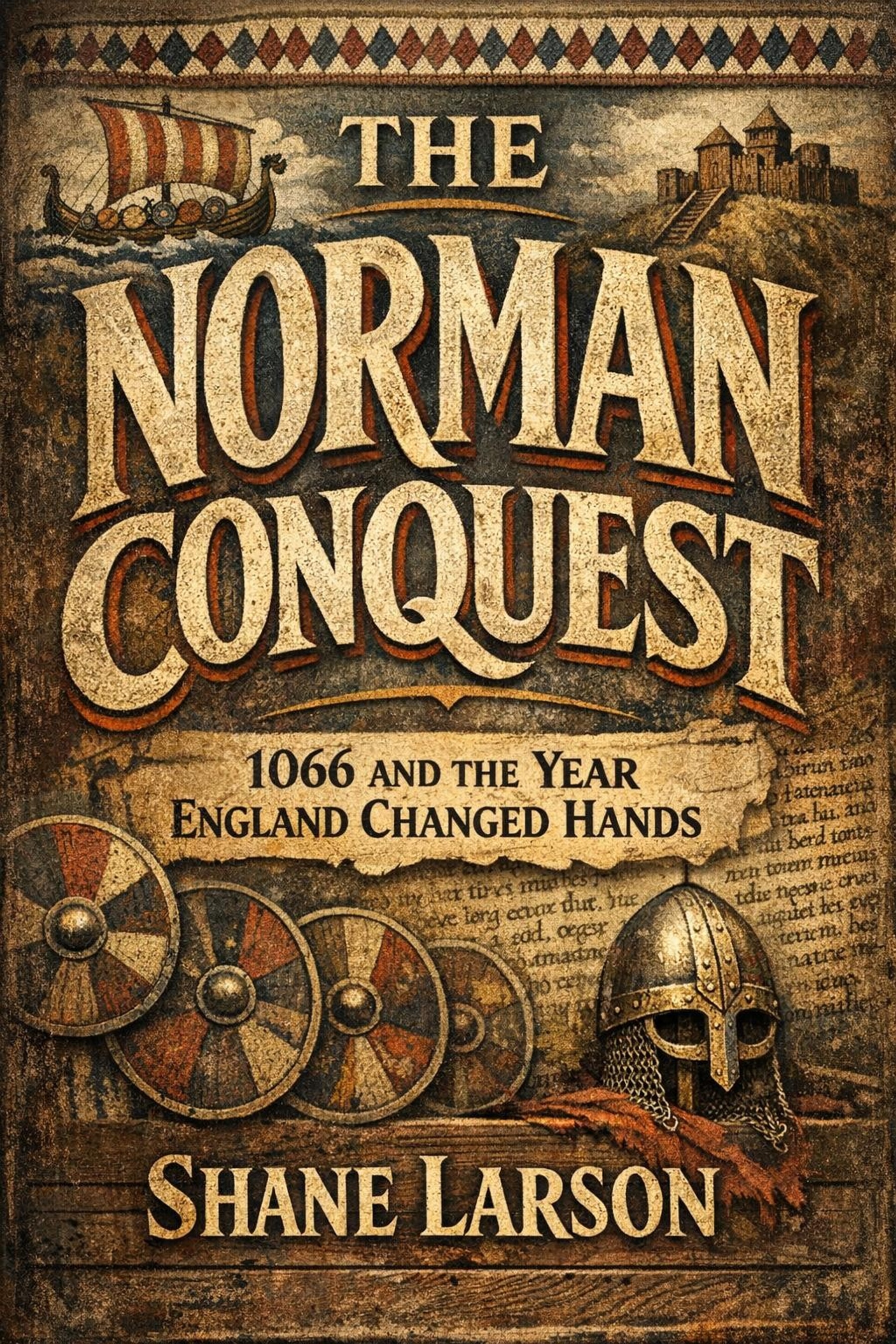
The Norman Conquest
When English surfaced again as a written language, it had absorbed roughly ten thousand French words, and the borrowings map the conquest precisely. The law: judge, jury, verdict, felony, attorney. Government: parliament, council, sovereign, court itself. War: army, soldier, battle, guard. Building: castle, tower, arch, chamber. Religion: sermon, prayer, saint. And the kitchen, from boil, roast, and fry to dine, feast, and appetite. Wherever the new rulers ran things, their words for running it stuck. Wherever they didn't — the plough, the field, the weather, the parts of the body, the words children learn first — English held.
The three-story house
The subtlest consequence is the one that makes English prose work the way it does. Because French words entered a language that already had words for many of the same things, English ended up with pairs — near-synonyms at different social altitudes. You can ask or you can inquire. You can begin or commence. A thing can be hearty or cordial, a home a house or a mansion, a condition freedom or liberty. In each pair the English word is plain and the French word is formal — because for three centuries, the French word literally was the formal register, the one used in court and courtroom.
Add the third layer — Latin, flowing in through the church and later through scholarship — and you get triplets: kingly, royal, regal. Same meaning, three altitudes: native and plain, French and stately, Latin and marmoreal. English is nearly alone among languages in having this three-story structure running through its entire vocabulary, and it is the reason English can shift tone the way it does — the reason "a hearty welcome" and "a cordial reception" describe the same event at two different temperatures. That flexibility is not a design feature. It is scar tissue from a conquest.
One honest caveat, since this article is being honest: the other big change in medieval English — the collapse of Old English's case endings and grammatical gender — is often blamed on the Normans, and mostly shouldn't be. That simplification was underway before 1066, driven partly by centuries of contact with Norse speakers in the north. What the conquest did was remove the written standard that might have slowed it: with no official English being taught or copied for two centuries, the spoken language changed at street speed, unanchored.
The language that came back
French did not hold the top floor forever. In 1204 the English crown lost Normandy itself, and the aristocracy on the English side of the Channel slowly stopped being French in any meaningful sense. The long wars with France that followed made French, awkwardly, the enemy's language. In 1362 a statute required the law courts to plead in English — enacted, with a straight face, in French. By the time Chaucer chose English for the Canterbury Tales, the question was settled.
But the English that came back was not the English that went underground. It came back carrying its ten thousand borrowings, its doubled vocabulary, its three registers — a hybrid instrument that neither an Anglo-Saxon thegn nor a Norman baron would have recognized, and more flexible than either of their languages had been. Every English sentence written since, including this one, runs on that machinery. Of all the things one October afternoon in 1066 changed — a dynasty, a landholding class, a skyline of castles and cathedrals — the most permanent is sitting in your mouth.
This is one thread of a larger story. My book, The Norman Conquest: 1066 and the Year England Changed Hands, tells the whole of it — the three claimants, the two battles three weeks apart, and then the twenty years after Hastings that most tellings skip: the dispossession of an entire aristocracy, the Harrying of the North, the Domesday survey that recorded it all, and the language you just read this in.
The Norman Conquest
New posts and releases, straight to your inbox. No spam, unsubscribe anytime.