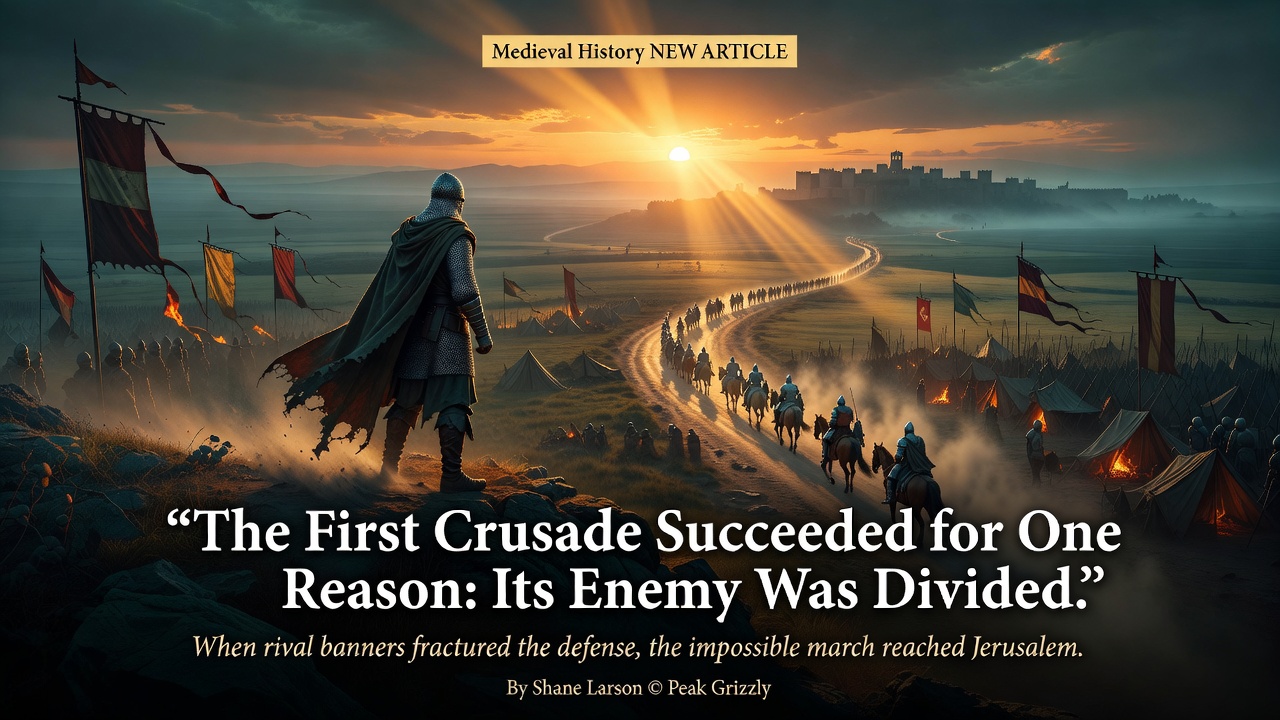
The First Crusade Succeeded for One Reason: Its Enemy Was Divided
July 7, 2026 · 7 min read
The First Crusade should not have worked.
Picture what it actually was. In 1096, after Pope Urban II's call at Clermont, tens of thousands of Europeans set out to walk to Jerusalem—roughly two thousand miles, across mountains, deserts, and the territory of empires that owed them nothing. They had no maps worth the name. They had no unified command; the great lords who led the expedition were rivals who barely agreed on a route, let alone a strategy. They had no reliable supply lines. They starved outside Antioch. They ate their horses. By the time they reached Jerusalem in the summer of 1099, the army that had set out was a fraction of its original size.
And yet in July 1099 they stormed the walls of Jerusalem and took the city.
How? The romantic answer is faith, courage, the favor of God. The honest answer is colder and more interesting: the crusaders won because the world they invaded was too divided to stop them.
A Patchwork, Not an Empire
We tend to imagine the medieval Near East as a single bloc—a unified Islamic power facing a unified Christian one. It was nothing of the kind.
In 1095 the region was a patchwork of competing dynasties that spent more energy fighting each other than worrying about a rabble of foreigners marching down from the north. The Fatimids ruled Egypt from Cairo and followed Shia Islam. The Seljuk Turks, Sunni and recently arrived, dominated Syria and the lands toward Baghdad—but their power had already begun to splinter into a constellation of local emirs, each running his own city, each jealous of his neighbor. Antioch, Aleppo, Damascus, Mosul: these were not provinces of one state. They were rivals.
When the crusaders arrived, the local rulers did not see an existential threat to a civilization. They saw a useful disturbance, a force that might be turned against a hated neighbor. Some negotiated. Some stood aside. The Fatimids of Egypt actually opened diplomatic channels with the crusaders early on, hoping the newcomers would weaken their Seljuk enemies. Nobody coordinated a defense, because there was no "everybody" to do the coordinating.
That is the engine of the First Crusade's success. The crusaders never had to beat a united enemy. They beat a series of isolated cities one at a time, and the cities let them.
Kingdoms Built on Sand
The states the crusaders founded after 1099—the Kingdom of Jerusalem, the County of Tripoli, the Principality of Antioch, the County of Edessa, collectively the Crusader states, or Outremer, "the land beyond the sea"—inherited that same fragile logic.
Look at the map and the problem is obvious. These were thin slivers of territory, mostly clinging to the coast, surrounded on the landward side by Muslim powers and dependent for survival on reinforcements arriving by sea from a Europe that, the moment Jerusalem fell, largely lost interest. The great castles the crusaders built—Krak des Chevaliers and its cousins—were not vanity projects. They were the architecture of a permanent garrison state that knew it was outnumbered and was trying to buy time with stone.
For a few decades it held, for the same reason the conquest had worked: the surrounding powers stayed divided. As long as Damascus distrusted Aleppo and Cairo distrusted both, the Crusader states could play one against another and survive in the gaps.
The whole arrangement depended on the enemy never getting its act together.
Then the Enemy Got Its Act Together
The turning point was not a battle. It was a process—the slow, deliberate unification of Muslim Syria and Egypt under a sequence of capable leaders.
It began with Zengi, the ruler of Mosul and Aleppo, who in 1144 captured Edessa—the first of the Crusader states to fall, and a shock that triggered the Second Crusade (which accomplished almost nothing). It continued with his son Nur al-Din, who pulled Syria together and made the recovery of Jerusalem an explicit, sustained political goal rather than a slogan. And it culminated in the figure everyone remembers: Saladin.
Saladin—Salah al-Din—was a Kurdish officer who rose through the Egyptian military, ended Fatimid rule, and over two decades stitched Egypt and Syria into a single power for the first time in the crusading era. He is often introduced to readers as the noble foil to Richard the Lionheart, and he was certainly a formidable and often genuinely magnanimous figure. But the most important thing about Saladin is structural, not personal: he was the man who finally united the two halves of the equation. Once Egypt and Syria answered to one ruler, the Crusader states were caught in a vise.
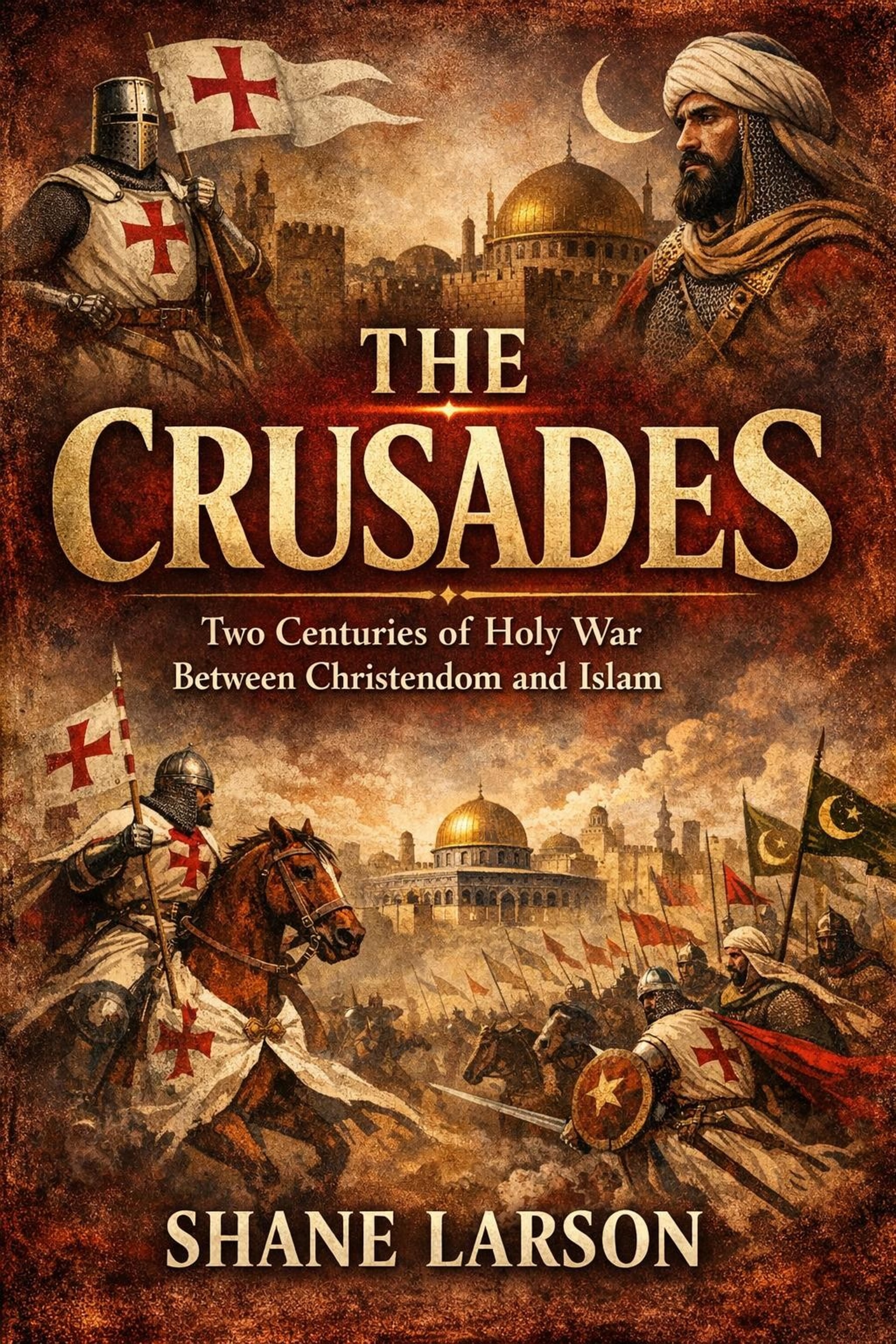
The Crusades
In July 1187 he proved it. At the Horns of Hattin, in the dry hills of Galilee, Saladin maneuvered the main field army of the Kingdom of Jerusalem onto waterless ground, cut it off, and destroyed it in a single brutal day. With the army gone, the kingdom had nothing left to defend its cities. Jerusalem surrendered within months. Eighty-eight years of crusader rule over the holy city ended almost without a fight, because the fight had already been lost at Hattin.
The Long Retreat
Everything after 1187 is, in a sense, an attempt to undo that one afternoon.
The Third Crusade brought Europe's greatest rulers east—most famously Richard the Lionheart of England—and they clawed back a strip of the coast and made Saladin's life difficult. Richard won battles; he never won Jerusalem. The crusade ended in a negotiated truce that left the holy city in Muslim hands, with Christian pilgrims granted access. It was the best the crusaders would ever do again, and it was not enough.
After that the story is mostly decline, punctuated by disasters. The Fourth Crusade never reached the Holy Land at all; in 1204, tangled in Venetian debt and Byzantine politics, it sacked Constantinople—the greatest Christian city in the world—and fatally weakened the very empire that had been a buffer against further losses. Later crusades aimed at Egypt and bogged down in its rivers and deltas. The initiative had passed for good, first to Saladin's Ayyubid heirs and finally to the Mamluks, the formidable slave-soldier dynasty that took Egypt and methodically reduced the remaining crusader strongholds one by one.
The end came in 1291. The Mamluks besieged Acre, the last great crusader city on the coast, and took it. The survivors fled by sea. After two centuries, the crusader presence in the Holy Land was simply gone.
The Pattern, Start to Finish
Stand back from the two hundred years and the shape is remarkably clean.
Disunity let the crusaders in. Unity drove them out. The First Crusade succeeded because no single power stood against it; the Crusader states survived as long as that division held; and they fell—steadily, then completely—as Zengi, Nur al-Din, Saladin, and finally the Mamluks assembled the unified force that the crusaders had always feared and never had to face at the start.
That is not the whole story, of course. There is the religious fervor that made men leave their homes forever, the strange hybrid society that grew up in Outremer, the military orders, the politics of a dozen courts, the role of Byzantium, the brutality on every side. A single afternoon at Hattin or a single decision outside Constantinople deserves a chapter of its own. But if you want the one thread that runs from Clermont in 1095 to Acre in 1291, this is it: the Crusades were decided less by who was braver or holier than by who was united.
That thread is what my new book follows from end to end. The Crusades: Two Centuries of Holy War Between Christendom and Islam tells the complete arc in one volume—the call at Clermont, the storming of Jerusalem, the fragile kingdoms of Outremer, the rise of Saladin, the Third Crusade and the famous standoff with Richard the Lionheart, the sack of Constantinople, and the long retreat to Acre. It treats every side as fully human and the Muslim powers—Fatimids, Seljuks, Zengids, Ayyubids, Mamluks—as serious, distinct players, not background scenery. No heroes, no villains, no modern axe to grind. Just the history, told straight.
It's available now on Kindle and free in Kindle Unlimited.
If you enjoyed this, you may also like my earlier books on the ancient and medieval world—The Fall of Rome and The Viking Expansion—which trace the same kind of long-arc collapse and transformation across the centuries before and after the Crusades.
The Crusades
New posts and releases, straight to your inbox. No spam, unsubscribe anytime.