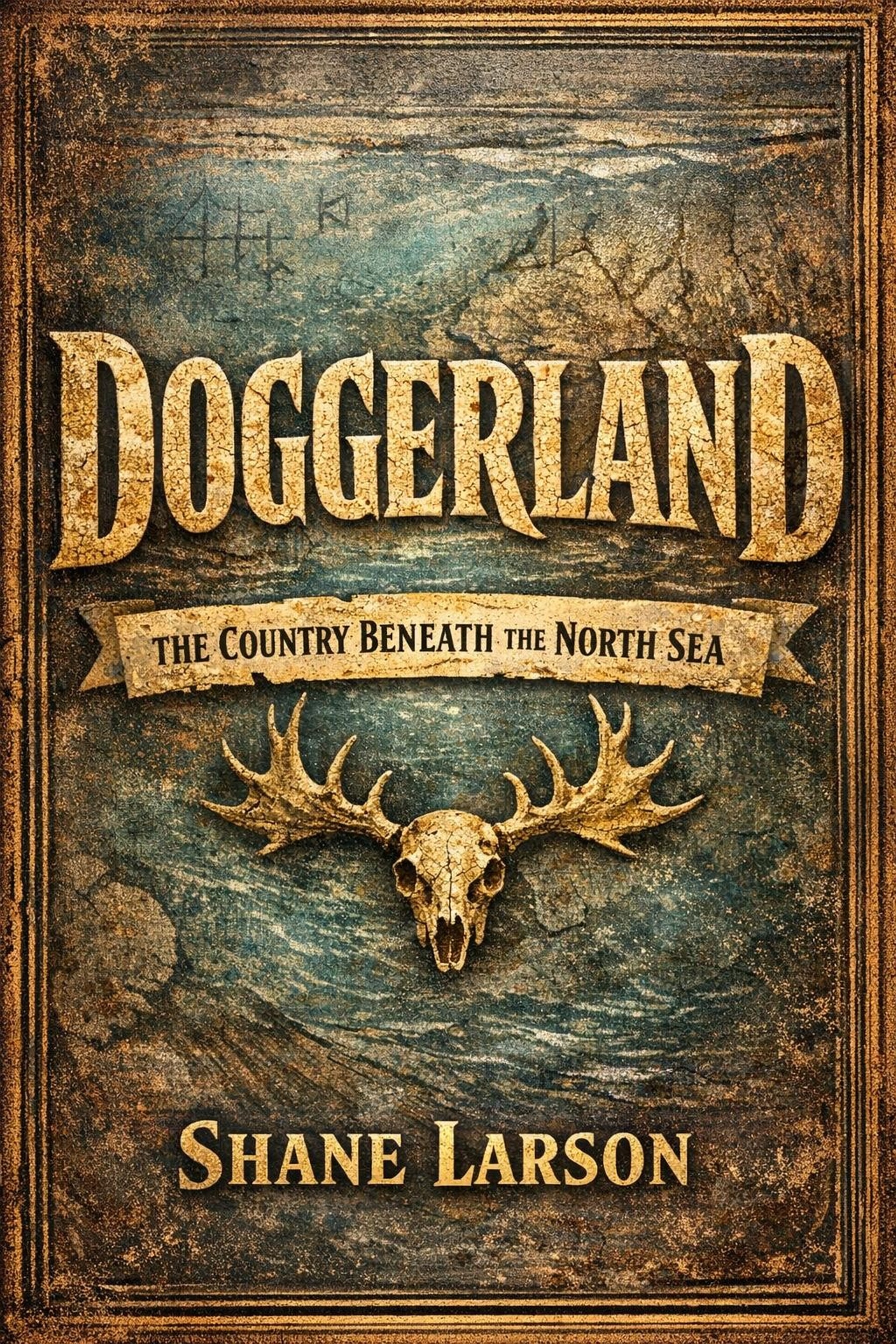
Doggerland
The Country Beneath the North Sea
By Shane Larson
About This Book
On a September night in 1931, a trawler working the fishing grounds off the Norfolk coast hauled up something the crew had been throwing back for as long as anyone could remember. The fleet called it moorlog — a black, fibrous, root-matted peat that fouled the nets and stank on deck. It was a nuisance, nothing more. That night, for reasons nobody wrote down, the skipper broke a lump of it open.
Inside was a barbed point of worked antler, about twenty centimetres long, shaped by hand.
Bone came up in nets all the time — mammoth tusk, reindeer antler, aurochs jaw — and everyone assumed it had washed out from the rivers. But a manufactured tool is a different kind of witness. Somebody made it, carried it, and lost it. The peat was the second witness, because peat forms in bogs and wet ground, not on a sea floor. Both were saying the same impossible thing: this had been dry land, and people had lived on it, dozens of miles out into the North Sea.
The Argument
The blank blue space between Britain and the Netherlands is not, and has not always been, sea. For thousands of years after the last ice age it was a low, wet, game-rich plain the size of a country, threaded by the Thames and the Rhine running together toward a distant coast. It had lakes, estuaries, reedbeds, oak and hazel woodland, and tens of thousands of people. Archaeologists now call it Doggerland, a name coined only in 1998.
The most persistent mistake made about this landscape is the phrase "land bridge." A bridge is something you cross to get somewhere. This was not a corridor between two real places — it was the destination, the most productive habitat in northwestern Europe, and Britain was the upland fringe on its western edge. The sea did not swallow a marginal periphery. It took the good land and left the margins.
How anyone came to map a country nobody has seen is one of the better stories in modern science. Oil and gas companies spent enormous sums shooting seismic surveys of the North Sea to image structures kilometres down. Almost incidentally, that data also recorded the top few tens of metres — the buried land surface. Researchers realised the discarded shallow section could be sliced horizontally to produce something very like an aerial photograph of a drowned landscape. Rivers appeared, and lake basins, and coastlines, detailed enough to name.
Then there is the ending, which is genuinely unresolved. Sea level climbed for millennia, narrowing the plain, breaking it into an archipelago, and finally reducing it to one last high island. Around 6200 BC a vast section of the Norwegian continental slope collapsed in one of the largest submarine landslides known, sending a tsunami across the basin, and a sand layer from that wave has been found in cores taken from the Doggerland seabed itself. What nobody can yet say is whether it struck a living country or erased the last traces of one the sea had already finished. That turns on how much land was still dry — a number still being measured.
Why I Wrote This
I came at this sideways. I had spent years writing about civilizations that ended — palaces burned, cities abandoned, systems that failed in ways you can trace. Then I read that fishermen had been dredging up worked flint and antler from the middle of the North Sea for a century, and that there was a whole country down there, and I could not believe I had never heard of it.
What kept me on it was the discipline the subject demands. Doggerland attracts nonsense. It has all the surface features of an Atlantis story — sunken land, vanished people, a catastrophic wave — and the temptation to write it that way is constant. But the real version is better. A harpoon in a net. A line on a seismic survey. A band of sand in a core. Every piece of it is physical, checkable, and stranger than anything anyone made up.
Frequently Asked Questions
Is Doggerland a real place or a theory?
Real, and not seriously disputed. The evidence includes worked tools and bone recovered from the seabed, terrestrial peat where no peat should be, and thousands of square kilometres mapped from seismic data. What remains under discussion is the detail — precise dates, population sizes, and when the last ground went under.
Do I need any background in archaeology or geology to read it?
No. Every method the book relies on — seismic survey, coring, pollen analysis, ancient DNA, radiocarbon — is explained from first principles when it first matters, and Appendix C is a plain-language primer on all of them.
Is this another Atlantis book?
The opposite. A full chapter explains why drowned-kingdom folklore is not a surviving memory of Doggerland, and the book declines to force verdicts the evidence cannot settle. If you want a lost civilization with secret knowledge, this will disappoint you on purpose.
Does it cover the Storegga tsunami in detail?
Yes — two chapters. One covers the landslide, how the wave is modelled, and the deposits it left from Scotland to Shetland to Norway. The second lays out the live argument over what it did to Doggerland, presenting both readings without picking a winner.
How does this compare to Europe's Lost World?
That book, by Vince Gaffney and colleagues, is the foundational academic report on the mapping project and remains the authority — but it was written for specialists. This is the popular narrative that has not existed until now: the same evidence, told as a story.
How long is the book?
About 56,000 words: an introduction, fourteen chapters, a conclusion, and three appendices covering the chronology, a catalogue of what has been recovered, and a guide to the methods.
If You Liked This, You Might Like
- Ancient Apocalypse — another world that ended, four thousand years later and with writing to record it; a useful measure of how much thinner the evidence gets when nobody could write anything down.
- The Collapse Pattern — the framework for reading systemic failure, which fits a Mesolithic plain losing its coastline as well as a palace economy losing its trade routes.
- Lost Civilizations of the Ancient World — the wider shelf of vanished societies, of which Doggerland is the earliest and most completely erased.
An entire inhabited country sits under thirty metres of grey water, and the evidence still comes up a piece at a time in fishing nets. This is what was there, how we learned it was there, and which questions remain open.
What You'll Learn
- The object that started it — the 1931 find, what a manufactured tool proved that dredged bone could not, and the half-century it took anyone to act on it.
- Why "land bridge" is the wrong phrase — how two words kept a whole country invisible, and what the geography looks like once you drop them.
- The landscape assembling itself — tundra to birch to oak, and the ecological reason a low wet plain of estuaries and river confluences was the richest ground in the region.
- Petroleum data as an archaeological instrument — how seismic surveys work, what the horizontal slices show, and the hard limits: the technique finds rivers and coastlines, never a camp or a hearth.
- The people, reconstructed honestly — dugout canoes, nets and fish traps, composite tools repairable in the field, dogs buried with care. Not survival at the edge, but skill in abundance.
- What mud can now be made to say — pollen sequences, salinity indicators that detect the sea arriving, and sedimentary ancient DNA that recovers species without a bone or seed surviving.
- Storegga — the landslide, how tsunami models are built and why physical deposits outrank them as evidence, and the debated run-up heights in Shetland.
- The folklore chapter that says no — drowned-kingdom traditions across northwestern Europe, and the four reasons the connection to Doggerland does not survive scrutiny.
- The seabed now — wind farms, cables, and dredging over an unprotectable landscape, and the irony that developer-funded survey is the field's largest engine of discovery.
- Where the rest of prehistory is — Sundaland, the Persian Gulf basin, Beringia, and the argument that our picture of the human past is skewed toward whichever land stayed dry.
Included with Kindle Unlimited — read it free if you're a member.
New Ancient History releases and free chapters — no spam, unsubscribe anytime.