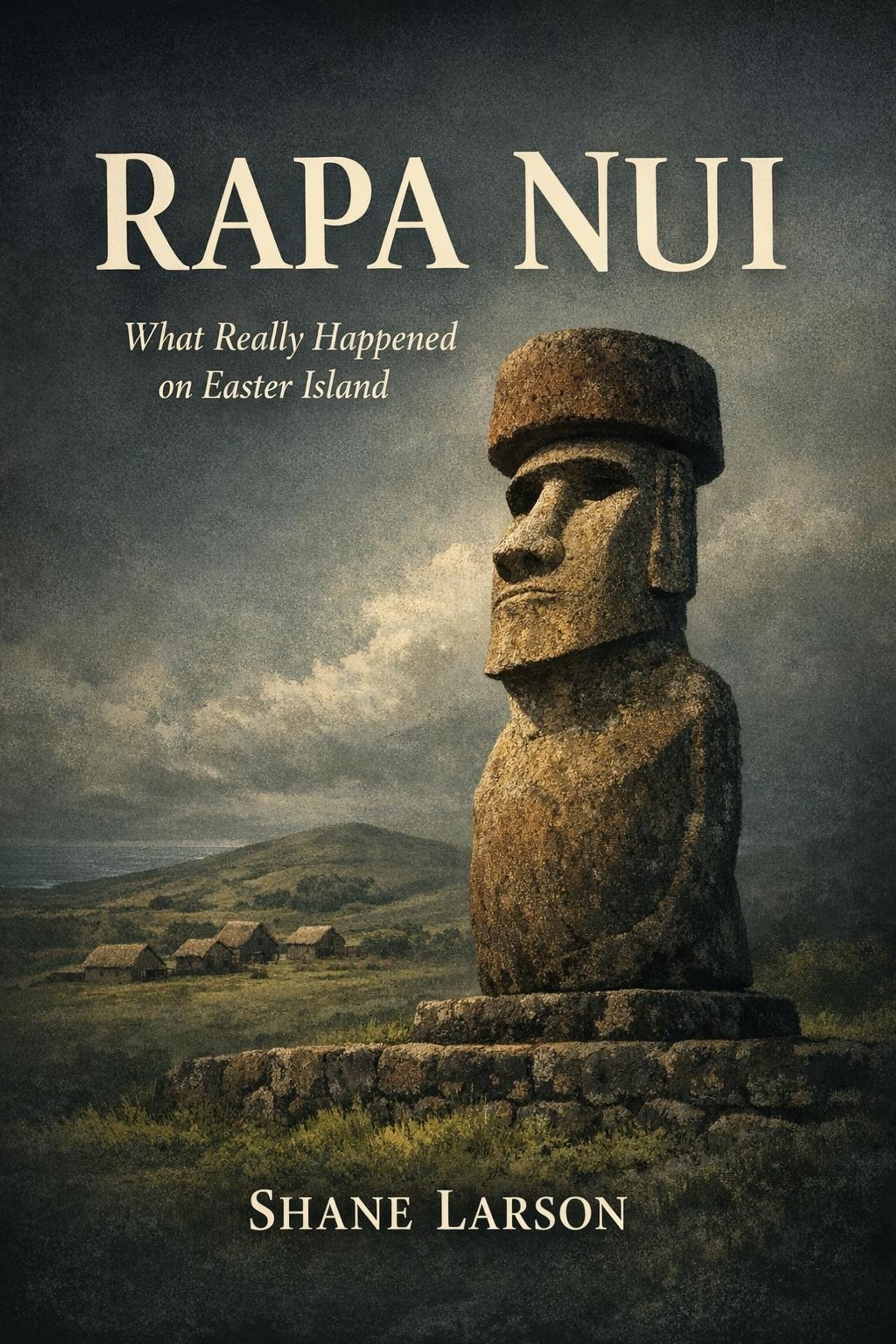
Rapa Nui
What Really Happened on Easter Island
By Shane Larson
About This Book
In 1914 a British archaeologist named Katherine Routledge landed on Rapa Nui and began asking the islanders a question that had puzzled Europeans for two centuries: how had the statues been moved? Some of them weighed as much as a locomotive, and they had been carried for miles across broken volcanic ground.
The answer she was given, repeatedly and without hesitation, was that the moai walked.
Routledge wrote it down, as a good ethnographer should. Then she and everyone who came after her filed it under mythology — a picturesque bit of folklore from people who had lost the real technique somewhere in the wreckage of the nineteenth century. The scientific answer was obvious. You lay the statue on its back on wooden rollers and you drag it. That is how heavy things move. That is how the pyramids were built.
Nobody had found a roller. Nobody had found a sledge. What everyone had was an assumption, and it turned out to be carrying an enormous amount of weight.
The Argument
If you need timber to move statues, then a society that keeps building statues keeps consuming forest. Follow that through and you get the story almost everyone knows: an island stripped bare by its own monuments, a people who cut down the last tree in service of their own vanity, famine, war, cannibalism, and a shattered remnant discovered by Europeans amid the ruins. It became the standard parable of ecological limits, taught in classrooms and repeated in bestsellers for forty years. A closed island is a small planet, and here was a complete worked example with a beginning, a middle, and a catastrophic end.
The last two decades have dismantled most of it. Radiocarbon redating moved settlement to around AD 1200, which compresses the whole story into five centuries rather than thirteen. The deforestation turns out to have been driven substantially by an animal — the Polynesian rat, which arrived in the founding canoes, has no predators on the island, and eats palm seeds. The trees that fell were not replaced, not because anyone was reckless, but because the next generation of palms was being eaten before it germinated.
And where the collapse model predicts famine, the archaeology shows the opposite. The islanders responded to a treeless landscape by engineering one that worked without trees: lithic mulching, rock gardens, and walled enclosures that trapped moisture and sheltered crops from salt wind. That is not a society failing. That is a society solving a problem, expensively and successfully, over centuries.
Then in December 1862 Peruvian slave ships arrived. Roughly fifteen hundred people were taken, including the chiefs, the priests, and the handful who could read the island's own script. Of the few eventually repatriated, most died on the way; the survivors carried smallpox ashore. By 1877 the population of Rapa Nui was about one hundred and ten people. The collapse was entirely real. It simply was not ecological, it was not self-inflicted, and it happened after Europeans arrived rather than before.
What's Inside
- The parable at full strength. Before dismantling the ecocide model, the book states it the way its most capable defenders state it — because a revision that beats up a strawman is worth nothing.
- The rats. How a fast-breeding rodent with no predators changes deforestation from a moral failure into an ecological accident, and the serious objections to leaning on that too hard.
- The walking statues. The physics of forward lean and a curved D-shaped base, why statues abandoned along the transport roads differ from those standing on platforms, and what the rope experiments did and did not prove.
- Farming without forest. Rock gardens, manavai enclosures, and the sweet-potato economy — the strongest positive evidence that this was adaptation rather than decline.
- The mata'a. Thousands of obsidian artifacts read for a century as weapons of endemic war, and what happened when someone finally analyzed their shape and wear.
- The cannibalism claim. Where it came from, how late the sources are, and why the physical evidence that should accompany it is absent.
- Contradictory Europeans. Cook found a poor island in 1774; La Pérouse found a productive one twelve years later. The collapse story resolved that by choosing.
- The raids. The documented catastrophe, set out plainly, with the archival record that has always been available.
- Rongorongo. Two dozen wooden tablets nobody can read, and the direct line between that failure and the deaths of the people who could.
Why I Wrote This
I have spent years writing about societies that ended, so Rapa Nui was always going to land on my desk eventually. What I did not expect was to find that the detective work ran backwards. Usually you are assembling a picture from fragments. Here the picture already existed, fully formed and beautifully told, and the job was to work out where it had come from — because it had not come from the evidence.
What kept me on it was the part that is not really about archaeology. The islanders said the statues walked, and they were right, and nobody believed them for a hundred years because the answer did not sound like an answer. That is a story about how knowledge gets certified and whose testimony counts. There are Rapanui people alive today who have spent their whole lives watching the world use their ancestors as a cautionary tale about somebody else's future. The least the rest of us can do is get the facts straight.
Frequently Asked Questions
Is this book saying Easter Island never had environmental problems?
No, and it is careful about this. The forest genuinely disappeared, humans genuinely contributed to that, and losing timber had real consequences for canoes and deep-sea fishing. What the evidence does not support is the causal chain — that statue-building consumed the forest, that the loss caused societal collapse, and that the collapse happened before Europeans arrived.
Is this a book attacking Jared Diamond?
No. Collapse gets a fair and serious hearing, and Chapter One makes the ecocide case as strongly as it can be made. The argument is that the evidence has moved since 2005, not that anyone was dishonest. The people who spread this story were, overwhelmingly, sincere.
What actually caused the population collapse?
Introduced epidemic disease and the Peruvian slave raids of 1862–63, followed by missionary-era disruption and the conversion of most of the island into a commercial sheep ranch. This is documentary history, recorded in archives and dated precisely, unlike almost everything in the pre-contact narrative.
Did the statues really walk?
Something close to it. Experiments have shown that a statue with the characteristic forward lean and curved base can be rocked forward upright by a small crew with three ropes, requiring no timber at all. Critics still favour horizontal transport for the largest statues, and the book presents their case. The honest conclusion is that log rollers are no longer the default assumption.
Do I need background in archaeology to read it?
None. Every method the argument relies on — radiocarbon dating, pollen cores, use-wear analysis, ancient DNA — is explained when it first matters, and the appendices include a claim-by-claim evidence table you can check the book against.
Is the debate settled?
No, and the book says so repeatedly. Serious scholars still defend substantial human responsibility for the deforestation, and several questions — the precise settlement date, the depth of any pre-contact decline, how the largest statues moved — remain genuinely open.
If You Liked This, You Might Like
- The Collapse Pattern — the framework this book stress-tests; Rapa Nui is the case where the pattern turns out to have been imposed rather than found.
- Ancient Apocalypse — a collapse that genuinely was systemic, and a useful contrast for what the real thing looks like in the record.
- Lost Civilizations of the Ancient World — the wider shelf of societies we describe as vanished, and the question of how often that word is doing too much work.
An island, a set of monuments, and a story that outran its evidence for forty years. This is where that story came from, what the archaeology actually shows, and which questions remain honestly unanswered.
What You'll Learn
- Why the deforestation of Rapa Nui was driven substantially by the Polynesian rat — and the serious objections to leaning on that explanation too hard.
- The physics of the walking statues: forward lean, a curved D-shaped base, and what the rope experiments did and did not prove.
- How the islanders farmed a treeless island — lithic mulching, rock gardens, and manavai enclosures — and why that is evidence of adaptation rather than decline.
- What use-wear analysis revealed about the mata'a, the thousands of obsidian artifacts read for a century as weapons of endemic warfare.
- Where the cannibalism claim came from, how late the sources are, and why the physical evidence that should accompany it is absent.
- Why Cook found a poor island in 1774 and La Pérouse a productive one twelve years later — and how the collapse story resolved that contradiction by choosing.
- The documented catastrophe: the Peruvian slave raids of 1862, the epidemics that followed, and the roughly 110 people left alive by 1877.
Included with Kindle Unlimited — read it free if you're a member.
New Ancient History releases and free chapters — no spam, unsubscribe anytime.