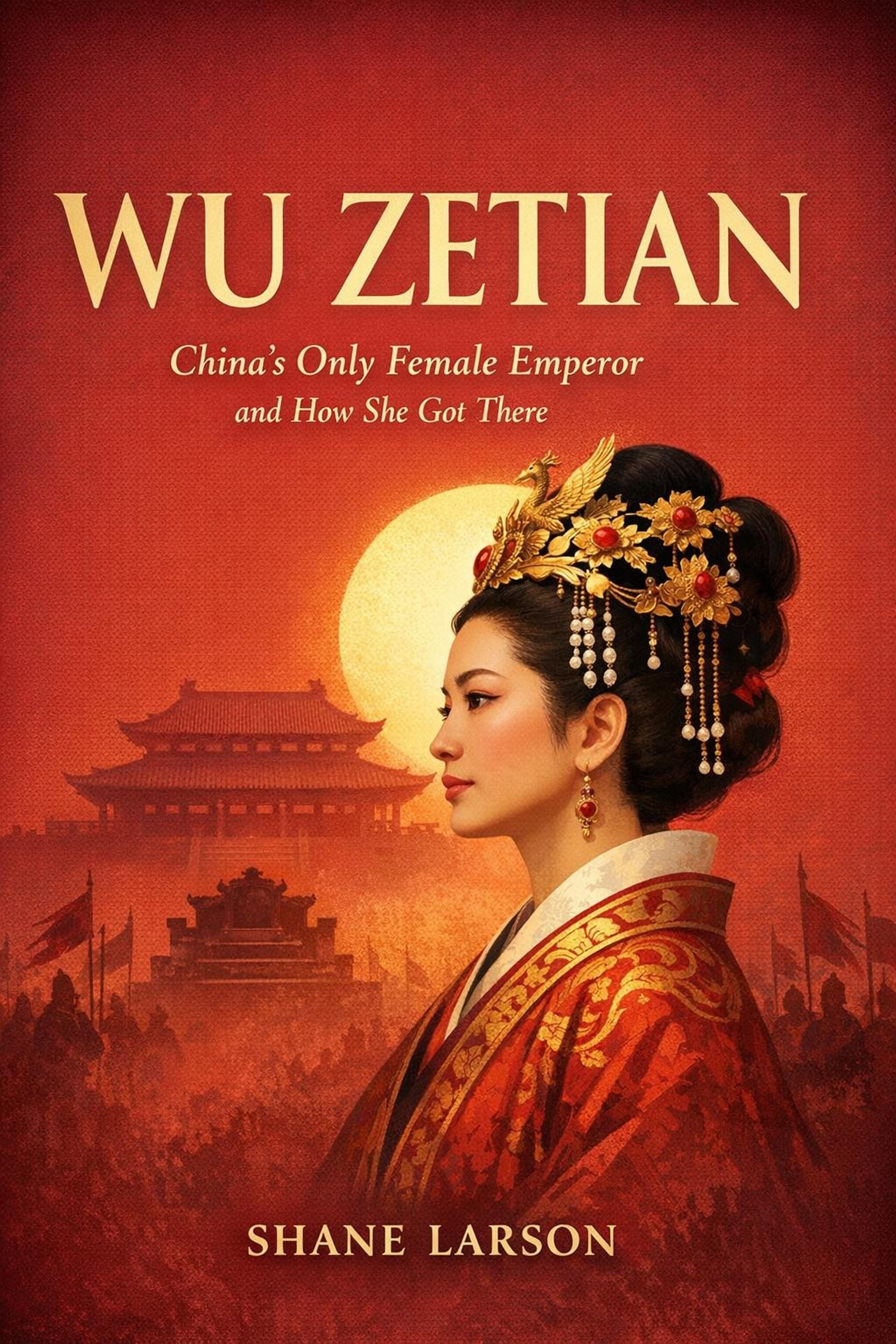
Wu Zetian
China's Only Female Emperor and How She Got There
By Shane Larson
About This Book
There is a stone tablet at the foot of Mount Liang, north of the old Tang capital, standing more than six meters tall. It was carved and raised over the tomb of a sovereign who ruled a fifth of the world's population for half a century. And it is blank. Not eroded, not defaced — deliberately, defiantly empty. Every other imperial monument of the age is crowded with praise. This one says nothing at all.
The ruler beneath it left instructions, or so the tradition holds, that others should judge her. It was an extraordinary gamble, because she knew exactly who would be holding the brush. For thirteen centuries the men who wrote China's official histories took up her challenge, and their verdict was close to unanimous: usurper, poisoner, seductress, murderer of her own children. A woman who reached too far and had to be remembered as a warning so that no woman would reach again.
The blank stone and the black legend are the same argument seen from opposite sides. One withholds the story; the other supplies a version so lurid it can't be trusted. The truth sits in the gap between them — and that gap is the subject of this book.
The Argument
Wu Zetian is the only woman in more than two thousand years of imperial Chinese history to hold the throne under her own name and title, not as a regent ruling for a boy or a dowager whispering behind a screen. In 690, at an age when most rulers were dead, she abolished the Tang and founded her own dynasty, the Zhou, with herself as emperor. The word for the office had no feminine form. She took it anyway.
Getting there took forty years and a tolerance for risk that would have destroyed almost anyone else. She entered the palace at fourteen as a minor concubine, was sent to a convent to have her head shaved when her emperor died, and came back through the bed of his son — a maneuver that should have been impossible and very nearly was. From consort she became empress, then the power behind a sickly husband, then ruler in fact, and finally ruler in name. Along the way, according to the sources, she strangled her own infant daughter to frame a rival, hunted the Tang royal clan nearly to extinction, and ran a secret police apparatus that turned a whispered accusation into a death sentence.
This book takes those charges seriously without swallowing them whole. Some of the violence is real and documented; a ruler who seizes an unprecedented throne does not do it gently. But the historians who recorded it were Confucian scholars for whom a female emperor was not merely a political problem but a violation of the natural order — heaven and earth inverted. They had every reason to make her monstrous and every tool to do it. Reading them requires the same care you'd bring to a hostile witness in a courtroom: not dismissing the testimony, but asking who is speaking and what they want you to conclude.
What emerges is neither the villain of the chronicles nor a rehabilitated icon, but something more interesting than either — a ruler of ferocious competence and genuine cruelty, in a system that gave a woman no legitimate path to power and then condemned her for taking an illegitimate one.
What You'll Discover
- The impossible return — how a shaved-headed nun in a Buddhist convent, legally finished, worked her way back into the imperial bed and then past the empress who should have stopped her.
- The dead daughter — the single most damaging accusation against her, examined against what the earliest sources actually say versus what later historians added, and why the timeline matters.
- The purge of the Li — the systematic dismantling of the Tang imperial family, and the network of informers and torturers that made opposition suicidal.
- Buddhism as a license — how she funded and promoted a religion that could imagine a female universal ruler, using scripture to make the unthinkable look ordained.
- The examinations — her expansion of the civil-service system that pulled talented commoners into government and weakened the aristocratic clans who despised her, arguably her most durable legacy.
- Half a century of stability — the unglamorous fact the legend works hardest to bury: the empire she ran did not fall apart, starve, or fragment.
- The thousand-year smear — how and why generations of scholars turned an effective monarch into a cautionary tale, and what that says about the histories we inherit.
- The wordless stele — the blank monument at her tomb, and the competing theories about what a ruler who controlled every other narrative meant by leaving this one silent.
Why I Wrote This
I kept running into her sideways. Every book about Tang China mentions Wu Zetian in the same breath and the same tone — the ruthless empress, the aberration, the woman who poisoned her way to the top — and then hurries past her to get to the poetry and the porcelain. Nobody seemed to want to sit with her.
So I went looking for the primary sources, and what struck me wasn't that the terrible stories might be true. It was how obviously the people telling them wanted her damned. You can watch the legend thicken over centuries, each historian adding a shade of black. That's not history I trust on its face, and the gap between what likely happened and what got written down turned out to be the most interesting thing about her. I wrote this because she deserved to be argued about honestly instead of dismissed, and because the way we've remembered her is a case study in how the past gets weaponized.
Frequently Asked Questions
Is this a straight biography or an argument about the sources?
Both, braided together. It runs chronologically from her entry into the palace to her death, so you get the full narrative arc. But at each contested moment it stops to ask what the evidence supports and who was writing it — the story and the reasons to doubt parts of it.
Do I need to know anything about the Tang dynasty going in?
No. The book builds the world as it goes — the court, the religious landscape, the aristocratic clans, the machinery of the examinations. If you've never read a page of Chinese history, you'll be fine. If you have, you'll see where the standard account gets complicated.
Does it decide whether she killed her daughter?
It weighs the evidence and tells you where it lands, but it doesn't pretend to a certainty the sources can't deliver. Part of the point is learning to be comfortable with "the record won't bear that much weight" instead of demanding a tidy verdict.
How does this compare to Stacy Schiff's Cleopatra?
Similar instinct — take a woman flattened into legend and reconstruct the person underneath by reading the hostile sources carefully. If you liked that approach, this works the same muscles in a different empire.
How long is it, and how much is speculation?
It's a focused narrative history of around 50,000 words, built on the documented record. Where it speculates, it says so plainly and shows its reasoning rather than smuggling guesses in as fact.
If You Liked This, You Might Like
- Hatshepsut — the other woman who took a throne that had no room for her, ruling Egypt as pharaoh centuries before Wu and edited out of the record just as thoroughly.
- Cleopatra's Egypt — a powerful queen remembered mostly through the propaganda of the men who defeated her; the same problem of reading a woman through hostile eyes.
- The Trung Sisters — women who defied imperial China directly, from the other side of the frontier, and became legend for it.
- The First Emperor — the ruler who first forged the empire Wu would one day command, and another study in absolute power and the histories written to condemn it.
- The Silk Road — the Tang world beyond her court: the Sogdian wine shops of Chang'an, the caravan trade that paid for the cosmopolitan century, and the roads that carried it all.
The blank stone is still standing. This book is one attempt to read it — not to acquit her, not to convict her on a thirteen-century-old rumor, but to meet her on the evidence and let the woman step out from behind the monster.
What You'll Learn
- How a shaved-headed nun in a Buddhist convent, legally finished, worked her way back into the imperial bed and past the empress who should have stopped her.
- The accusation that she strangled her own infant daughter — weighed against what the earliest sources actually say versus what later historians added.
- The systematic purge of the Tang imperial clan, and the network of informers and torturers that made opposition suicidal.
- How she funded and promoted a Buddhism that could imagine a female universal ruler, using scripture to make the unthinkable look ordained.
- Her expansion of the civil-service examinations, which pulled talented commoners into government and weakened the aristocratic clans who despised her.
- The unglamorous fact the legend works hardest to bury: the empire she ran for half a century did not fall apart, starve, or fragment.
- How generations of Confucian scholars turned an effective monarch into a cautionary tale — and what that says about the histories we inherit.
- The wordless stele at her tomb, and what a ruler who controlled every other narrative meant by leaving this one silent.
Included with Kindle Unlimited — read it free if you're a member.
New Ancient History releases and free chapters — no spam, unsubscribe anytime.