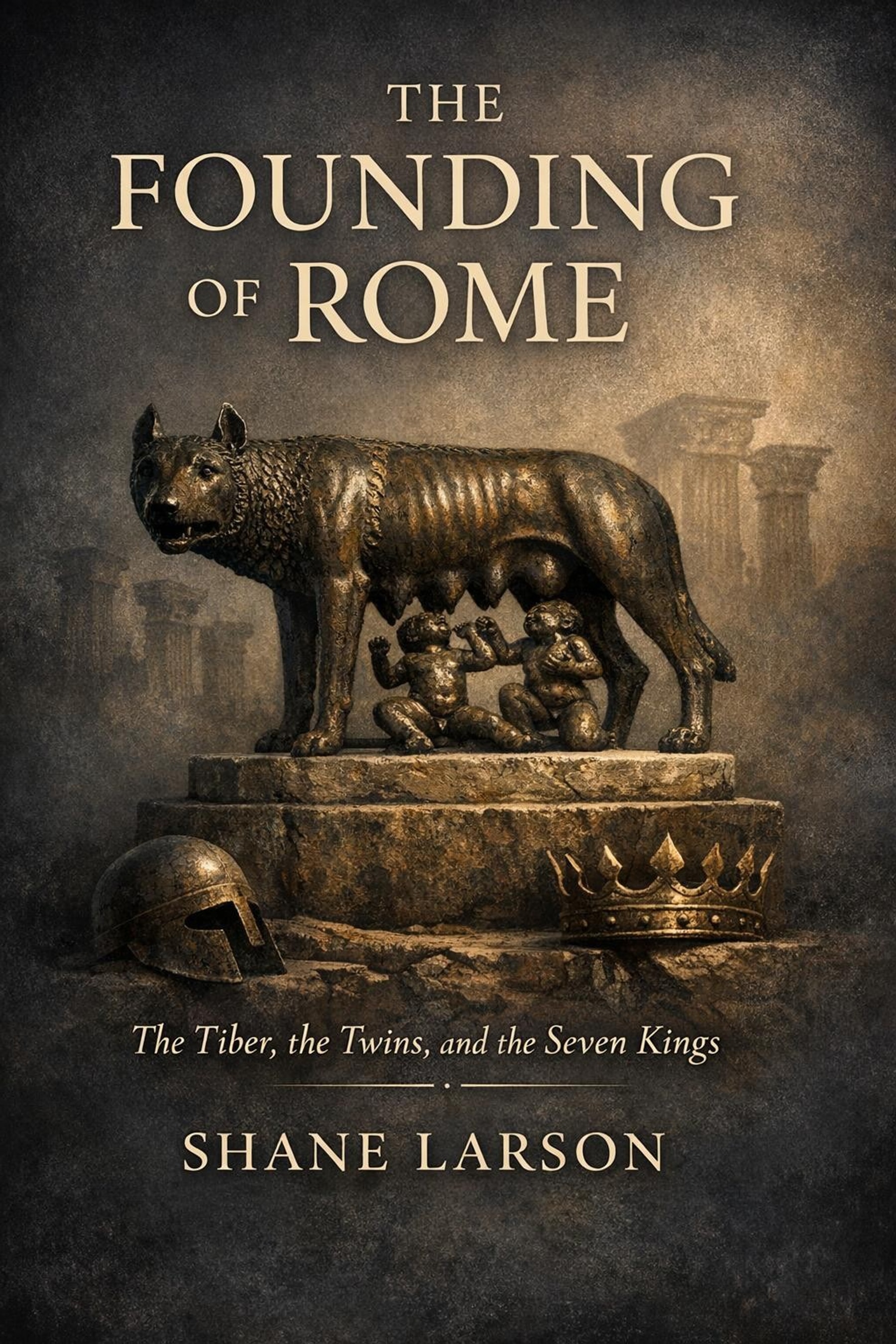
The Founding of Rome
The Tiber, the Twins, and the Seven Kings
By Shane Larson · Rome: From Village to Empire (Book 1)
About This Book
Rome is in the wrong place for a great city. It is not on the coast or a defensible height, and the farmland is ordinary. What the site has is the lowest point at which the Tiber can be crossed on foot — an island splits and slows the current — on the route salt travelled inland from the flats at the river's mouth. A ford and a salt road. Whoever held that crossing held a place other people had to pass through; every later fact about Rome flows downhill from that one. It is the one piece of the founding that needs no legend.
Everything else required legends, and the strange part — the part this book is built around — is which legends the Romans decided to live with. A brother dead over a boundary line on day one. A population recruited by open invitation to debtors, exiles, and escaped slaves. Wives obtained by seizing them from guests at a religious festival. A monarchy ended by an aristocratic woman's public suicide. Athens claimed its people had sprung from the soil of Attica, clean and unarrived. Rome kept the grave, the fugitives, and the abduction.
The Founding of Rome follows the five centuries from the first Iron Age huts above the crossing to the expulsion of the last king in 509 BC — the wolf, the wall, the Sabine war, the seven kings — at full narrative pressure, weighed against what the ground beneath the city actually shows.
The Argument
Line up the founding stories and a single pattern emerges that has nothing to do with wolves or omens. The city's first recorded policy is an asylum: come, whoever you are, whatever you are running from, and be Roman. The war the abduction causes ends not in victory but in fusion — two kings on one throne, the defeated moving inside the walls, the Romans afterward calling themselves Quirites, plausibly the name of a Sabine town. Alba Longa, Rome's own mother city, is demolished and its population carried inside and enrolled. A half-Greek immigrant from Etruscan Tarquinii talks his way onto the throne; his successor, remembered in one tradition as a slave's son, counts the whole accumulation and files it into a single graded citizen body. Rome's origin story, read whole, is not about defeating people. It is about absorbing them — told by the civilisation that then spent a thousand years doing exactly that.
The sources demand a strict discipline about evidence: Livy wrote seven centuries after the events, from a tradition already patched, inflated, and burned over. So every claim arrives in one of three registers, never mixed: the tradition says, for legend reported as legend; Livy reports (or Dionysius, or Plutarch), for a specific late author who can be weighed and caught embroidering; and the archaeology shows, for physical evidence with its own hard limits. You will always know which of the three you are holding.
And there is archaeology worth holding: the postholes of oval huts cut into the Palatine rock, dated to roughly the century in which the Romans placed their founding; a burial ground beneath the Forum older than the city's politics; and an inscription in Latin so archaic the late Republic struggled to construe it, with a reference to a king among its legible words. None of it confirms a name from the legend. All of it confirms a real settlement, begun about when the tradition claims, poorer and stranger than the story that grew over it.
What's Inside
- Aeneas and Romulus — two founders who cannot both be right, centuries apart, and the transparently invented Alban king list that papers over the gap.
- The wolf, and the other reading the Romans preserved: lupa meant she-wolf and also prostitute, and some ancient writers said plainly which one nursed the twins.
- The asylum — why the neighbours saw a bandit camp, and why their refusal to intermarry with it set the catastrophe in motion.
- Five full chapters on the Sabine arc: the refused embassies, the seizure at the festival of Consus, Tarpeia and the shields, the women's walk between two armies with their children, and the merger that ended it.
- The kings as machine-builders: the calendar and the priesthoods, the destruction of Alba Longa and the relocation of its people inside the walls, the great drain that turned the Forum from swamp into civic floor, and the census whose classes Rome was still voting in five centuries later.
- Lucretia, Brutus, and the night the monarchy fell — how a private atrocity became a public constitution, and why rex became a word no Roman politician could survive.
- Three appendices: who wrote this history down and when; all seven kings, the plausible and the retrojected; and a site-by-site tour of the archaeology under the Forum.
Why I Wrote This
What hooked me was not the wolf or the wall. It was watching Livy squirm. He tells of the abduction and then justifies it three different ways in the space of a page — and a writer only does that when he knows the story is indefensible and cannot stand to lose it. That is the puzzle I could not put down: a civilisation with a thousand years and the best literary talent in the ancient world, which never once wrote itself a cleaner origin. It kept the fratricide. It kept the abduction. Then it spent seven centuries apologising for both. Somewhere in that long wince, it seemed to me, was the most honest thing Rome ever said about itself, and I wanted to find out what it was.
Frequently Asked Questions
Was Romulus a real person?
Almost certainly not as the tradition describes him, and possibly not at all — his name looks derived from the city's rather than the reverse, the usual signature of an invented founder. The evidence does support a real eighth-century settlement on the Palatine, and real kings ruling early Rome. Whether any single founder stood at the beginning is a question the sources cannot answer, and the book says so.
Is there any archaeological evidence for the founding of Rome?
Yes: hut foundations on the Palatine from roughly the traditional founding era, a burial field under the Forum, and the archaic Lapis Niger inscription that mentions a king. What archaeology cannot do is attach names or stories to any of it — a posthole cannot tell you who cut it — and the book is explicit about that line.
Do I need to have read other Roman history first?
No. This is deliberately the starting point — Book One of a series running from the first huts to the fall of the empire — and it assumes no prior knowledge. Latin terms are glossed in plain English, and the appendices carry the reference material.
How does the book handle the Sabine episode?
Plainly, and without resolving what the sources leave unresolved. The seizure is described as the sources describe it, the ambiguity in the Latin word raptio is explained rather than quietly settled, and the ancient writers' visible discomfort — Livy's stacked justifications, Dionysius's legal briefs, Ovid's appalling approval — is treated as historical evidence. The women's intervention between the armies gets a full chapter, including whether that scene redeems the seizure or indicts it further.
Does the book treat the legends as true?
No — but not as garbage either. The legends are evidence: not of what happened in 753 BC, but of what Rome believed itself to be. The book tells the stories properly, labels them honestly, and never lets them blur into the physical evidence.
If You Liked This, You Might Like
- The Etruscans — the civilisation across the river that supplied Rome's kings, engineering, and most of its public symbols; Chapter 15 of this book is a doorway into it.
- Julius Caesar — the far end of the road that starts here: the man who died, five centuries later, over the word this book ends by outlawing.
- Spartacus — the city built on an asylum for runaway slaves, seen from underneath, when a slave finally answered back with an army.
- The Fall of Rome — the other bookend: how the machine for turning outsiders into Romans finally stopped, and what followed.
How did a swamp, a ford, and a crowd of people no other city wanted become the power the whole ancient world had to answer to? This is where that story begins. Rome: From Village to Empire, Book One.
What You'll Learn
- Why Rome sits in the wrong place for a great city — and why the ford and the salt road made it inevitable anyway
- Aeneas and Romulus: two founders who cannot both be right, and the invented Alban king list that papers over four centuries
- The wolf, and the other reading the Romans themselves preserved — lupa meant she-wolf and also prostitute
- The asylum: why the neighbours saw a bandit camp, and why their refusal to intermarry set the catastrophe in motion
- Five chapters on the Sabine arc — the refused embassies, the seizure at the festival of Consus, Tarpeia and the shields, and the merger that ended it
- The seven kings as machine-builders: the calendar, the great drain that turned the Forum from swamp into civic floor, and the census Rome was still voting in five centuries later
- Lucretia, Brutus, and the night the monarchy fell — how a private atrocity became a public constitution
- What the ground actually shows: Palatine hut postholes, the burial field under the Forum, and the archaic Lapis Niger inscription that names a king
Included with Kindle Unlimited — read it free if you're a member.
New Ancient History releases and free chapters — no spam, unsubscribe anytime.
More in Rome: From Village to Empire
View series →