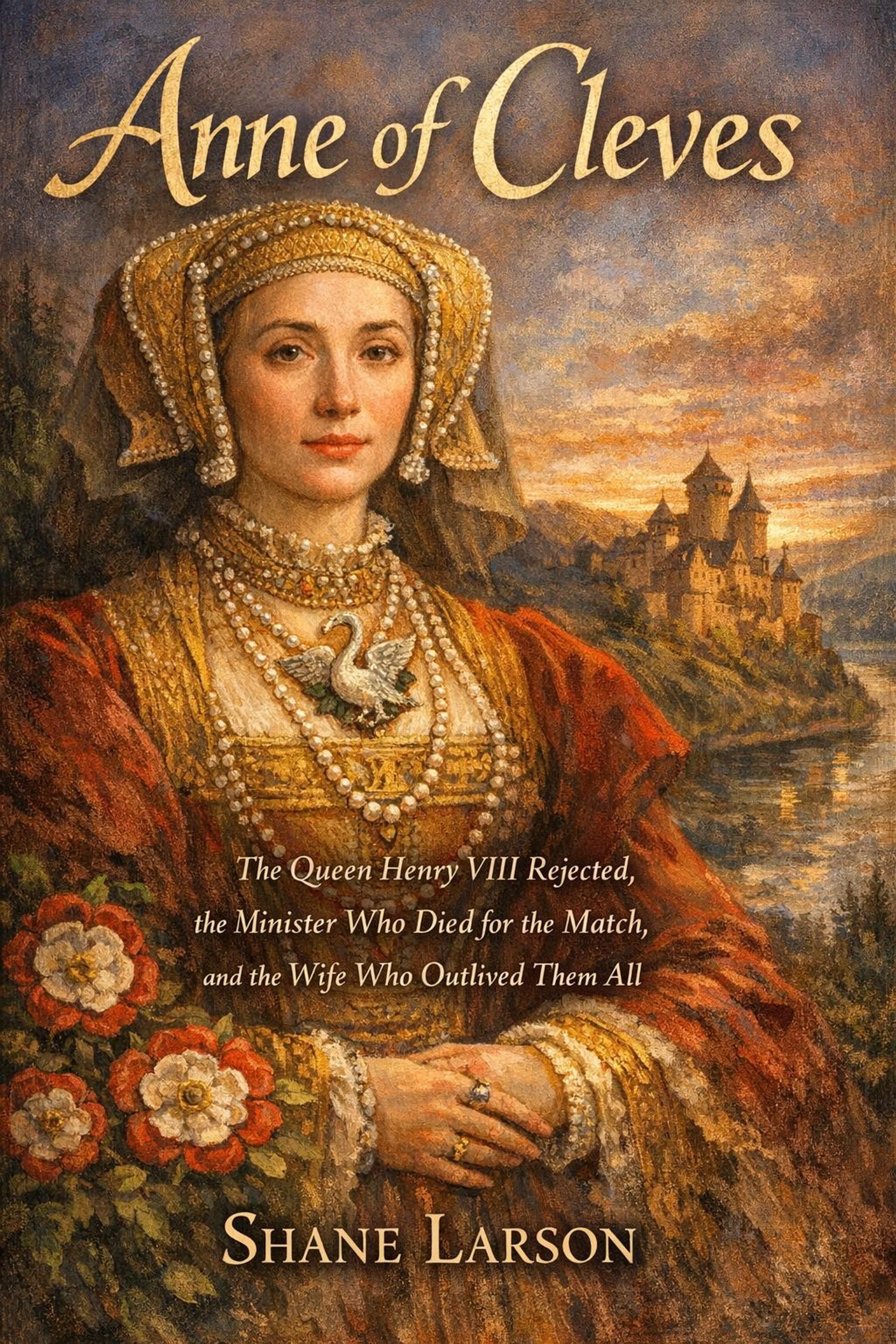
Anne of Cleves
The Queen Henry VIII Rejected, the Minister Who Died for the Match, and the Wife Who Outlived Them All
By Shane Larson
About This Book
On the morning of 28 July 1540, Thomas Cromwell was led out to the scaffold on Tower Hill and beheaded. The same morning, at Oatlands, Henry VIII privately married Catherine Howard, nineteen, who had come to court eight months earlier as a maid of honour to the queen. Two days later six men died at Smithfield, three burned and three hanged.
The queen whose maid had just become queen was at Richmond, where she had been sent on 24 June on the excuse of plague. On 9 July the clergy had declared her marriage void. On 11 July she had signed a letter accepting the judgement, and within days she had sent back her wedding ring with a request that it be broken up. She had been Queen of England for six months and had never been crowned. She was twenty-four.
The minister who made her marriage was dead. The man who had married her had married someone else. And Anne of Cleves, who had landed at Deal on 27 December speaking no English, with no party at court and no appeal, was the only one of them still standing. She stayed standing for seventeen more years.
The Line Everyone Knows and the Record Nobody Reads
Ask most people what they know about Anne of Cleves and you get a horse. The "Flanders mare" is a line from 1679, written by a bishop who gave no source for it. What the sixteenth century actually recorded, in four words gathered six months after the fact for an annulment, is "I like her not." That is a different sentence about a different thing, and the whole book follows from the difference.
Behind the phrase is a story thin where the legend is thick and full where the legend is silent. Six months of queenship will not honestly fill a book, and this one says so and builds accordingly. Its first part is in Germany: the United Duchies of Jülich-Cleves-Berg, a Rhineland state with a church reformed in 1532 without breaking from Rome, and a quarrel with Charles V over Guelders that is the actual reason an English king married a princess from Düsseldorf. The middle is the match and its unmaking as one story: the isolation of 1539 that drove Cromwell toward the Rhine, Holbein at Düren, the hooded king at Rochester, and the minister's fall once the alliance was no longer needed. The last part follows Anne through three reigns as the king's sister, with houses at Richmond and Hever, and precedence over every woman in England but the queen and the king's daughters.
The argument lives in that last part. Five of Henry's queens are defined by how they fought, and four of them lost. Anne is the one defined by how she settled: she agreed inside a week, she asked for terms, and for seventeen years under a Henrician, a Protestant and a Catholic regime she stayed out of every faction. The book calls that skill rather than luck, and makes the case from what she did, since what she thought is not on record.
Why I Wrote This
What got me was the arithmetic. Of six wives, the one Henry rejected on sight is the one who outlived him and all the others, and the only one buried in Westminster Abbey, and no book I had read treated that as the point rather than a footnote. Everything written about Anne for three hundred years has been written around a line a bishop produced in 1679, and the two clichés it bred, the plain German and the lucky one, both give her nothing to do. The record does. It is thin where she is the subject and rich around the edges, in Cleves, in Cromwell's office, in the household accounts, and following those edges turned out to be a way of writing about her honestly. The other draw was the Rhineland: a reformed church that stayed Catholic, a duke called the Peaceful, a tutor who had learned from Erasmus that the middle of the road was a place.
Frequently Asked Questions
Did Henry VIII really call Anne of Cleves a Flanders mare?
No record from her lifetime contains the phrase. It first appears in Gilbert Burnet's History of the Reformation in 1679, more than 130 years after Henry's death, and Burnet gave no source. The words that do survive, in a courtier's sworn statement six months later, are "I like her not." The book traces how the later phrase spread through Agnes Strickland's Victorian chapter and on into television drama.
Do I need to read Jane Seymour first?
No. This volume opens in early 1539, where Volume 3 ends, with Cromwell's agents at the Saxon and Cleves courts, and the hand-off takes one paragraph. Henry's first three marriages are assumed, not retold.
Was the marriage ever consummated, and why was it annulled?
The king said it was not, his physicians and his minister supported him, and the queen's ladies reported a conversation gathered for the same purpose. Convocation voided the marriage on 9 July 1540 on three grounds: an old betrothal to the heir of Lorraine, the king's lack of inward consent, and non-consummation. The book sets out each ground and who supplied the evidence for it.
What happened to Anne of Cleves after the annulment?
She lived in England for seventeen years as the king's adopted sister, through the reigns of Henry, Edward VI and Mary I. She rode in Mary's coronation procession beside Elizabeth, died at Chelsea on 16 July 1557 aged forty-one, and was buried in Westminster Abbey. Part Four of the book is given to those years.
If You Liked This, You Might Like
- Jane Seymour — the volume before this one: the widowerhood and the failed search for a bride that ends where this book begins.
- Anne Boleyn — the queen whose fall Cromwell managed four years before his own, and whose family house at Hever came to Anne of Cleves in the settlement.
- Catherine of Aragon — the wife who was offered terms in 1528 and refused them; the comparison this book's argument rests on.
- Suleiman the Magnificent — the Ottoman pressure on Charles V that shaped every truce and treaty of 1538–43.
Behind a seventeenth-century joke is a woman who treated a king's will as weather, kept her life, her income, her rank and her people, and lies in the church where English kings are crowned. Anne of Cleves: The Queen Henry VIII Rejected, the Minister Who Died for the Match, and the Wife Who Outlived Them All is the record of how she did it, told from the sources that survive and stopping where they stop.
Volume 4 of a series on the six queens of Henry VIII.
What You'll Learn
- **Cleves as a real place** — four territories joined by one marriage into one of the larger lay states of the Empire; the Erasmian church ordinance of 1532; and the Anabaptist kingdom at Münster next door that taught every ruler on the Rhine to fear the extremes.
- **Rochester turned over** — the chivalric game of the disguised suitor and how it was meant to go, the depositions sworn six months later for a court that had already decided, and the reading in which Anne lost the king's game by behaving correctly.
- **Cromwell's fall as part of the marriage** — Earl of Essex on 18 April, arrested at the council table on 10 June, the Tower letter of 30 June, and the honest debate over how much of it was Cleves and how much was his enemies at home.
- **The settlement, house by house** — Richmond, Bletchingley, Hever, Dartford, Penshurst, Chelsea; the paper income of about £4,000 a year and how far the receipts fell short.
- **Seventeen years** — kneeling to Catherine Howard at New Year 1541; the rumour of a child, examined and dismissed; the chariot of cloth of silver shared with Elizabeth in 1553; and the will of July 1557, which names Mary, Elizabeth, her brother, her sister and her German servants, and never mentions Henry at all.
- **What they said about her face** — an appendix laying every surviving remark about her appearance in one dated table, from Mont to Burnet, with each writer's interest named. It is a short table.
New Early Modern History releases and free chapters — no spam, unsubscribe anytime.
More in This Genre
View all →