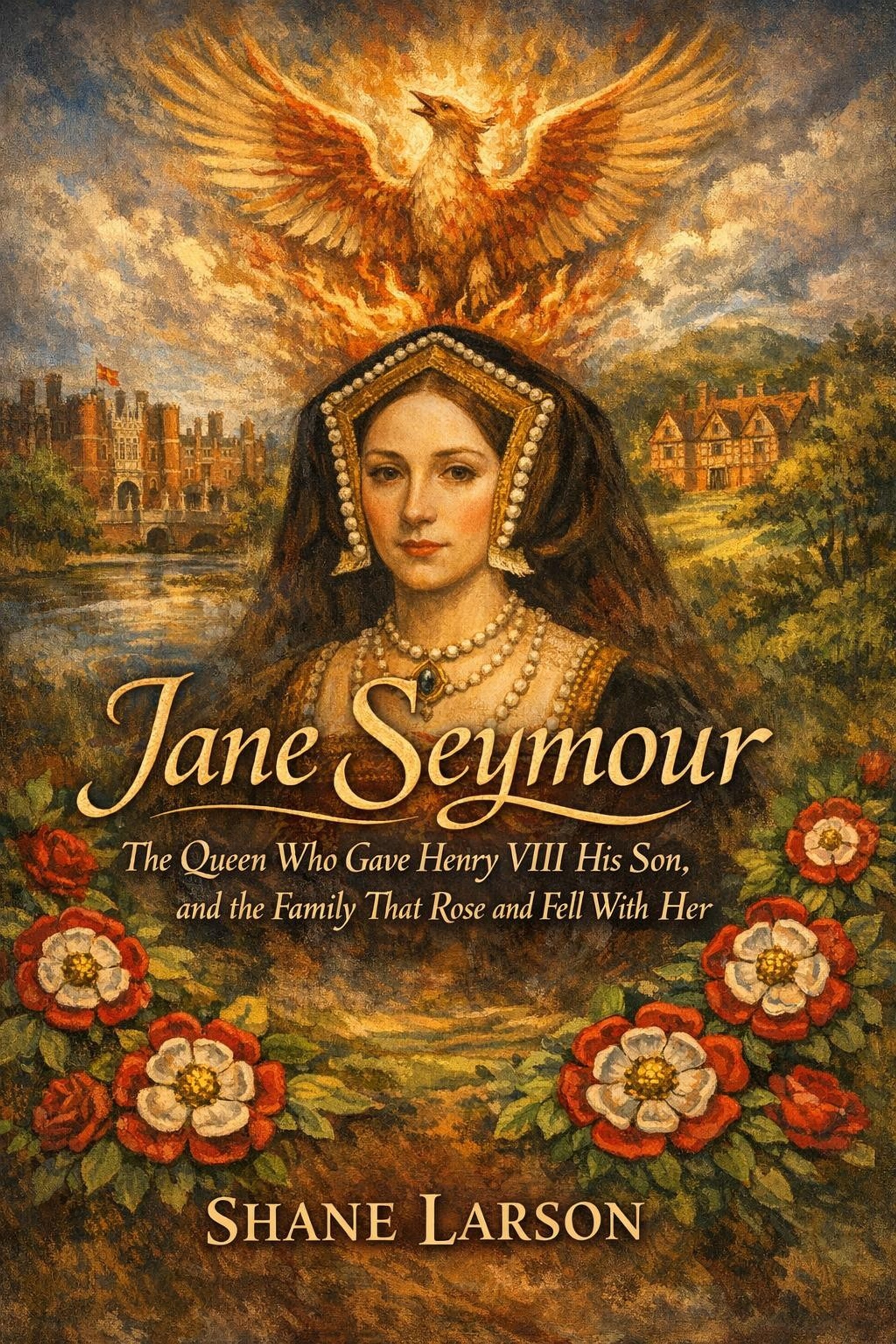
Jane Seymour
The Queen Who Gave Henry VIII His Son, and the Family That Rose and Fell With Her
By Shane Larson
About This Book
At midnight on 15 October 1537, in the Chapel Royal at Hampton Court, a three-day-old boy was christened Edward. His godmother was his half-sister Mary, who a year earlier had signed away her own legitimacy to get back into their father's favour. His other half-sister, Elizabeth, four years old and lately bastardised by Act of Parliament, carried the chrisom cloth, and was herself carried by the baby's uncle, Edward Seymour. Within the week that uncle was Earl of Hertford. Within a decade he would be Lord Protector of England.
The boy's mother was not in the chapel. She had come through a labour the sources describe as lasting two days and three nights, and the council's letters over the following days record a decline. On 24 October she died. She had been Queen of England for seventeen months and had never been crowned.
Twelve years later the uncle who carried Elizabeth signed his own younger brother's death warrant. Three years after that he went to the block himself, and the boy christened that night wrote it into his journal in a single line. None of it would have happened without Jane Seymour, and she saw none of it.
The Quiet Wife and the Family That Was Not
Jane Seymour is the wife the group biographies pass over quickly. In a set of six she is the one who did not fight a divorce, did not break a church, did not get accused of adultery, and did not survive. The usual word is quiet, and the record bears it out. She left a handful of formal letters, two Holbein likenesses, a motto, and a few remarks reported at one or two removes by an ambassador who wanted her to succeed. Even her birth year is an inference from the number of women who walked in her funeral procession.
This Jane Seymour biography takes that thinness seriously instead of papering over it. Jane is never given a thought, a feeling or a motive the sources do not record, and when the sources go silent the book says so and turns to the people who did leave records: Eustace Chapuys writing to the emperor every few days, Cromwell's office keeping everything, the Lisles at Calais describing the queen's household from the inside, the pilgrims of 1536, and her brothers, whose careers can be followed year by year.
The argument is that the quiet wife is the consequential one. In her seventeen months Mary was broken into submission and brought back to court; a new Act of Succession bastardised both of Henry's daughters and settled the crown on children Jane did not yet have; the North rose under the banner of the Five Wounds in the most dangerous rebellion any Tudor faced, and was pardoned and then hanged; and at Hampton Court she gave birth to the only legitimate son Henry VIII ever had. Very little of it was her doing. All of it turned on her. Then the family she had raised took over, one brother governing England for her son and the other marrying the king's widow, until both had died on Tower Hill. No six-wives book follows that story to its end. This one does.
Why I Wrote This
What hooked me was the gap between how little Jane Seymour left and how much turned on her. Six wives, and the one Henry chose to be buried beside is the one nobody can describe. Every life of her has had to solve that problem, and most have solved it by telling me what she must have felt. I did not want to write another of those. The family solved it for me. The Seymours left records: careers, letters, warrants, a boy king's journal. Following them from a forest in Wiltshire to Tower Hill turned out to be a way of writing about Jane honestly, by writing about the world her marriage made and then unmade, and saying "the sources do not say" wherever that was the truth. The Pilgrimage of Grace was the other draw: it rose in her first autumn as queen, and in most six-wives books it gets a paragraph.
Frequently Asked Questions
Do I need to read Anne Boleyn first?
No. This volume stands alone. It opens on 20 May 1536, the day after Anne's execution, and refers back to the second volume for her fall rather than retelling it. Nothing here depends on having read it.
How did Jane Seymour really die, and was it a caesarean?
She died on 24 October 1537, twelve days after giving birth, after a decline the council's letters record. The book sets out the diagnoses the evidence can support, puerperal fever and a retained placenta among them. No contemporary source supports a caesarean; the story grew up afterwards in later polemic, and the book traces where.
Was Jane Seymour really Henry VIII's true love?
The honest answer is that the evidence is compatible with love and does not require it. Henry mourned her and asked to be buried with her; she was also the only wife who died with the marriage intact and the only one who gave him a son. Whether she loved him is a question nothing surviving can answer, and the book does not pretend otherwise.
Does the book cover the Pilgrimage of Grace in detail?
Yes, across two chapters and an appendix, from the Lincolnshire rising to the executions that followed Bigod's rising. The pilgrims' grievances and the crown's case are both put fairly, and the contested figures are given as ranges.
Is this the same story as the Wolf Hall novels?
No. Wolf Hall was the real Seymour house in Wiltshire, and the first part of this book is about the real family that lived there. Nothing in it comes from fiction. Where it reports what a Seymour said, the source is sixteenth-century and named, and where a famous story about the family is late or contested, the book says so.
If You Liked This, You Might Like
- The Hundred Years' War — the English claims in France that Jane's brother was still fighting for at Boulogne in 1544, and why an English king thought he had business there at all.
- Justinian and Theodora — another court where a rising in the capital came within hours of toppling the throne, and another empress known mainly through a witness with an agenda.
- The Norman Conquest — the longer story of the English crown and the question of who inherits it, which is the question Jane's son was born to answer.
A woman does not have to be interesting to be important. This is the record of what one quiet queen set in motion, told from the sources that survive and stopping where they stop.
Volume 3 of a series on the six queens of Henry VIII.
What You'll Learn
- **Wolf Hall before it was famous** — the house on the edge of Savernake Forest, the hereditary wardenship that gave the Seymours their standing, and the royal blood on their mother's side.
- **The spring of 1536 from Jane's side** — the purse of gold returned unopened, Cromwell's Greenwich rooms handed to her brother, and the question the evidence cannot close: willing player, coached pawn, or a woman in the right place.
- **The queen's household through the Lisle Letters** — a place sought for a daughter from Calais, the French hood giving way to the gable hood, and the quails sent across the Channel for a pregnant queen's craving.
- **The Pilgrimage of Grace at full length** — Lincolnshire, Robert Aske and the Five Wounds, Norfolk outnumbered at Doncaster, the pardon, Bigod's rising, and the reckoning that followed.
- **The report of Jane on her knees** — the plea for the abbeys and Henry's warning to remember her predecessor, traced to its single source and weighed for what it is worth.
- **The birth, the death and the caesarean story** — the diagnoses the evidence can support, and where the surgical myth came from, since no contemporary source supports it.
- **The Protector and the Admiral** — Edward Seymour from a page in a princess's wedding train to Duke of Somerset, Thomas from the Admiralty to a January night in the palace and the dog found dead at the king's door, and the rivalry that put both on the block.
- **What Jane left** — an appendix listing every surviving letter, likeness and reported word with its source and its reliability. It is short, and the shortness is the point.
New Early Modern History releases and free chapters — no spam, unsubscribe anytime.
More in This Genre
View all →