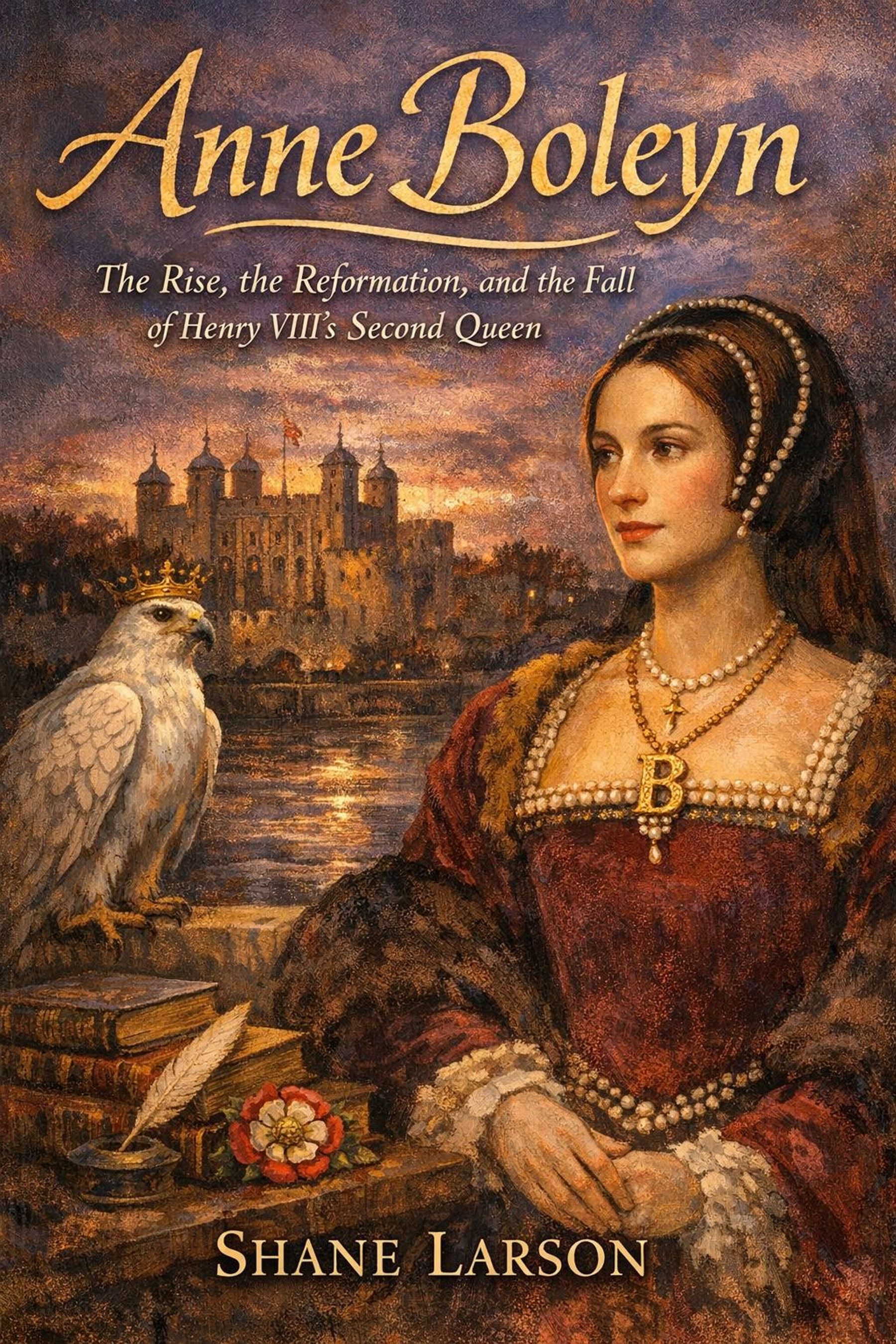
Anne Boleyn
The Rise, the Reformation, and the Fall of Henry VIII's Second Queen
By Shane Larson
About This Book
On the afternoon of 2 May 1536 a barge brought the Queen of England down the Thames from Greenwich to the Tower of London. The Constable, Sir William Kingston, met her at the gate. By his own report she asked him whether she was going into a dungeon. He told her no; she was going to the lodging she had used before her coronation, three years earlier almost to the month. Then she knelt, and laughed, and wept, and talked — and Kingston, who had been told to listen, wrote it all down for Thomas Cromwell.
Those letters are the closest thing we have to Anne Boleyn's own voice at the end of her life. Two centuries later a fire in the library that held them burned their edges away, so that the sentences the case may have turned on now end in holes. That is the condition of almost everything about her: the most important evidence is damaged, partisan, written down long afterward, or missing.
Seventeen days after that barge landed, she was dead.
How a Queen Fell in Seventeen Days
The question that drives this Anne Boleyn biography is not whether she was guilty — most historians are sure she was not — but how a woman who had outlasted a cardinal, a queen, a Pope's resistance and Thomas More could be undone in a single spring by charges that do not survive a calendar. The answer depends on where you start, and the book starts where she did: in the households of Margaret of Austria at Mechelen and Queen Claude in France, where a diplomat's daughter acquired the languages, the music, the clothes and the reading that made her the most cosmopolitan woman at Henry VIII's court.
From there it follows her home in 1522, through a broken engagement to an earl's heir and years of refusing to become the king's mistress, into the long campaign that turned Henry's wish for a son into a break with Rome. It takes seriously the question most romances skip: was Anne the cause of the English Reformation, or the occasion for a revolution Henry, Cromwell and Cranmer wanted for their own reasons? Her own religion is laid out as the argument it still is among historians, with the evidence for an evangelical queen and the evidence for a conventional one side by side.
Then the queenship, which was shorter and stranger than legend allows. A coronation in cloth of gold, six months pregnant. A daughter instead of a son. A patron of scholars and reformers who quarrelled with Cromwell over what to do with monastic money. And a marriage that rested on one promise she could not keep.
Why I Wrote This
I went looking for one book that would lay out the arguments about her fall side by side, and could not find it. Each serious life of Anne argues a case, often well, and the reader comes away believing whichever historian they happened to read first. Meanwhile the novels and dramas have filled the gaps with scenes that never happened, and many readers can no longer tell which parts are sixteenth-century evidence and which are twenty-first-century invention. What hooked me was how little is certain about the most famous queen in English history — no firm birth year, no face painted from life, no grave anyone can swear to — and how much of what everyone "knows" comes from her enemies. I wanted to write a life that shows its sources at every turn and trusts the reader to weigh them.
Frequently Asked Questions
Was Anne Boleyn guilty of the charges against her?
Almost certainly not as charged. On several of the dates the indictment names she can be placed somewhere else, and most historians believe the case was built backward from a verdict. The book sets out the minority view too, that something she said or did gave her enemies material, and lets the reader weigh it.
Do I need to read Catherine of Aragon first?
No. This volume stands alone. It refers back to the first volume for the canon-law case and Henry's early reign, and readers who want that story in full will find it there.
How is this different from the novels and TV dramas about Anne Boleyn?
Nothing in it comes from fiction. Where a famous scene rests on a single hostile witness, a source written decades later, or nothing at all, the book says so. Several well-known "facts" — the sixth finger among them — turn out to trace back to a polemic written fifty years after her death.
Does the book say whether Anne was Protestant?
It presents the evidence on both sides rather than deciding. She protected evangelical scholars and owned reformist books, which one major historian reads as conviction; another argues she remained a conventional Catholic of a reforming kind. The book explains why the question is hard to close.
Where is Anne Boleyn buried?
In the chapel of St Peter ad Vincula inside the Tower of London. Remains identified as hers were examined during restoration work in 1876, but the identification rests partly on assumption, and the book explains why it cannot be treated as certain.
If You Liked This, You Might Like
- Theodora — another queen whose story survives mainly through a writer who hated her, and another exercise in reading hostile evidence without being captured by it.
- The Hundred Years' War — how England came to hold Calais, the last fragment of its French possessions and the town that supplied Anne's executioner.
- The Thirty Years' War — where the religious split Anne's England took part in led a century later, when it set the continent on fire.
She left almost no certainties behind her, and a great deal of argument. This is that argument, laid out in the open, with every witness named and the verdict left to you.
Volume 2 of a series on the six queens of Henry VIII.
What You'll Learn
- **Her education abroad** — Mechelen and the French court given the room they need, because they explain the woman who came home in 1522.
- **The birth-year problem** — 1501 or 1507, with every source on each side, and what six years change about every later reading of her choices.
- **Henry's letters** — the seventeen that survive, how they reached the Vatican Library, and what can and cannot be read into them.
- **The reformist books** — the story of Tyndale's banned treatise reaching the king, how late its sources are, and why it matters anyway.
- **The marriage date** — two candidates two months apart, one from a chronicler and one from later testimony, and what each implies about when Anne conceded.
- **Elizabeth** — the birth, the amended letters, the Succession Act, and the shadow it threw over Henry's elder daughter.
- **The spring of 1536** — Jane Seymour's rise, the almoner's sermon against Cromwell, the ambassador's bow, and the open question of when Henry decided.
- **The arrests and trials** — the five men, the Tower conversations, the verdicts, and the swordsman sent for from Calais.
- **The indictment against the calendar** — an appendix setting each alleged offence beside where Anne actually was.
- **Every explanation of her fall** — a minister's coup, a court in panic, a case with something in it, a queen convicted by her own words, a king who wanted it done.
New Early Modern History releases and free chapters — no spam, unsubscribe anytime.
More in This Genre
View all →