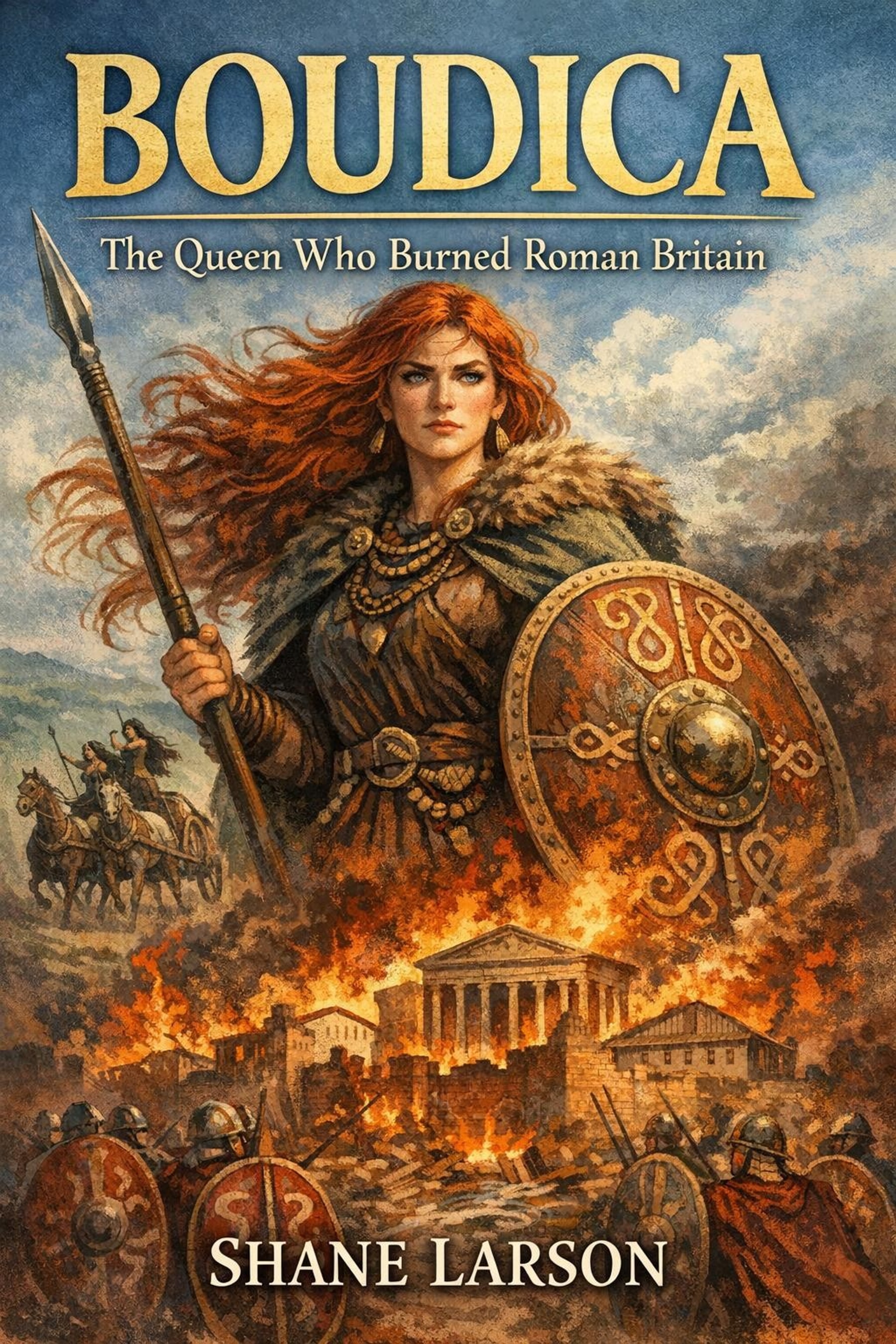
Boudica
The Queen Who Burned Roman Britain
By Shane Larson
About This Book
Rome flogged a queen and assaulted her daughters. Within months, three Roman cities were ash.
In 60 CE, Roman officials in Britain made a decision so casually cruel they could not have understood what it would cost them. The Iceni king Prasutagus had died, leaving his kingdom jointly to his daughters and the Emperor Nero — a careful arrangement designed to keep the peace. Rome ignored it. Soldiers seized the royal estates, flogged the widow Boudica in front of her people, and assaulted her two daughters. They expected the Iceni to absorb the humiliation the way conquered peoples were supposed to.
The Iceni did not absorb it. They, the long-aggrieved Trinovantes, and other tribes raised an army of perhaps fifty thousand and walked it straight into the heart of Roman Britain.
Camulodunum — modern Colchester, the symbolic capital of the new province — had no walls. The Temple of Claudius became first a refuge, then a tomb. The Ninth Legion's relief column was destroyed on the road. The governor Suetonius Paulinus, campaigning in Wales, raced east to find Londinium undefended and made the coldest decision of his career: he abandoned the city. The rebels burned it so completely that archaeologists still find the red-orange ash layer beneath modern London — the Boudican destruction horizon, almost two thousand years old. Verulamium followed. Tacitus put the dead at seventy thousand.
Then came the final battle, fought in a defile along Watling Street. Boudica's army outnumbered the Romans ten to one and was annihilated against its own wagon train. She died soon after — by poison according to Tacitus, by illness according to Cassius Dio — but she was never captured. No body was paraded through Rome.
Boudica is the full story: the province before the revolt, the specific cruelties that ignited it, the burning of three cities, the military campaign, the final battle, and the strange afterlife of a queen whose meaning every later age has remade in its own image.
What you'll discover:
The bargain between Rome and the client kingdoms — how it was supposed to work, and the precise moment it broke What actually happened on the Iceni royal estates the day the Roman officials arrived How an army of fifty thousand assembled without Roman intelligence noticing The archaeological record: burned timber, carbonized grain, decapitated heads beneath three modern cities Why Suetonius Paulinus chose to sacrifice Londinium, and what it cost him politically The location debate over the final battle — Mancetter, Church Stowe, or somewhere still unfound Where Tacitus and Cassius Dio agree, where they diverge, and what each almost certainly invented The Victorian transformation that placed Boudica's chariot at Westminster Bridge — the supreme irony of imperial history This is character-led, source-honest narrative history for readers of Mary Beard's SPQR, Tom Holland, and Adrian Goldsworthy. Boudica's story has been told as fiction, as scholarship, and as imperial myth. Here it is told as it happened.
The ash layer is still there. The chariot still stands. This is how it all came to pass.
Included with Kindle Unlimited — read it free if you're a member.
New Ancient History releases and free chapters — no spam, unsubscribe anytime.