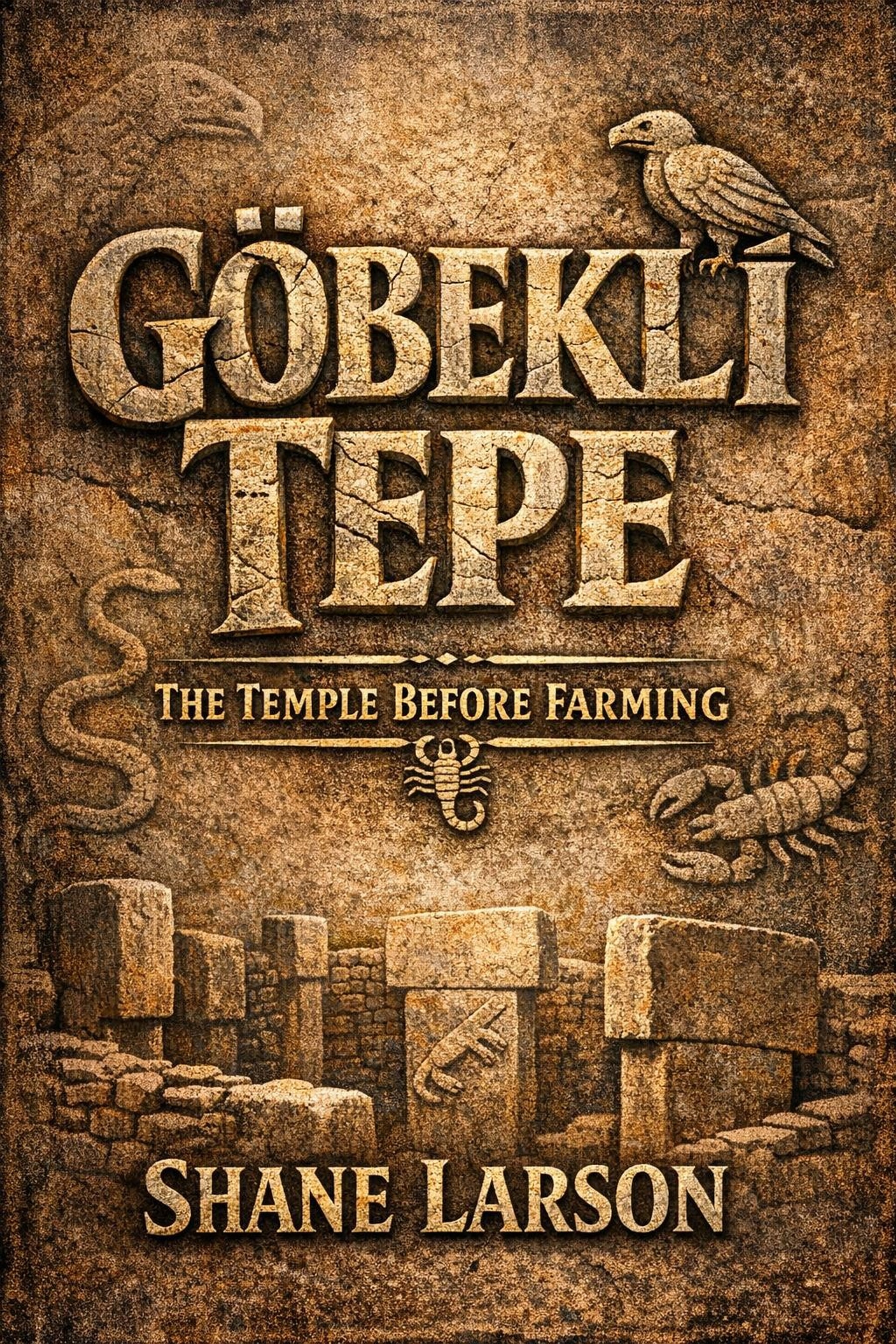
Göbekli Tepe
The Temple Before Farming
By Shane Larson
About This Book
When the work was finished, they filled it in. Not slowly, and not by neglect. The people who had quarried the great pillars, carved them with foxes and vultures, and stood them in rings on the hilltop gathered rubble, broken flint, animal bone, and earth, and packed their own monuments until the stones disappeared. That act of deliberate burial is the reason anything survived — and it is one of the strangest endings in the human record. A society did not lose its temple. It closed it, on purpose, and walked away.
The hilltop is called Göbekli Tepe, in southeastern Turkey, and the burial was the last chapter of a story that runs backward from everything you were taught about how civilization began. The standard sequence is tidy: people invent farming, farming produces a surplus, the surplus feeds a settled population, the population builds towns, and only much later — with priests and rulers and full granaries — does anyone raise monuments to the gods. Göbekli Tepe takes that sequence and stands it on its head. The monuments are here first, built around 9600 BC by hunter-gatherers who had no agriculture, no pottery, no metal, no writing, and no wheel. The wild ancestors of wheat grew on the hills around them. The first farmers came after.
That inversion is the most consequential idea in modern archaeology, and it has attracted more nonsense than almost any site on earth. This book is the version without the nonsense.
The Argument
The heart of the book is a single question that refuses to close: how did people who lived by hunting and gathering organize the labor to quarry pillars weighing up to sixteen tons, move them without draft animals or wheels, carve them in relief, and raise them into enclosures — again and again, across a whole region — with no state, no kings, and no stored surplus to pay the workers?
The answer being pieced together at Göbekli Tepe and its neighbors is that belief and feasting did the work that coercion and wages do in later societies. People gathered, perhaps seasonally, to build and to feast; the gathering created obligations; the obligations pulled more people in; and the sheer demand of feeding a crowd on that scale may have been one of the pressures that nudged humanity toward planting grain in the first place. If that is right, the famous formula reverses completely: the temple came first, and farming followed it — not the other way around.
None of this is settled, and the book is careful to say so at every turn. Göbekli Tepe is the most over-interpreted place in world archaeology, and the honest account is more interesting than the invented ones precisely because it keeps drawing the line between what the evidence shows, what it merely suggests, and what we simply cannot know yet — with less than a tenth of the site excavated and a dozen more buried enclosures waiting under the slopes.
What You'll Discover
- How the hill was nearly missed — dismissed in a 1963 survey as a medieval cemetery, and only recognized for what it was in 1994, when an archaeologist saw the tops of buried Neolithic pillars for what they were.
- The engineering problem at the center of it all — quarrying and raising sixteen-ton stones with flint tools, muscle, and rope, and what experimental archaeology can and can't tell us about how it was done.
- The carved menagerie — foxes, vultures, snakes, scorpions, boars: a bestiary overwhelmingly of dangerous, scavenging, and venomous animals, and the discipline required to read it as evidence rather than a Rorschach blot.
- The beings in the middle — the T-shaped central pillars with their arms, hands, and belts, which are not abstract supports but stylized figures standing at the heart of every enclosure.
- A Neolithic skull cult — the modified human skulls that hint at how these people treated their dead, set against similar practices across the wider region.
- The case that hunger built the temple, and the temple built farming — the full argument, its strongest evidence, and the serious objections to it.
- Why they buried it — the competing explanations for the deliberate backfill, and why closing a monument is a rarer and stranger act than abandoning one.
- Karahan Tepe and the Taş Tepeler — the buried world now emerging across the region, which turns Göbekli Tepe from a freak into the best-known node of an entire lost culture.
- What the fringe gets wrong — the comet-catastrophe and ancient-astronaut claims, taken seriously enough to examine, and shown against the evidence.
Why I Wrote This
I kept running into Göbekli Tepe from the wrong direction. Every time I read about the origins of the ancient Near East — the subject of most of my catalog — the trail ran back to this hilltop, and every time I searched for it online I hit a wall of lost-civilization theories and comet mysticism. The real story was buried under the invented one, which felt exactly backward, because the documented facts here are more astonishing than anything the fringe has dreamed up. Hunter-gatherers organizing monumental labor, carving a language we can't read, and burying their own temples is a better story than aliens, and it has the advantage of being true. I wanted to write the book I couldn't find: a clear, honest account that respects the reader enough to say "we don't know" out loud, and trusts that the wonder survives the honesty.
Frequently Asked Questions
Do I need any background in archaeology to read this?
No. The book assumes you're curious and nothing else. Every term, date, and method is explained as it comes up, and the appendix on dating walks through how we actually know the site's age without requiring any prior knowledge.
Is this like the Graham Hancock version of Göbekli Tepe?
It's the opposite, and it engages those claims directly rather than ignoring them. There's a full chapter on why the site attracts comet-catastrophe and lost-civilization theories, what each popular claim actually rests on, and what the evidence does to it — written for readers who arrived through that door and want a straight answer.
Does it cover Karahan Tepe and the newer discoveries?
Yes, and that's part of the point. Most older popular accounts predate the recent work. This book treats Göbekli Tepe as one site in the wider Taş Tepeler — including Karahan Tepe, with its chamber of pillars and the human head carved from bedrock — because a whole regional culture is a very different story from a single anomalous hill.
Is this a narrative history or an academic text?
Narrative, front to back — a single argument told as a story, with a beginning, a turning point, and an ending (the burial). It draws on the scholarship but is written to be read straight through, not consulted.
How long is it, and is it part of a series?
It runs to roughly fifteen chapters plus appendices — a full-length read of a single subject. It opens the prehistory strand of the ongoing Lost Civilizations / Origins work and sits several thousand years before the ancient Near Eastern titles it eventually connects to.
If You Liked This, You Might Like
- Twilight of the Ziggurats — the first true cities of Sumer, which are what the farming revolution that began around Göbekli Tepe eventually made possible.
- The Bronze Age World — the connected civilization that grew, thousands of years later, out of the shift from foraging to farming told here.
- Lost Civilizations of the Ancient World — for the same pull as Göbekli Tepe's deliberate burial: whole worlds that vanished, some by catastrophe and some by their own hand.
- The Collapse Pattern — the mirror image of this book's subject, trading the origin of complex society for the study of how it comes undone.
Prehistory usually reaches us as a diagram with arrows — foraging, then farming, then cities. This is the story of the hilltop that broke the diagram, told without the mysticism and without losing the astonishment that makes it worth telling.
Included with Kindle Unlimited — read it free if you're a member.
New Ancient History releases and free chapters — no spam, unsubscribe anytime.