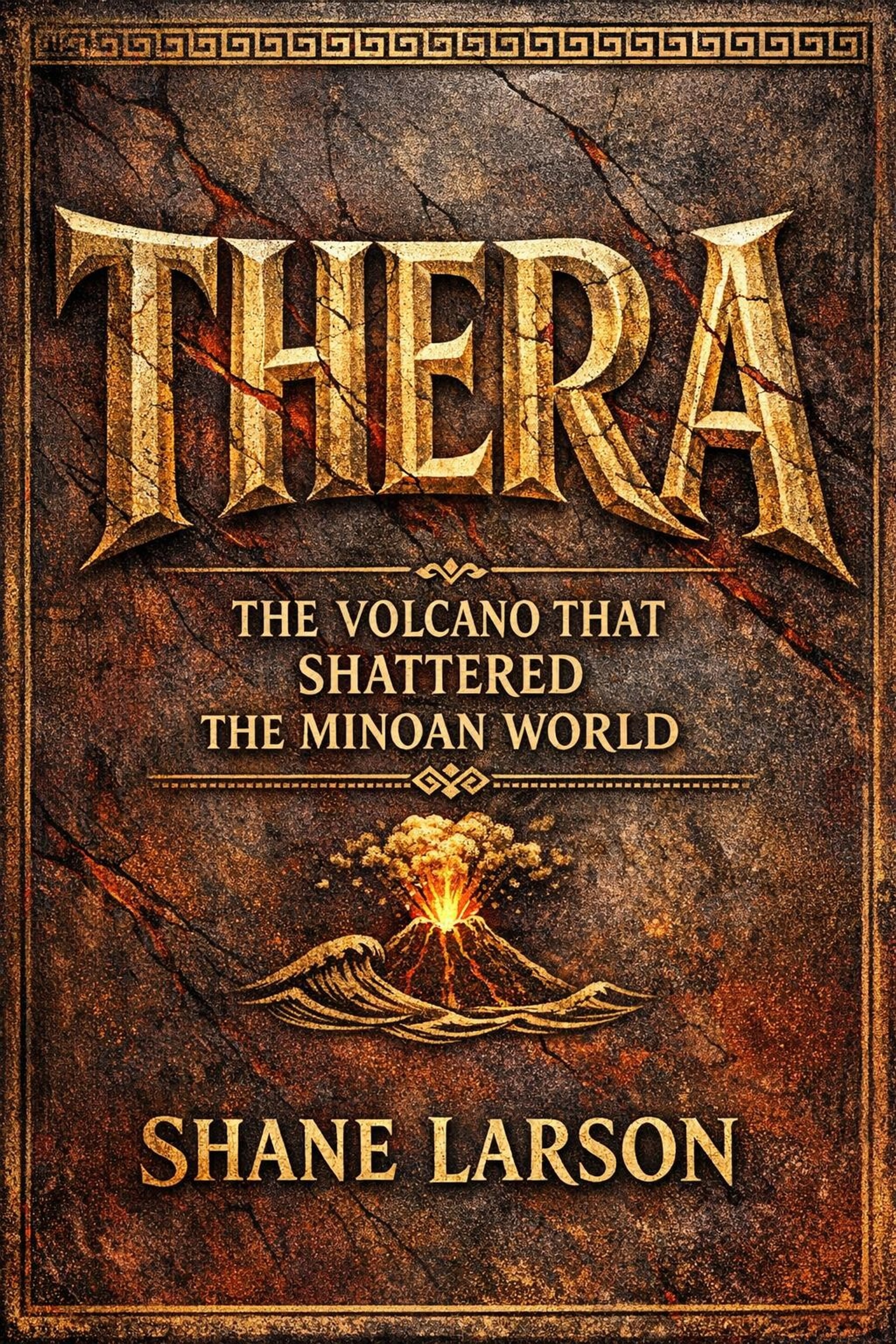
Thera
The Volcano That Shattered the Minoan World
By Shane Larson
About This Book
In 1967, a Greek archaeologist named Spyridon Marinatos began digging through volcanic ash on the island of Santorini, and almost immediately hit a wall — a real one, plastered and painted, standing to the height of a second storey. Below it were streets. Below the streets were clay pipes. What he had found was a Bronze Age town, sealed under metres of pumice, preserved the way Pompeii was preserved and for the same reason.
He kept digging, and he kept not finding what every excavator of a buried city expects to find. No bodies in doorways. No skeletons curled in cellars. No jewellery dropped in a stairwell by someone who ran out of time. The heavy furniture had been carried out before the ash came, and repairs to earthquake damage had been abandoned mid-job, tools set down where the work stopped.
The people of Akrotiri had watched the mountain behave badly, drawn a conclusion, packed, and gone — and then they disappeared from the historical record entirely. Nobody knows where they sailed. Nobody knows whether any of them were still alive a year later. That absence sits at the centre of the largest volcanic event in four thousand years of human history.
The argument this book is actually making
The Thera eruption is one of those subjects everyone half-knows. A volcano exploded in the Aegean. The Minoans — Europe's first great civilization, with its plumbing and its light wells and its bull-leaping frescoes — collapsed. Cause, effect, tragedy, done. It is a satisfying story and it has been told confidently for a hundred years.
It is also wrong, and the reasons it is wrong are more interesting than the story it replaces. Crete was never buried. The ash plume ran east, not south. The great palaces did not burn for roughly another century, which is a very long gap to bridge with a single afternoon of falling rock. And whether the eruption happened before or after the Minoans' most prosperous phase depends entirely on a date that archaeology has been unable to settle since the 1970s.
That date is the hinge. Radiocarbon, Greenland ice cores, tree-ring anomalies, and an olive branch buried alive and still standing in the pumice all point to the late seventeenth century BC. Egyptian synchronisms and the pottery sequence — the traditional backbone of Bronze Age chronology — pull the eruption a century later. A hundred years is not a rounding error in a period this compressed. It is the difference between a volcano that plausibly broke a civilization and a volcano that a civilization survived, rebuilt after, and then lost to something else.
So this is a book with three subjects braided together: an eruption reconstructed hour by hour from the layers it left, a vanished world recovered from a town nobody died in, and a scientific argument still very much unresolved. Where the evidence gives out, the book says so — which happens more often than popular accounts of Thera tend to admit.
What's inside
- The eruption as a transcript. Pumice fall, ground-hugging surges, the phase where seawater found the vent, the final ignimbrite — read in sequence, the layers give you hours and days, wind direction, and the fact that the town was already empty when the first ash landed.
- Akrotiri in detail: the drainage under the streets, the three-storey houses, the frescoes of fleets and monkeys and boxing boys, and the specific archaeological signatures that tell you an evacuation happened rather than a massacre.
- The warnings. Earthquake damage, repair work, abandoned building sites, and what a population can and cannot infer from a mountain that has begun to shake.
- The wave. Tsunami deposits on the north coast of Crete, marine sediment sitting inland where no sea should reach, and what the destruction of a harbour does to an economy built entirely on ships.
- Ash, sulphur, and volcanic winter — what the ice-core and tree-ring proxies genuinely support, and where the climate argument outruns its evidence.
- The hundred-year dating fight, given in full and with both sides argued at their strongest, including the ice-core signal that had to be reassigned to a different volcano.
- The Mycenaean arrival on Crete, the Linear B tablets that record Greek administrators keeping Minoan accounts, and the question of whether that was conquest, opportunism, or something quieter.
- Atlantis, placed late and handled as historiography: how a Bronze Age catastrophe becomes a philosopher's parable, what Plato plausibly had access to, and why neither credulity nor contempt is the honest response.
- Three appendices: a dossier on the dating evidence, a reader's guide to the Akrotiri frescoes, and a plain-language explanation of volcanic magnitude for people who do not work with tephra volumes for a living.
Why I wrote this
I went looking for a straightforward book about the Thera eruption a few years ago and could not find one I trusted. Half of what I picked up was still repeating the 1939 catastrophe thesis as though the last fifty years of fieldwork had not happened. The other half had swung so hard into correction that the volcano barely mattered at all — as if the largest eruption in recorded human experience going off ninety miles upwind of a maritime civilization were a piece of local weather.
What kept pulling me back, though, was the empty town. I find I cannot stop thinking about it. Somebody in Akrotiri made a decision, and everyone followed it, and it worked — they got out — and then history simply lost them. That is a rare thing in archaeology: a mass survival with no ending attached. Most of what we dig up is the story of people who did not get away. This is the other kind, and it deserved a book that took the uncertainty seriously instead of resolving it for the sake of a cleaner narrative.
Frequently asked questions
Do I need to read The Minoans first?
No. This book stands on its own and rebuilds the Minoan world from scratch in its early chapters. If you have read The Minoans, you will find this one picks up the civilization from the volcano's side of the story rather than the palace's, and the two fit together without repeating each other much.
Is this a science book or a history book?
Both, and it does not pretend otherwise. The eruption chapters are geology — deposits, column heights, surge dynamics — written for a reader with no background in any of it. The rest is archaeology and history. The dating chapters are where the two collide, and they are deliberately the most demanding part of the book.
Does it argue that Thera destroyed the Minoan civilization?
No. The evidence does not support that, and the book says so directly. The case it does make is narrower and, I think, more defensible: the eruption removed the margin — the ships, the harbours, the trade seasons, the surplus — that would have let Crete absorb the pressures that arrived afterwards.
How much of the book is about Atlantis?
One chapter, placed late. It is treated as a question about how catastrophes turn into stories, not as a thesis the rest of the evidence is arranged to support. If you want a book arguing that Plato was writing history, this is not that book.
What background does it assume?
None. No archaeology, no geology, no Greek. Terminology and volcanic measurements are explained as they arrive, and the appendices exist for anyone who wants the technical material laid out separately rather than threaded through the narrative.
If you liked this, you might like
- The Minoans — the companion volume: the same civilization approached from its palaces, its script, and its trade network rather than from the volcano that interrupted it.
- Pompeii — the other buried city, and a useful contrast, because Pompeii is full of the dead that Akrotiri is missing.
- Ancient Apocalypse — what happened to the eastern Mediterranean three centuries later, when the whole interconnected Bronze Age system came apart at once.
- The Collapse Pattern — the structural version of the question this book asks about Crete: what actually kills a civilization, and what merely gets blamed.
A volcano is a simple thing to explain and a difficult thing to hold responsible. Thera: The Volcano That Shattered the Minoan World takes the eruption apart layer by layer, gives the empty town the attention it has always deserved, and leaves the hundred-year argument standing where it honestly stands.
Part of The Bronze Age Collapse Chronicles.
Included with Kindle Unlimited — read it free if you're a member.
New Ancient History releases and free chapters — no spam, unsubscribe anytime.