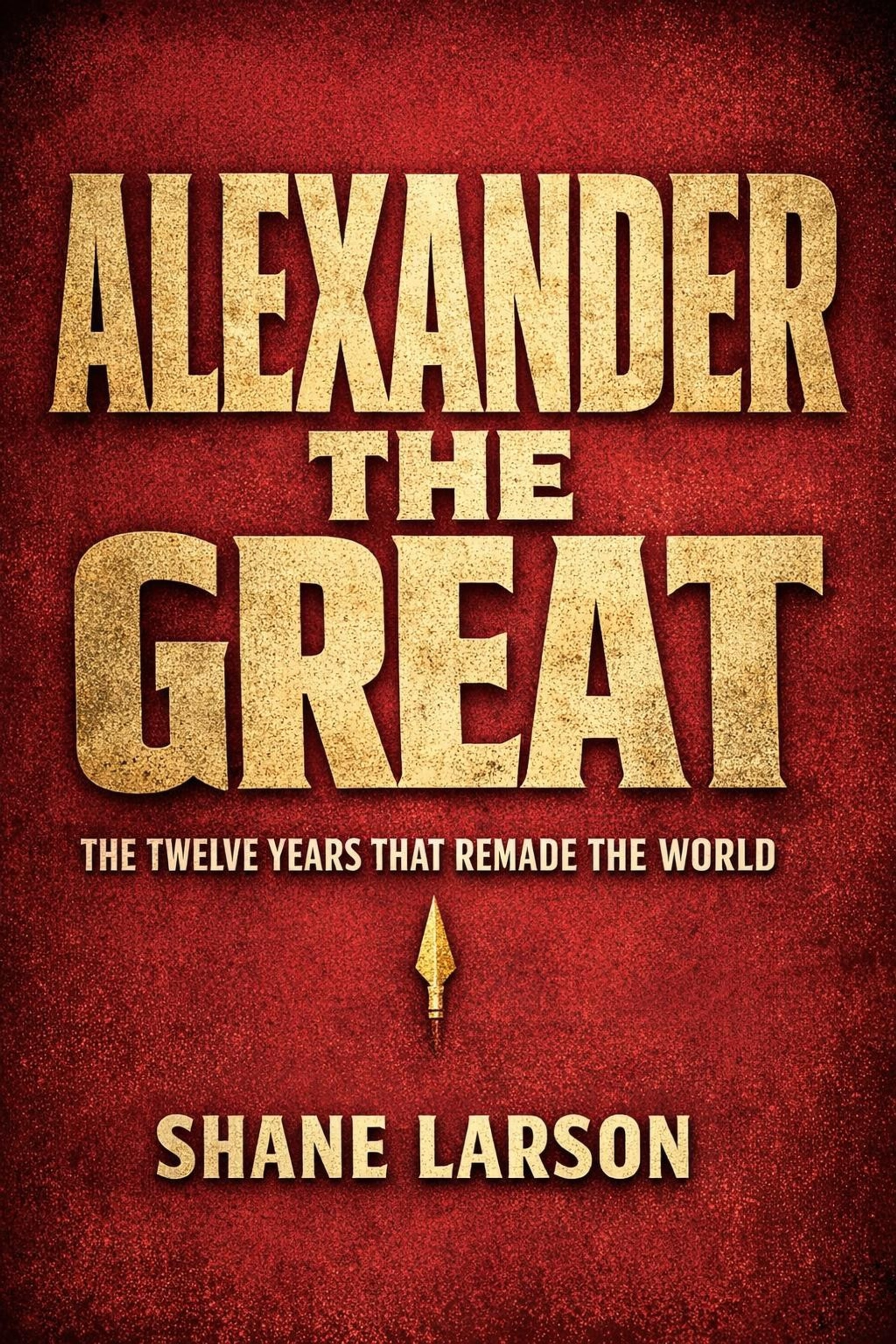
Alexander the Great
The Twelve Years That Remade the World
By Shane Larson
About This Book
In the summer of 323 BC, a thirty-two-year-old man lay dying in Nebuchadnezzar's palace in Babylon. Outside, an army that had marched from the Adriatic to the Punjab waited for news. When his officers asked who should inherit an empire stretching across three continents, he is said to have whispered, "to the strongest" — and within a generation, the men at his bedside had torn his conquests apart fighting to answer that question.
Whether he actually said it, nobody knows. That's the trouble with Alexander the Great: the eyewitness accounts are all gone. Every history written by someone who marched with him, ate with him, or watched him fight has vanished. What we have instead was composed four centuries later, stitched together from lost books — and then buried under two thousand years of hero-worship, propaganda, and armchair psychoanalysis.
This book digs the man out. It follows the evidence where it leads, says plainly where the record runs thin, and shows how some of the most famous "facts" about Alexander are repetition masquerading as history.
The Story
The story doesn't begin with Alexander. It begins with Philip II of Macedon — the shrewd, scarred, one-eyed king who transformed a backwater kingdom into the most formidable military power in the Greek world. The sarissa phalanx, the Companion cavalry, the engineering corps, the professional standing army: all of it was Philip's work. Alexander inherited a weapon his father spent twenty years forging, and understanding that inheritance is the only honest way to understand what came next.
From Philip's assassination in 336 BC, the narrative moves fast — because Alexander did. The crossing into Asia. Granicus, where the campaign nearly ended in a river before it began. Issus, where Darius III fled the field and left his family behind. The brutal sieges of Tyre and Gaza. The strange detour to the oracle at Siwa. Gaugamela, the battle that finished the Achaemenid Empire as a fighting power. The burning of Persepolis — accident, calculated statement, or drunken vandalism, depending on which source you trust.
Then the harder chapters: the grinding counterinsurgency in Bactria and Sogdiana, where set-piece brilliance gave way to a dirty war of raids and reprisals. The killing of Cleitus at a drunken banquet. The Philotas affair and the execution of Parmenion. The proskynesis controversy, when Macedonian officers refused to bow to their own king. The tactical masterwork against Porus at the Hydaspes — and then the Hyphasis, where the army that had never lost a battle simply refused to take another step east, and won.
Crucially, this is not just a Macedonian story. The Persian Empire gets its due as a sophisticated, tolerant, effectively governed state that had administered a quarter of humanity for two centuries — and Darius III appears as the capable, unlucky king the evidence supports, not the cartoon coward of Greek propaganda. Understanding why Persia fell requires understanding what Persia was, and why an empire built around the person of the Great King proved fatally exposed once that person kept losing.
What You'll Discover
- The Macedonian military revolution under Philip II, and why Alexander's campaigns are unintelligible without it — the phalanx, the Companions, and the logistics system that made a march to India physically possible
- How the assassination at Aegae put a twenty-year-old on the throne, and how quickly he crushed the revolts that assumed he'd fail
- The three battles that broke an empire — Granicus, Issus, and Gaugamela — reconstructed from the ground up, tactics and terrain included
- What actually happened at the oracle of Siwa, what Alexander may have believed about his own divinity, and how thin the evidence really is
- The dark turn: Cleitus, Philotas, Parmenion, and a court that increasingly did not recognize its own king
- The Hydaspes campaign against Porus and his war elephants — arguably Alexander's finest tactical performance
- The mutiny at the Hyphasis, where the undefeated conqueror met the one force he could not beat: his own exhausted men
- The final days in Babylon — the fever, the poisoning theories weighed against the medical evidence, and the succession crisis that ignited forty years of war
Why I Wrote This
I'd already written about what happened after Alexander died — the Successor wars, the carving-up of the empire — and I kept realizing that book leaned on a story I was assuming readers knew. Most people know the name, the map arrow sweeping east, maybe the horse. Far fewer know the actual sequence of events, and almost nobody hears the Persian side. What finally pushed me to write it was the sourcing problem: once you learn that every eyewitness account is lost, you start reading the familiar anecdotes differently. Some hold up. Some are almost certainly invented. Sorting one from the other turned out to be the most interesting version of the story, so that's the one I told.
Frequently Asked Questions
Do I need to read Alexander's Generals first?
No — the two books work in either order. This book tells the story of Alexander's life and conquests; Alexander's Generals picks up at his deathbed and follows the Successor wars. If anything, this is the natural starting point, since it's the story the other book presupposes.
Is this a scholarly biography or narrative history?
Narrative history. It moves at the pace of the campaigns and is written to be finished in a couple of evenings. But it takes the sourcing problem seriously — where the ancient accounts conflict or the evidence is weak, the book says so rather than picking the best anecdote and running with it.
Does it cover the Persian Empire's perspective?
Yes, deliberately. The Achaemenid Empire is treated as a real state with real strengths, and Darius III as the capable ruler the evidence suggests rather than the coward of Greek propaganda. The collapse makes no sense unless you understand what was collapsing.
How was Alexander the Great's history recorded if the eyewitness accounts are lost?
The surviving narratives — Arrian, Plutarch, Curtius Rufus, Diodorus — were written three to five centuries after Alexander's death, drawing on earlier books that no longer exist, including accounts by his general Ptolemy and his engineer Aristobulus. The book explains this chain of transmission early on, because it shapes how much confidence any given story deserves.
Does the book cover how Alexander died?
Yes. The final chapters walk through the fever in Babylon, weigh the poisoning claims against the medical evidence honestly, and follow the immediate aftermath — including how the mythmaking began within days of his death.
Is this book available on Kindle Unlimited?
Yes. Like the rest of the Peak Grizzly catalog, it's enrolled in Kindle Unlimited, so subscribers can read it at no extra cost.
If You Liked This, You Might Like
- Alexander's Generals — the direct sequel in all but name: the forty-year war among the Successors to control what Alexander left behind.
- The Persian Empire — the full story of the Achaemenid state Alexander destroyed, from Cyrus the Great to Darius III.
- The Ptolemies — what one of those generals built with his share: three centuries of Macedonian rule in Egypt, ending with Cleopatra.
- The Golden Age of Athens — the Greek world at its cultural height, a century before Macedon swallowed it.
Twelve years of conquest, four centuries of lost sources, two thousand years of myth — and underneath it all, a story that needs no embellishment.
Included with Kindle Unlimited — read it free if you're a member.
New Ancient History releases and free chapters — no spam, unsubscribe anytime.
More in This Genre
View all →