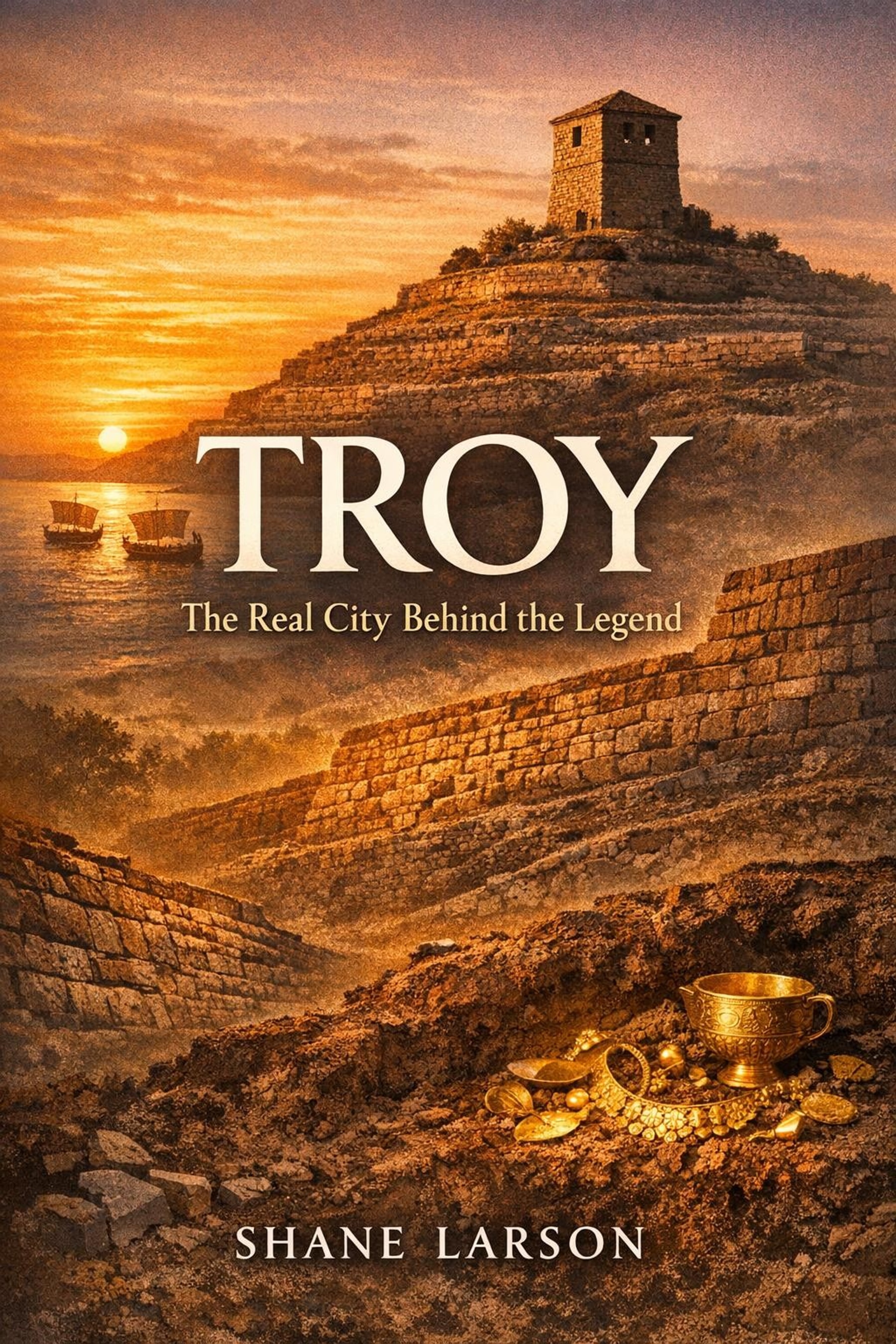
Troy
The Real City Behind the Legend
By Shane Larson · The Bronze Age Collapse Chronicles (Book 4)
About This Book
Somewhere in the clay archives of a vanished empire, a scribe recorded a treaty. It was sworn around 1280 BC between the king of the Hittites and the ruler of a small but strategically placed kingdom on the Anatolian coast. The kingdom was called Wilusa. Its king bore the name Alaksandu — a name close enough to Alexandros, Homer's other name for the prince we call Paris, to make a careful historian sit up straight. The same archives complain about aggressive Mycenaean Greeks meddling on that coast, and mention, in passing, a past war fought over Wilusa itself.
None of that comes from a poem. It comes from the bureaucratic paperwork of a Bronze Age superpower that had no interest in Homer and no reason to flatter him. And it raises the question this book exists to answer: how much of the most famous story in Western literature actually happened, and how would we ever know?
For centuries the assumption was that none of it did — that Troy was a poet's beautiful invention. That assumption did not survive contact with a hill in northwestern Turkey called Hisarlik, where the ground turned out to be packed with the ruins of not one city but at least nine, stacked in layers across three thousand years.
The argument
Troy is really two problems wearing one name, and this book keeps them apart on purpose. The first is archaeological: what is actually buried at Hisarlik, and what does it tell us? The second is literary and historical: what, if anything, connects those ruins to the war Homer sang about four or five centuries after the fact?
The archaeology begins in scandal. In 1870 a wealthy businessman named Heinrich Schliemann, clutching his copy of the Iliad, drove a great trench straight down through the mound — and in his hurry to reach Homer's Troy destroyed a good deal of what he was looking for, then declared the wrong layer to be the right one. Before him, and largely forgotten, was Frank Calvert, the man who had actually identified the site and pointed Schliemann to it. The treasure Schliemann pulled out and named for King Priam was smuggled out of the country, vanished from Berlin in the chaos of 1945, and turned up again in Moscow in 1993. The story of digging up Troy is nearly as tangled as the legend itself.
What a century and a half of more disciplined excavation has revealed is a place stranger and more substantial than the myth. The earliest settlement at Hisarlik is older than the Egyptian pyramids. The layer archaeologists label Troy VI was a genuine Late Bronze Age power with the finest defensive walls in the Aegean, walls that seem to have been brought down by an earthquake rather than an army. And the layer above it, Troy VIIa, was destroyed by fire around 1180 BC — with arrowheads in the streets and unburied bodies left where they fell — right in the window when the entire Bronze Age world was collapsing into ruin from Greece to the Near East.
Set the spades beside the Hittite tablets and a bridge appears between legend and record: a real, well-walled city, in the right place, destroyed by violence at roughly the right time, named in the diplomatic correspondence of the age as a flashpoint between the Hittites and the Mycenaean Greeks. That is not proof that Achilles chased Hector around the walls. But it is a great deal more than nothing, and this book lays out exactly how much weight the evidence can bear — and where it stops. The final chapter delivers an honest verdict on the eternal question, without either romantic wishful thinking or the reflexive debunking that is just romanticism in reverse.
What's Inside
- The nine cities of Hisarlik, sorted out layer by layer, including which one Schliemann wrongly crowned as Homer's Troy and which one the evidence actually favors.
- Frank Calvert, the overlooked man who found the site and identified it before Schliemann ever arrived with his trench and his publicity.
- Priam's Treasure and its century-long odyssey: excavated, smuggled, lost in the fall of Berlin, and rediscovered in a Moscow museum decades later.
- The Hittite files on Wilusa — the Alaksandu treaty, the complaints about Mycenaean aggression, the reference to an earlier war — laid out as the strongest documentary link between the poem and the past.
- Troy VI's great walls, the best in the Bronze Age Aegean, and the earthquake that appears to have toppled them.
- The burning of Troy VIIa around 1180 BC — the fire, the arrowheads, the bodies in the streets — set against the wider collapse swallowing the whole eastern Mediterranean at that exact moment.
- A straight answer on whether there was a Trojan War: what the combined evidence genuinely supports, and the precise point where honest history has to stop and say it does not know.
Why I Wrote This
I grew up on the Iliad the way a lot of people do — half in love with it, half assuming it was pure fantasy. What changed everything for me was learning about the Hittite tablets. The idea that a real Bronze Age filing cabinet, kept by people who had never heard of Homer, contained a place called Wilusa and a king with a name like Alexandros felt like finding a fingerprint at a scene everyone had written off as fiction.
I wrote this because the popular conversation about Troy tends to collapse into two lazy camps: the romantics who want every word of the poem to be literally true, and the debunkers who enjoy announcing that none of it is. Both skip the actual work, which is more interesting than either position — carefully weighing spades against tablets against a poem composed centuries later, and being willing to end on an honest maybe. The evidence deserves to be handled with more care and more curiosity than the legend usually gets.
Frequently Asked Questions
Was Troy a real place?
Yes. The city at Hisarlik in northwestern Turkey is real and thoroughly excavated, and few archaeologists doubt it is the Troy of legend. The harder question — whether the Trojan War of the Iliad actually happened — is exactly what this book weighs, and it gives you a genuine verdict rather than a dodge.
Do I need to have read the Iliad first?
No. The book explains the relevant parts of Homer's story as it goes and is really about the archaeology and history behind the poem, not the poem itself. Reading the Iliad first will enrich it, but nothing here assumes you have.
Is this archaeology, history, or myth-busting?
All three, kept deliberately separate. It follows the excavations and the Hittite documents like a detective story while refusing both starry-eyed romanticism and cynical debunking, and it always tells you which category a given claim belongs to.
Does it connect Troy to the Bronze Age collapse?
Yes. The destruction of Troy VIIa lands right inside the great collapse that brought down civilizations across the Mediterranean and Near East around 1200 to 1150 BC, and the book places the burning city in that larger catastrophe.
Do I need to know anything about the Hittites or Mycenaeans?
Not going in. Both civilizations are introduced from scratch, because Troy sits precisely between them, and understanding that position is central to the whole case.
If You Liked This, You Might Like
- The Mycenaeans — the warrior kingdoms of Bronze Age Greece who, in both poem and Hittite record, are the ones sailing against the Anatolian coast.
- The Hittite Empire — the forgotten superpower whose diplomatic archives supply the strongest real-world evidence for Troy in this entire book.
- Ancient Apocalypse — the wider collapse that consumed Troy VIIa along with the whole interconnected Bronze Age world around 1200 BC.
- The Collapse Pattern — the broader study of how great societies come apart, the framework into which Troy's violent end fits.
Strip away the poetry and the salesmanship and what remains at Hisarlik is remarkable on its own: nine cities, real walls, a documented name, and a fire in the streets at exactly the moment a world was ending.
Part of Shane Larson's narrative histories of the ancient world.
Included with Kindle Unlimited — read it free if you're a member.
New Ancient History releases and free chapters — no spam, unsubscribe anytime.
More in The Bronze Age Collapse Chronicles
View series →