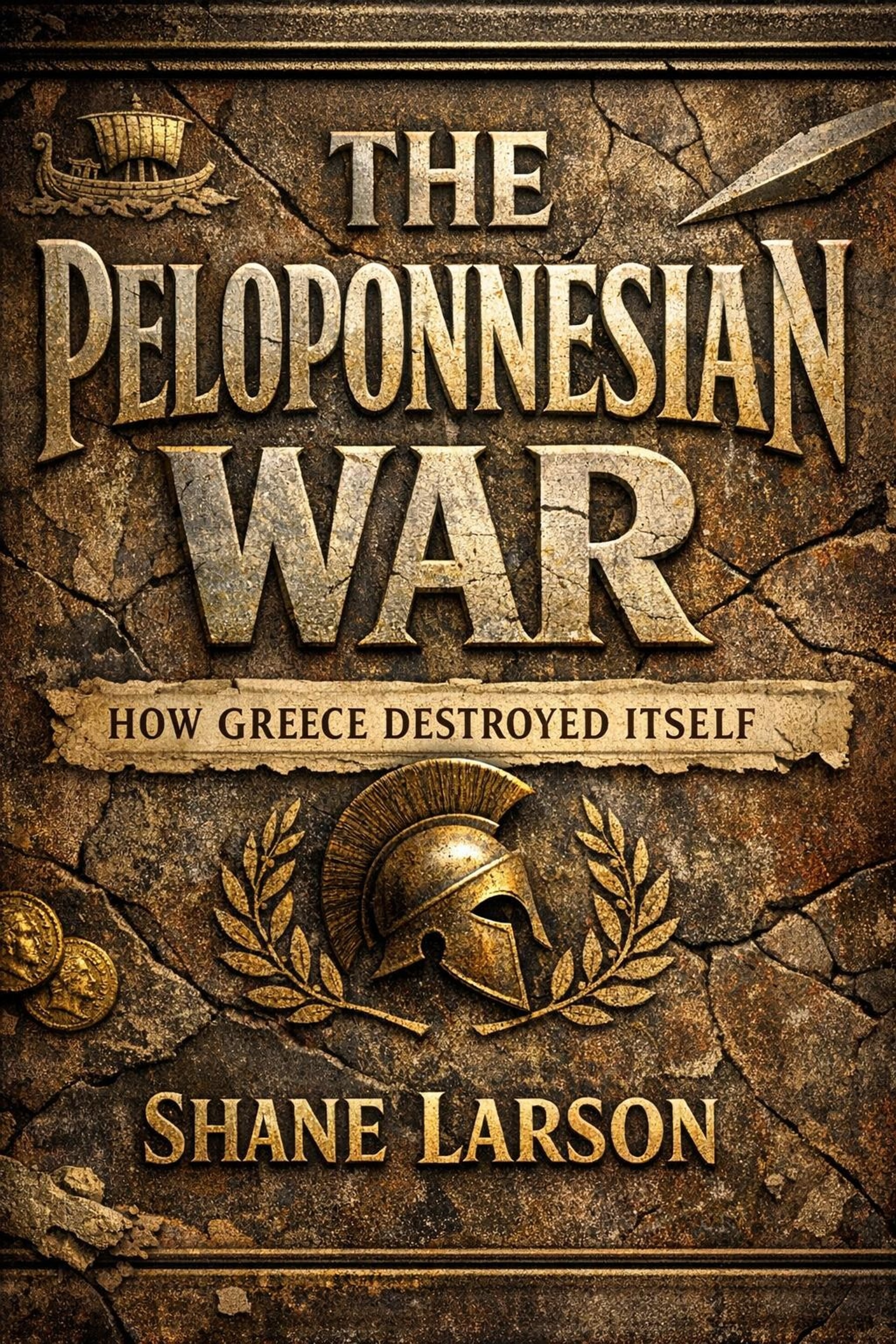
The Peloponnesian War
How Greece Destroyed Itself
By Shane Larson
About This Book
In the summer of 413 BC, in the Great Harbor of Syracuse, the largest fleet Athens had ever put to sea tried to fight its way out of a trap and failed. Ships fouled one another in water too narrow to maneuver. Men who could not swim went down in their armor. On the shore, an army watched its own navy die and understood, in that hour, that there would be no going home. Within days the survivors were marching inland to captivity in the stone quarries, where most of them would starve.
That catastrophe was not the beginning of the Peloponnesian War, and it was not quite the end. It sat in the middle of a twenty-seven-year unraveling in which the two most powerful states in the Greek world — Athens on the sea, Sparta on the land — methodically took apart the civilization they had just jointly saved from Persia. A single generation separated the victory at Salamis from the harbor at Syracuse. In that span the Greeks proved something they would spend the next two and a half millennia trying to forget: that the deadliest enemy of a great power is usually itself.
This is the story of how the Golden Age ended. Not in a heroic last stand, not under a foreign boot, but through a long sequence of decisions that each looked reasonable in the moment and added up to ruin.
The argument
The war began, as most great wars do, over something smaller than itself. A quarrel between second-tier cities pulled the two alliance systems into collision, and once the great powers were committed, the machinery of fear and obligation made backing down feel more dangerous than fighting. Sparta feared a rising Athens; Athens could not imagine surrendering the empire that fed it. Neither side actually wanted the war it got.
Pericles had a strategy, and on paper it was sound: refuse the land battle Sparta wanted, retreat behind the walls, let the fleet and the empire wear the enemy down. Then a plague swept the overcrowded city in the war's second year, killed perhaps a third of the population, and carried off Pericles himself. What followed was a democracy learning, in real time, that escalation won votes and restraint did not. The assembly ordered the men of one rebellious city slaughtered and the women and children sold — then reversed the order the next morning by the margin of a single ship rowing faster than the first. It executed its own victorious admirals after a naval win because they had failed to recover the dead in a storm. It gambled everything on an expedition to Sicily that no sober accounting could justify, and lost.
By the end, it was not Spartan valor that decided the outcome but Persian money, funneled to whichever Greek side could keep the war going longest. When Athens finally fell, in 404 BC, it fell in a single afternoon at a beach called Aegospotami, its fleet caught on the sand with the crews ashore looking for lunch. And Sparta's reward for winning was to inherit an empire it had no idea how to run, and to be destroyed by it within a lifetime. Nobody won. That is the point.
Running through all of it is Thucydides — the exiled Athenian general who wrote the war down with a cold, forensic clarity that military academies still assign. This book leans on him hard, because he is extraordinary, while never forgetting that he was a participant with his own scores to settle and his own speeches to put in other men's mouths. Every ancient source here is paraphrased in plain modern English; no copyrighted translation is quoted.
What's Inside
- Alliance systems that converted a local dispute over a minor colony into a war neither Athens nor Sparta had chosen — the anatomy of how commitments become traps.
- Pericles' walls-and-fleet strategy examined on its own terms: why it was the correct plan, and how a plague no one could have modeled dismantled it in eighteen months.
- The Mytilene debate, where the Athenian assembly voted for mass execution and then unvoted it overnight — the clearest surviving X-ray of democracy under wartime pressure.
- The trial of the generals after Arginusae, in which Athens put to death the admirals who had just won it a battle, and what that reveals about a system that had learned to punish success.
- The Sicilian expedition reconstructed decision by decision — each step defensible, the sum a disaster that cost Athens a fleet, an army, and the war.
- Persian gold, not hoplite courage, as the resource that actually tipped the balance, and the parade of Greek commanders willing to take it.
- Aegospotami, the ten-minute collapse that ended everything, and why the war's final act was an anticlimax rather than an epic.
- The aftermath for Sparta — how the victor's prize became the victor's undoing, and why "the winner" is the wrong way to read the whole affair.
- The "Thucydides Trap" as modern foreign-policy writers use it, set against what Thucydides actually wrote — and where the soundbite goes wrong.
Why I Wrote This
I wrote a book about Sparta and a book about the Golden Age of Athens, and both of them kept pointing at the same war without ever fully entering it. Sparta's story bends toward this war; Athens' story breaks on it. I got tired of circling the thing and decided to stage it directly.
What holds me about the Peloponnesian War is that there is no villain in it worth the name. Everyone is intelligent. Everyone has reasons. The Athenians who vote for atrocities are the same citizens who built the Parthenon and sat through the plays of Sophocles. That is far more unsettling than a story with a monster in it, because it suggests the failure is structural rather than moral — that a free, sophisticated, self-governing society can argue itself, step by reasonable step, straight into the ground. I find that more relevant now than I would like it to be.
Frequently Asked Questions
Do I need to read Sparta or The Golden Age of Athens first?
No. This book stands entirely on its own and explains every institution, battle, and personality from the ground up. If you have read the other two, you will recognize how the threads finally come together here — but nothing is assumed.
Is this a dry academic history or a narrative one?
It is narrative history written for a general reader who wants the real evidence. It moves like a story, but it stops to show you where the sources disagree and why, rather than smoothing everything into a single confident tale.
Does it actually explain the "Thucydides Trap"?
Yes, and honestly. The phrase comes from modern political science, not from Thucydides, and the book separates what he wrote from what the soundbite claims. If you have heard the term and want to know whether it holds up, there is a full treatment here.
Does it quote Thucydides directly?
It paraphrases him and every other ancient source in plain language, with no copyrighted modern translation reproduced. Where his exact framing matters, the book explains what he says and how he says it, in its own words.
How much military detail is there?
Enough to follow every campaign — terrain, logistics, why triremes fought as they did — without turning into a wargame. The battles are there to be understood, not admired.
If You Liked This, You Might Like
- Sparta — the warrior state that won this war and was ruined by the winning, told from the inside of the society that produced it.
- The Golden Age of Athens — the city at its creative height, the world that the war you just read about tore down.
- The Persian Empire — the superpower whose gold quietly decided the Greek civil war after its armies had failed to.
- The Collapse Pattern — the wider study of how great societies come apart from within, of which Athens is a founding case.
The Golden Age was not conquered. It argued and gambled and escalated its way to its own funeral, and left behind the sharpest account ever written of how it happens.
Part of Shane Larson's narrative histories of the ancient Greek world.
Included with Kindle Unlimited — read it free if you're a member.
New Ancient History releases and free chapters — no spam, unsubscribe anytime.