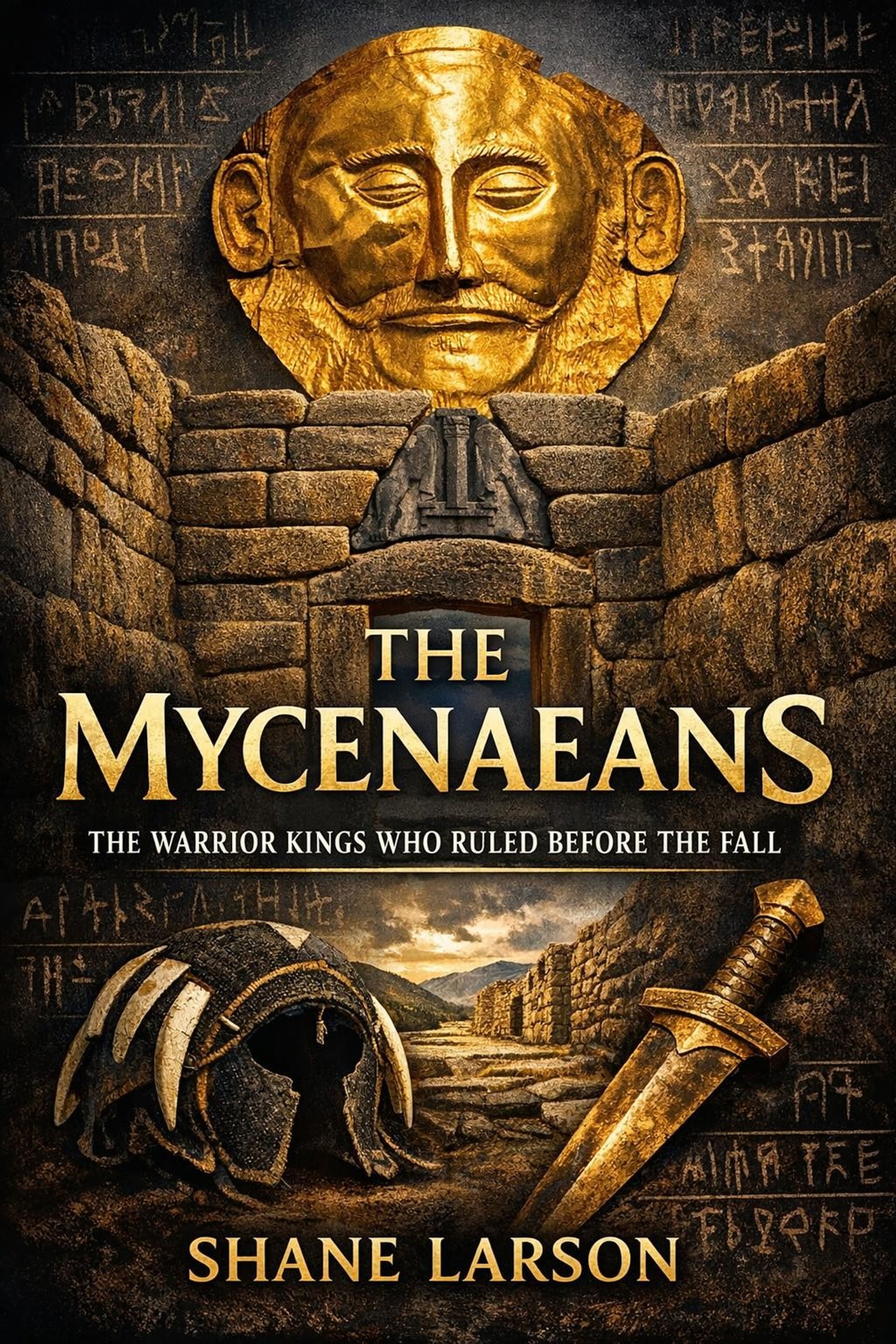
The Mycenaeans
The Warrior Kings Who Ruled Before the Fall
By Shane Larson · The Bronze Age Collapse Chronicles (Book 3)
About This Book
Around 1200 BC, someone put a torch to the palace at Pylos. The fire that ended a kingdom also, by accident, preserved its memory: the heat baked hundreds of unfired clay tablets hard as brick, freezing the palace's last year of paperwork in place for three thousand years. Ration lists. Bronze allocations. Rowers assigned to watch the coast. The catastrophe that destroyed Mycenaean Greece became its own archivist.
When those tablets finally spoke again — deciphered in 1952, in one of the great intellectual detective stories of the twentieth century — they revealed something nobody expected. The language wasn't some lost pre-Greek tongue. It was Greek. The oldest Greek ever read. Which meant the citadels of Mycenae and Tiryns, the tholos tombs, the gold in the shaft graves — all of it belonged to the first Greeks, centuries before anyone thought Greek history began.
This book tells the whole story of Mycenaean Greece, from its sudden and still-mysterious rise to the collapse that erased it so completely that later Greeks could only explain the ruins as the work of giants.
The Civilization Homer Half-Remembered
The Mycenaeans emerge from the archaeological record almost without warning: around 1600 BC, a handful of graves at Mycenae suddenly fill with gold on a scale mainland Greece had never seen. Where that wealth came from is one of the enduring puzzles of the Bronze Age, and this book weighs the candidate answers against the evidence rather than picking a favorite and defending it.
From there the story widens. Mycenaean power spreads across the Aegean and reaches Crete, where Greek-speaking rulers end up in charge of Knossos itself — the student overthrowing the Minoan teacher. Linear B, the script those rulers adapted for their own language, opens a window few ancient civilizations offer: an economy documented in its own hand, down to individual named workers, chariot wheels in storage, and quotas owed to the palace. The book reconstructs daily life inside that command economy from its actual paperwork.
Then there is the war everyone asks about. Hittite diplomatic archives mention a western kingdom the tablets call Ahhiyawa, trouble at a city that sounds a great deal like Ilios, and kings whose reach extended across the sea. Whether those letters record the conflict behind the Iliad is one of the sharpest debates in Aegean archaeology, and the book walks through what the Hittite record and the ruins at Hisarlik can actually support — and where legend takes over.
Finally, the end. Within roughly a single generation around 1200 BC, every Mycenaean palace was destroyed or abandoned. Writing vanished from Greece for four hundred years. The book examines each suspect in the collapse honestly — invaders, earthquakes, drought, internal revolt, systems failure — and shows how four centuries of forgetting transformed real Bronze Age kings into the heroes of Homer.
What You'll Discover
- The shaft graves of Mycenae and the sudden, unexplained explosion of gold that announces the civilization's arrival — plus the leading theories for where that wealth came from
- How Greek speakers came to rule Knossos, and what the takeover of Minoan Crete tells us about who the Mycenaeans were
- The full decipherment story of Linear B, including Alice Kober, the American scholar whose painstaking analysis built the foundation Michael Ventris stood on
- A working tour of the palace economy: who got rations, who owed bronze, and how a Bronze Age bureaucracy actually ran its kingdom
- The warrior world of boar's-tusk helmets, body-length shields, and fortification walls twenty feet thick
- Ahhiyawa, Wilusa, and the Hittite letters — the strongest real-world evidence connected to the Trojan War, assessed without romance
- The palace destructions of 1200 BC, suspect by suspect, and why the collapse was probably not one thing
- How oral memory carried fragments of this world across four illiterate centuries and delivered them to Homer
Why I Wrote This
After finishing The Minoans, I kept running into the same problem: you can't tell the end of that story without the Mycenaeans, and the Mycenaeans deserve more than a supporting role in someone else's book. They're the first Greeks — the actual people underneath the age of heroes — and yet most readers know them only as the vaguely historical backdrop to the Trojan War. What hooked me was the paperwork. A civilization this old that left behind its own ration lists and inventory sheets is rare, and reading a kingdom's final year in its own records is a strange, almost eerie experience. I wanted to write the book that takes the evidence — tablets, graves, walls, Hittite letters — and builds the story up from there, keeping an honest line between what we know and what Homer imagined.
Frequently Asked Questions
Do I need to read The Minoans first?
No. This book stands entirely on its own. The two civilizations overlap — the Mycenaean takeover of Crete is a major chapter here — so reading both gives you the full arc of the Aegean Bronze Age, but each book is written to be a complete story by itself.
Is the Trojan War treated as history or myth?
Neither, dogmatically. The book lays out the physical evidence at Hisarlik and the Hittite diplomatic correspondence, explains what each can and cannot support, and lets you see where the documented record ends and the legend begins. There was a real city, real conflicts in the region, and a real Mycenaean presence — how far that gets you toward Homer's war is the question the chapter works through.
What is Linear B, and how much of the book covers it?
Linear B is the earliest written form of Greek, used by palace scribes for administrative records. It gets substantial coverage on two fronts: the decipherment itself — a twentieth-century detective story involving Alice Kober's classification work and Michael Ventris's breakthrough — and what the deciphered tablets reveal about how Mycenaean kingdoms actually functioned.
Is this an academic book?
It's narrative history written for general readers, built on current archaeology and scholarship. No prior knowledge of the Bronze Age, Greek history, or archaeology is assumed. Where scholars disagree — the shaft-grave wealth, the Trojan War, the collapse — the book presents the competing positions rather than flattening them.
Does it cover the Bronze Age collapse?
Yes. The destruction of the palaces around 1200 BC and the four-century dark age that followed form the final act of the book. If the collapse era is your main interest, this pairs naturally with our titles focused on that catastrophe across the wider eastern Mediterranean.
If You Liked This, You Might Like
- The Minoans — the civilization the Mycenaeans learned from, and then overthrew; the other half of the Aegean Bronze Age story.
- The Hittite Empire — the superpower on the far side of the Aegean whose royal archives hold the best real-world evidence tied to Troy.
- Ancient Apocalypse — the collapse of 1200 BC across the entire eastern Mediterranean, of which the fall of the palaces was one part.
- The First Dark Age — what happened in the four hundred years after the palaces burned, when Greece forgot how to write.
The Mycenaeans built the world Homer sang about — this is the version the evidence tells, from the first gold in the shaft graves to the last fires in the palaces.
Included with Kindle Unlimited — read it free if you're a member.
New Ancient History releases and free chapters — no spam, unsubscribe anytime.
More in The Bronze Age Collapse Chronicles
View series →
More in This Genre
View all →