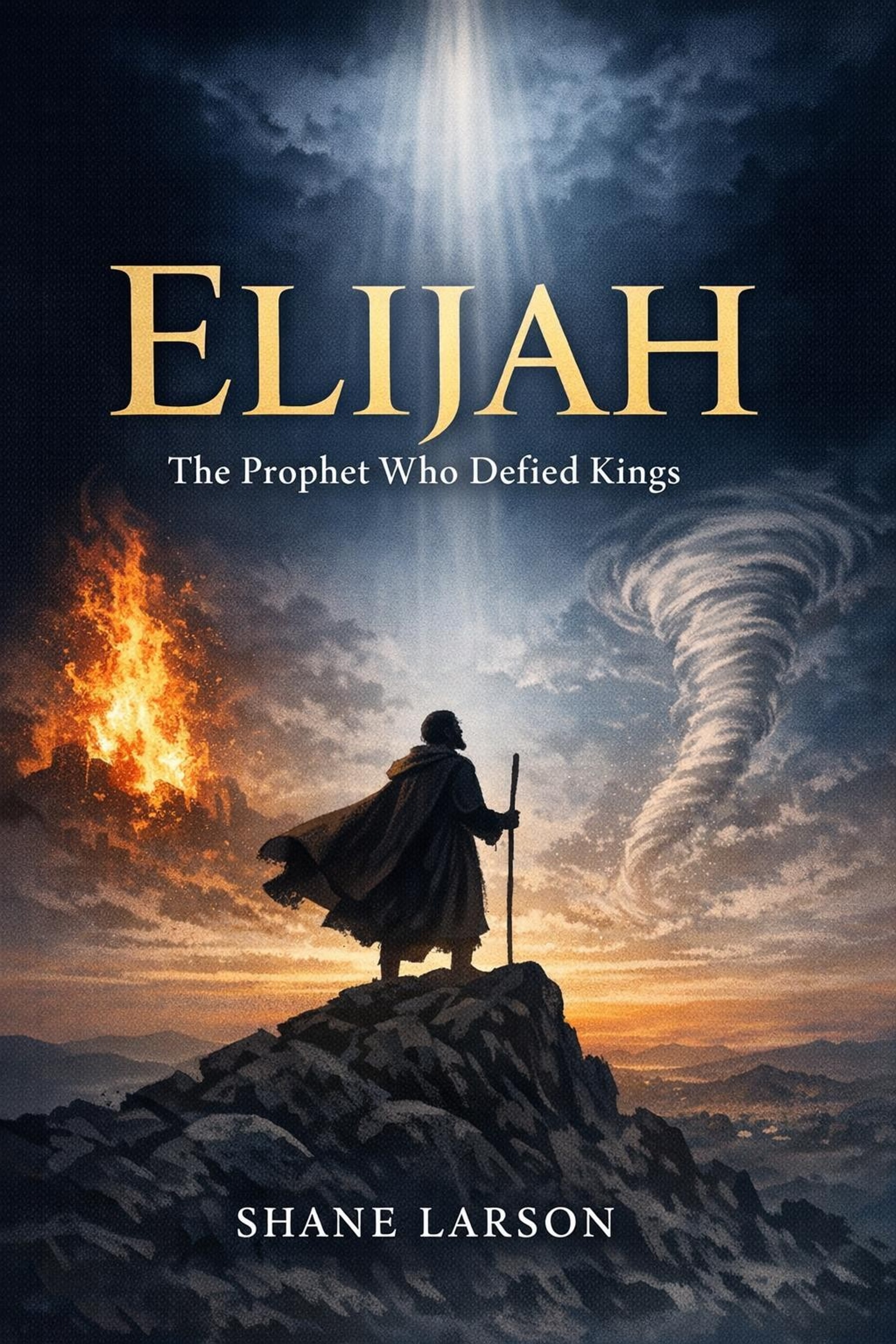
Elijah
The Prophet Who Defied Kings
By Shane Larson
About This Book
A man sits under a juniper tree in the Negev desert and asks God to kill him. He has just won. He has just publicly humiliated four hundred and fifty priests of the most powerful state cult in the kingdom of Israel, called fire down from a clear sky, and watched a three-year drought break in a single afternoon. The queen has put a price on his head. He has run for a hundred miles, alone, into wilderness, and now he wants to die.
This is the moment most books about Elijah skip past. It's also the moment that tells you everything about what kind of figure he actually was — not a triumphant miracle-worker but a hunted political enemy of the wealthiest royal house Israel ever produced, a man who picked a fight with an international alliance and barely survived winning it.
Elijah: The Prophet Who Defied Kings takes the story of Israel's most dangerous prophet and puts it back inside the world it actually happened in: the ninth-century-BCE Levant, the house of Omri, and a Phoenician marriage alliance that brought the storm god of Tyre into the heart of the Israelite court.
The Argument
Most popular treatments of Elijah are devotional — sermons in book form, the prophet as moral hero. Most academic treatments are the opposite, dismantling the cycle into source layers and rarely reassembling it for a general reader. This book sits between those two modes. It treats the Elijah cycle as narrative history: events that happened to a real man in a real political situation, preserved through traditions that were later edited, theologized, and canonized — but anchored in a recoverable Iron Age world.
That world is richer than most readers realize. The Omride dynasty was not the corrupt afterthought the Deuteronomistic History portrays. Outside sources — the Mesha Stele commissioned by Moab's king Mesha, Assyrian royal inscriptions naming Ahab as a major regional power at the Battle of Qarqar, archaeology at Samaria and Jezreel — describe a sophisticated, internationally connected state with significant military and economic reach. Jezebel was a Tyrian princess from the dominant naval power of the eastern Mediterranean, and her marriage to Ahab brought the temple of Baal-Melqart into the Israelite capital as a matter of state policy.
Into that world walks an outsider from the rough country east of the Jordan, claiming to speak for a god the royal house has officially demoted. Shane Larson follows that confrontation through every famous beat of the cycle — the drought, the ravens at the Wadi Cherith, the widow at Zarephath, Mount Carmel, the flight to Horeb, the still small voice, the calling of Elisha, the murder of Naboth and the seizure of his vineyard, Ahab's death by a stray arrow at Ramoth-Gilead, fire from heaven on the soldiers sent to arrest the prophet, the chariot of fire and the whirlwind. And then, where most books stop, this one keeps going. Because Elijah is the only major Hebrew Bible figure who, in the text itself, never dies. Three religions did something with that.
What's Inside
- A reconstruction of the house of Omri as international historians describe it — wealthy, militarily formidable, diplomatically connected — versus the polemical portrait the biblical editors handed down
- The Phoenician backstory of Jezebel: who Tyre was in the ninth century, why a marriage alliance mattered, and what it meant to import Baal-Melqart into Samaria
- A close read of the Carmel contest — the staging, the theology, the politics, and what it tells us about competing god-claims in the Iron Age Levant
- Why "Elijah" the name (Eliyahu — my god is Yah) is itself a theological argument, and what the Hebrew of his most famous line actually says
- The Naboth episode as a legal and political event: land tenure, royal overreach, and the prophetic critique of state power
- How the Elijah and Elisha cycles were composed, edited, and woven into the larger Deuteronomistic narrative
- The afterlife of Elijah in Second Temple Judaism, the Gospels, rabbinic tradition, the Qur'an, Eastern Orthodox iconography, and folk practice — including the Passover cup, the empty chair, and the Carmelite tradition
Why I Wrote This
Most of what I'd read about Elijah, before I started this project, fell into one of two camps. There were the Sunday-school treatments — Elijah the brave hero of faith, no historical context, no political stakes — and there were the academic treatments, where the man dissolved into Deuteronomistic source layers and you couldn't tell what actually happened, if anything did.
What I wanted to read, and couldn't find, was the version that took the Iron Age seriously. A book that treated the Omride court as a real political institution, Jezebel as a real Phoenician royal rather than a misogynist shorthand, and Elijah as a real opposition figure operating inside a real diplomatic crisis. The story is more interesting that way, not less. The fight over which god got the state cult of Israel was a fight with consequences that ran for three thousand years and shaped three religions. That deserves to be told as history, on its own terms, without either the piety or the dismissiveness.
I also wanted to follow the thread past the whirlwind. The afterlife of Elijah — the way Malachi made him the herald, the way the Gospels put him on the Mount of Transfiguration, the way the Qur'an renamed him Ilyas, the way every Seder still leaves a chair for him — is one of the strangest and most instructive cases of how an ancient figure becomes load-bearing for civilizations that didn't yet exist when he was alive.
Frequently Asked Questions
Do I need to know the Hebrew Bible to read this?
No. The book assumes you've heard of Elijah and know roughly what the Old Testament is, but it doesn't assume any deeper familiarity. Biblical context is supplied as it's needed, the same way a book on Roman history would supply context on the Senate without requiring you to have read Livy. If you've read the Elijah cycle before, you'll recognize the beats; if you haven't, you'll get them in narrative form.
Is this a religious book or a history book?
A history book. It treats the Elijah cycle as a source to be read critically — the same approach a serious historian would take to Herodotus or Suetonius — and tries to reconstruct what can be known about the ninth-century-BCE Israelite kingdom from biblical, epigraphic, and archaeological evidence. It's not devotional, but it's also not anti-religious. The afterlife of Elijah in three religions is itself part of the historical story.
How does this compare to popular ancient history writers like Tom Holland or Mary Beard?
The closest comparison is probably Holland's Dominion or In the Shadow of the Sword — narrative ancient history that takes religious texts seriously as historical sources without treating them as transparent windows onto the past. Eric Cline's 1177 BC is another reference point for the regional setting. The book is written for the same general reader those authors write for.
What sources does it draw on?
The Hebrew Bible (1 Kings 16–22, 2 Kings 1–2, with cross-references to Chronicles, Hosea, and Malachi); the Mesha Stele; Assyrian royal inscriptions, especially Shalmaneser III's record of Qarqar; archaeological reports from Samaria, Jezreel, Megiddo, Hazor, and Tel Dan; standard scholarship on the Deuteronomistic History; and later Jewish, Christian, and Islamic traditions about Elijah's afterlife.
Is this part of a series?
It's a standalone, but it sits naturally alongside other Peak Grizzly titles on the Iron Age and the eastern Mediterranean — particularly the Bronze Age and Carthage books, which cover the world that produced Tyre and Phoenicia in the centuries before and after Elijah's lifetime.
Is it available on Kindle Unlimited?
Yes. The ebook is in Kindle Unlimited, and the print edition is available as well.
If You Liked This, You Might Like
- Canaan to Carthage — the longer story of the Phoenician world that produced Jezebel, from its Levantine homeland to its Mediterranean colonies.
- The Sea Peoples — the Bronze Age catastrophe that cleared the political ground for the Iron Age kingdoms Elijah was born into.
- Iron Age Dawn — the regional reset that produced Israel, Tyre, Damascus, and the early Assyrian shadow as recognizable political actors.
- The Library of Alexandria — for readers drawn to the strange afterlives of ancient institutions and figures in later civilizations.
A history of one prophet's quarrel with a king, a queen, and a god — and the three thousand years of waiting that the quarrel left behind.
Included with Kindle Unlimited — read it free if you're a member.
New Ancient History releases and free chapters — no spam, unsubscribe anytime.