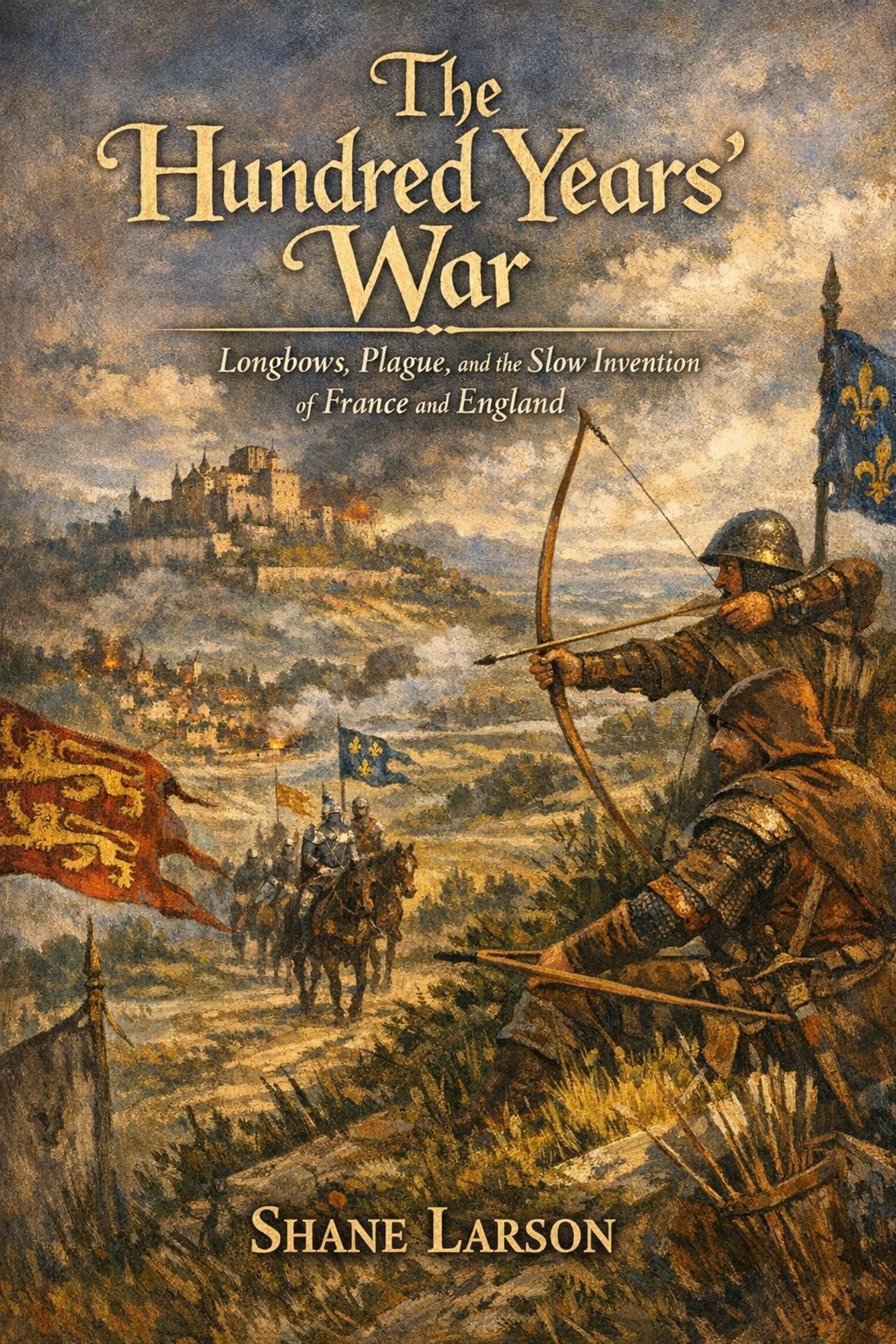
The Hundred Years' War
Longbows, Plague, and the Slow Invention of France and England
By Shane Larson
About This Book
In the winters of the late 1430s, wolves came into Paris. A citizen who kept a private journal through those years recorded them swimming the Seine and taking dogs, and sometimes children, inside the walls of what had recently been the largest city in western Europe. The countryside that should have fed the capital had been burned, taxed, and fought over for a century by then, and the men who did the burning had mostly never met a battle. They rode in fast columns, torched the granaries, and moved on. There is a French word for it — the chevauchée, the ride — and if you want to understand the Hundred Years' War, that word matters more than Agincourt does.
The war between England and France ran from 1337 to 1453, and nearly everything popularly remembered about it fits into about thirty hours: three famous battles and a handful of sieges scattered across a hundred and sixteen years. The other side of that arithmetic is the actual war — the raids, the truces that were only exhaustion wearing a legal costume, the ransom markets, the demobilized soldiers who turned to freelance extortion between campaigns, and the slow grinding discovery by two kingdoms that neither could afford what they had started and neither could stop.
The Argument
This book tells the whole span in one volume, and it makes an argument along the way: the war's most important product was not a border or a dynasty but the two countries that fought it. England entered the war as a kingdom whose rulers spoke French, held a large piece of France as feudal tenants, and thought of the Channel as a hallway rather than a wall. It came out with nothing left on the continent but Calais, with English displacing French in its courts and parliament, and with a national identity substantially manufactured by four generations of fighting the neighbours. France entered as a crown surrounded by magnates who could ignore it, and came out with Europe's first standing army since Rome and a tax — the taille — that had begun as an emergency measure and simply never ended.
None of this was policy. It was plumbing. Soldiers had to be paid, and a war that outlives everyone who started it forces both sides to invent permanent machinery for raising money. In England the machinery was parliamentary consent, asked for so many times over so many decades that the asking hardened into a constitution. In France it was the opposite: a crown that won the right to take without asking. Follow the money through this war and you watch two modern states assemble themselves by accident, each the mirror image of the other.
The plague runs through the middle of the story, because it ran through the middle of the war. The Black Death arrived in 1348, eleven years into the fighting, and the fighting resumed around it. Wages doubled, governments tried to freeze them by statute, and within a generation both kingdoms faced armed risings from the people who paid for everything — the Jacquerie in France, the great revolt of 1381 in England. Most histories treat the pandemic and the war as separate catastrophes. They happened to the same people, in the same decades, and this book keeps them in the same frame.
Why I Wrote This
I wrote The Black Death knowing I had told half a story. The plague did not arrive in a quiet Europe; it arrived in year eleven of the biggest war on the continent, and the two disasters spent a century braided together — the war changing how the plague-struck kingdoms taxed and governed, the plague changing who was left to fight and what they demanded for it. Every time I tried to point readers somewhere for the other half, I found a five-volume scholarly masterwork, a shelf of single-battle books, and a classic that is now fifty years old. The single readable volume on the whole war did not exist. That gap annoyed me for about a year, and then it became this book.
Frequently Asked Questions
Do I need to read The Black Death first?
No. Each book stands alone. This one covers the plague's arrival and consequences in its own chapters, from the war's point of view. If you have read The Black Death, this book is its natural continuation — same century, same kingdoms, the other half of the catastrophe.
Is this a military history?
Partly. The battles are here and treated seriously — Crécy, Poitiers, Agincourt, and the artillery battles that ended the war each get a full chapter. But the book argues that the raids, the taxes, and the ransoms were the real war, so finance, plague, and politics get equal footing with the fighting.
How does the book handle Joan of Arc?
From the records. Her trial transcript survives complete, and the rehabilitation inquiry a generation later produced a second official record of the same events. The book reconstructs her career and trial from those documents and takes no position on her voices beyond what she said and what the court did about it — neither mystified nor debunked.
What background knowledge does it assume?
None. The opening chapters build the feudal situation from the ground up — why English kings held French land in the first place, and why that arrangement produced a war. Names, places, and institutions are explained as they appear.
How long is the book?
Around 80,000 words — a full-length narrative history: an introduction, fourteen chapters in four parts, a conclusion, and three appendices covering the chronology, the longbow evidence, and war finance.
If You Liked This, You Might Like
- The Black Death — the pandemic at the heart of this war, told in full; the two books cover the same century from opposite directions.
- The Viking Expansion — how Norsemen became Normans and planted the cross-Channel entanglement this war finally settled.
- The Crusades — the other great multi-generation war of the Middle Ages, and the world the fourteenth century inherited.
- The Thirty Years' War — Europe's next century-defining conflict, and the closest thing this war has to a sequel in scale and consequence.
A dynastic quarrel outlived everyone who began it, and the machinery built to pay for it became England and France. This is the story of how that happened — told whole, in one book.
What You'll Learn
- **A homage ceremony gone wrong** opens the story: the young Edward III kneeling to Philip VI at Amiens in 1329, crowned and armed and committing to as little as possible — the feudal absurdity of one king owing service to another, and why it could not hold.
- **The set-piece battles reconstructed from the evidence** — Crécy, Poitiers, Agincourt — including what the longbow actually did, what the chroniclers exaggerated, and why England's most famous victories were all fought by armies trying to leave.
- **The plague chapters** connect the Black Death's demographic collapse to wages, labour law, taxation, and the peasant revolts on both sides of the Channel.
- **A captured king** — John II taken at Poitiers and priced at three million crowns — and what a kingdom does when its sovereign becomes a commodity.
- **The free companies:** what happens when a truce releases thousands of professional soldiers into a countryside with no other employer.
- **Joan of Arc across two chapters**, written from the trial transcript that survives in full — the campaign that broke the siege of Orléans, the interrogation of a nineteen-year-old by trained theologians, and the rehabilitation twenty-five years later that produced a second official record contradicting the first.
- **The artillery ending:** the Bureau brothers' gun train, Formigny and Castillon, and an English continental presence three centuries old dismantled in five years — a war that ended with no treaty at all.
- **Three appendices:** a parallel chronology of the whole war, an evidence-first examination of the longbow, and a comparison of English and French war finance — the machinery behind the book's thesis.
New Medieval History releases and free chapters — no spam, unsubscribe anytime.
More in This Genre
View all →