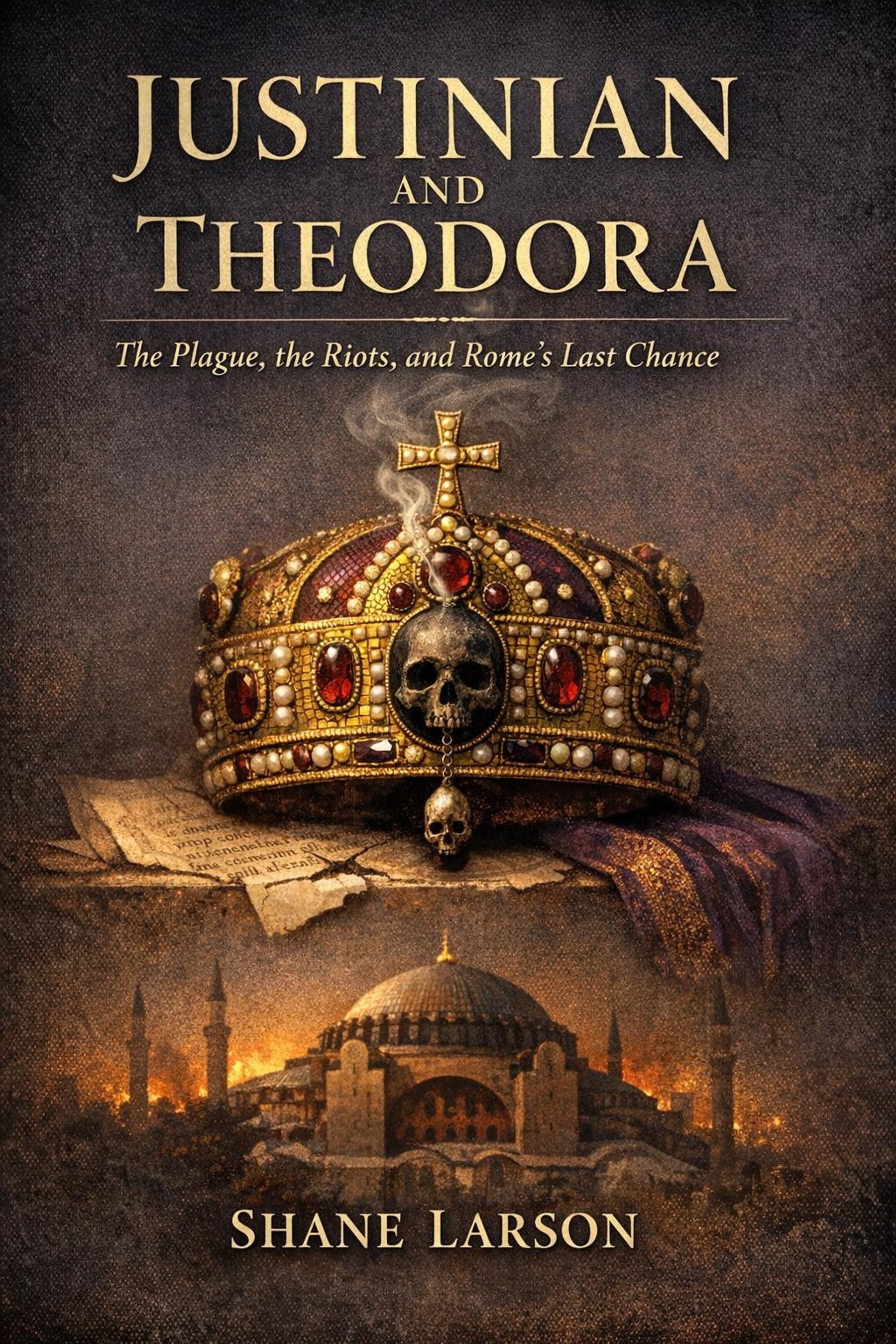
Justinian and Theodora
The Plague, the Riots, and Rome's Last Chance
By Shane Larson
About This Book
In the summer of 542, the largest city in the Christian world was dying at a rate no one had the tools to measure. Bodies outpaced the graves, then the graveyards, then the men left to dig them; corpses were stacked in the towers of the sea walls and loaded onto boats to be dumped. The markets emptied. The great machine of the imperial capital ground to a near halt. And in the palace at the center of it, the emperor himself lay sick with the same disease, expected to die, while his court quietly began to plot the succession.
The emperor was Justinian, and only a few years earlier he had looked unstoppable. He had reconquered North Africa from the Vandals in a single season. He had taken back Rome. He had compressed a thousand years of Roman law into a single code and was raising, out of the ashes of a riot, the most astonishing church ever built. He had come closer than anyone before or since to reversing the fall of the Roman Empire.
The plague of 542 is where that story turns. This book is about the whole arc of it — the rise, the near-catastrophe, and the reign that came within a generation of putting the ancient world back together.
The Answer to "What Happened Next"
Most people's knowledge of Rome ends in 476, with the deposition of the last Western emperor and a vague sense that the lights went out. But the lights did not go out. Half the Roman Empire — the richer, more urban, more populous eastern half — carried on, intact and solvent, ruled from Constantinople by men who still called themselves Romans and still regarded the lost West as theirs by right. Sixty years after the West fell, one of those men decided to take it back.
Justinian was an unlikely restorer: the nephew of an illiterate peasant-soldier who had clawed his way to the throne, a scholar and administrator rather than a warrior, remembered by his own contemporaries as the emperor who never slept. Beside him ruled Theodora, a former actress from the hippodrome — a woman from about as far down the Roman social ladder as it was possible to start — who was named in his legislation as his partner in power and who proved to be one of the shrewdest political operators of the age. Together they ran the empire as a two-handed machine, and this book treats their marriage as what it really was: not a romance, but a constitution.
What they attempted was staggering, and for a decade it worked. Then came the riots that nearly burned it all down, the Italian war that ground on for two brutal decades, the Persian shah who sacked one of the empire's greatest cities while its armies were fighting in the west, and finally the pandemic that gutted the whole project from beneath. The book weighs, honestly and without romance, the question its title poses: was Rome's last chance ever real, or was it doomed by distance, money, and manpower no matter who sat on the throne?
What's Inside
- The reign told as the reign, not a biography — the governing partnership, the wars, the law, and the plague, with Theodora as co-ruler rather than subject
- Why the eastern empire survived when the west collapsed, and the full treasury that made a reconquest thinkable
- The Nika riots of 532: how a chariot-race grudge became a five-day inferno that nearly toppled the throne
- Belisarius, the finest general of the age, and the reconquests that looked cheap in Africa and turned ruinous in Italy
- The Corpus Juris Civilis — how a decade of legal work became the foundation of civil law across continents
- Hagia Sophia, and the mathematician and physicist who built a dome that seemed to hang from heaven
- The Plague of Justinian as the hinge of the reign and the recorded debut of the pathogen behind the Black Death
- Procopius, the insider who wrote both the official praise and a secret manuscript calling the emperor a demon — and how historians read a witness like that
Why I Wrote This
I wrote a book called Fall of Rome, and it did something I didn't fully expect: it left readers hungry for the sequel. Message after message arrived asking the same thing — all right, Rome fell, so what happened next? The honest answer is that what happened next is more dramatic than the fall itself, and hardly anyone knows it.
The reign of Justinian and Theodora had everything I look for in a story: an unlikely pair at the center, a project of impossible ambition, a genuine turning point that hinges on a pandemic, and a source problem so delicious it becomes part of the tale. Our main witness, Procopius, wrote both the glowing official history and a venomous secret one, and learning to read him is a masterclass in how history actually gets made. I also wanted to give this reign to readers who find Byzantium intimidating — a thousand years of extraordinary history that mainstream books mostly skip. This is the doorway in.
Frequently Asked Questions
Do I need to read Fall of Rome first?
No. This book stands entirely on its own and rebuilds the world from the ground up. That said, it is designed as the sequel to Fall of Rome — if you've read that one and wondered what came after 476, this is the answer.
How is this different from your Theodora biography?
They're deliberate companions. Theodora: From the Arena to the Throne is the story of the empress as a person — her childhood in the theater, the scandal, the improbable rise. This book is the story of the reign: the governing partnership, the riots, the wars, the law, the dome, and the plague, with Theodora appearing as co-ruler in the drama of empire. Read either and you're the ideal reader for the other.
Is this a dry academic history?
No. It's narrative history written for the general reader — character-driven and paced like a story, in the vein of Tom Holland or Mary Beard, while staying honest about what the evidence does and doesn't support. It runs about fifty thousand words with a timeline, a who's-who, and a guide to the sources in the back.
How does the plague connect to the Black Death?
They're the same disease. The Plague of Justinian in 541 is the first securely recorded pandemic of the bacterium that returned eight centuries later as the Black Death. This book is, among other things, the origin story of that catastrophe.
Does it quote the ancient sources directly?
The ancient sources — Procopius, the chroniclers, the law code — are paraphrased in my own voice rather than quoted from modern translations, so you get their content and their bias without a wall of bracketed scholarship between you and the story.
If You Liked This, You Might Like
- The Fall of Rome — The prequel this book answers: how the Western empire came apart in the first place.
- The Black Death — The return of the same pathogen eight centuries later, and the pandemic Justinian's plague foreshadows.
- The Persian Empire — The Achaemenid original: the first Persian superstate, whose inheritance the dynasty on Justinian's eastern frontier claimed to have restored.
- The Sassanids — The empire on the other end of the Endless Peace: Khosrow's Persia from the inside, and the long rivalry that finally exhausted Rome and Persia together.
- The Crusades — The medieval world that grew out of the Byzantium this reign helped shape.
For the empress's own story — the arena childhood, the stage, the ascent — the companion volume Theodora: From the Arena to the Throne tells it in full.
Rome fell in the West in 476. Sixty years later, a sleepless emperor and an actress-empress tried to put it back together, and for one astonishing generation they nearly did. Here is how close they came, and what it cost.
Companion to Theodora: From the Arena to the Throne and the sequel to Fall of Rome*.*
Included with Kindle Unlimited — read it free if you're a member.
New Medieval History releases and free chapters — no spam, unsubscribe anytime.