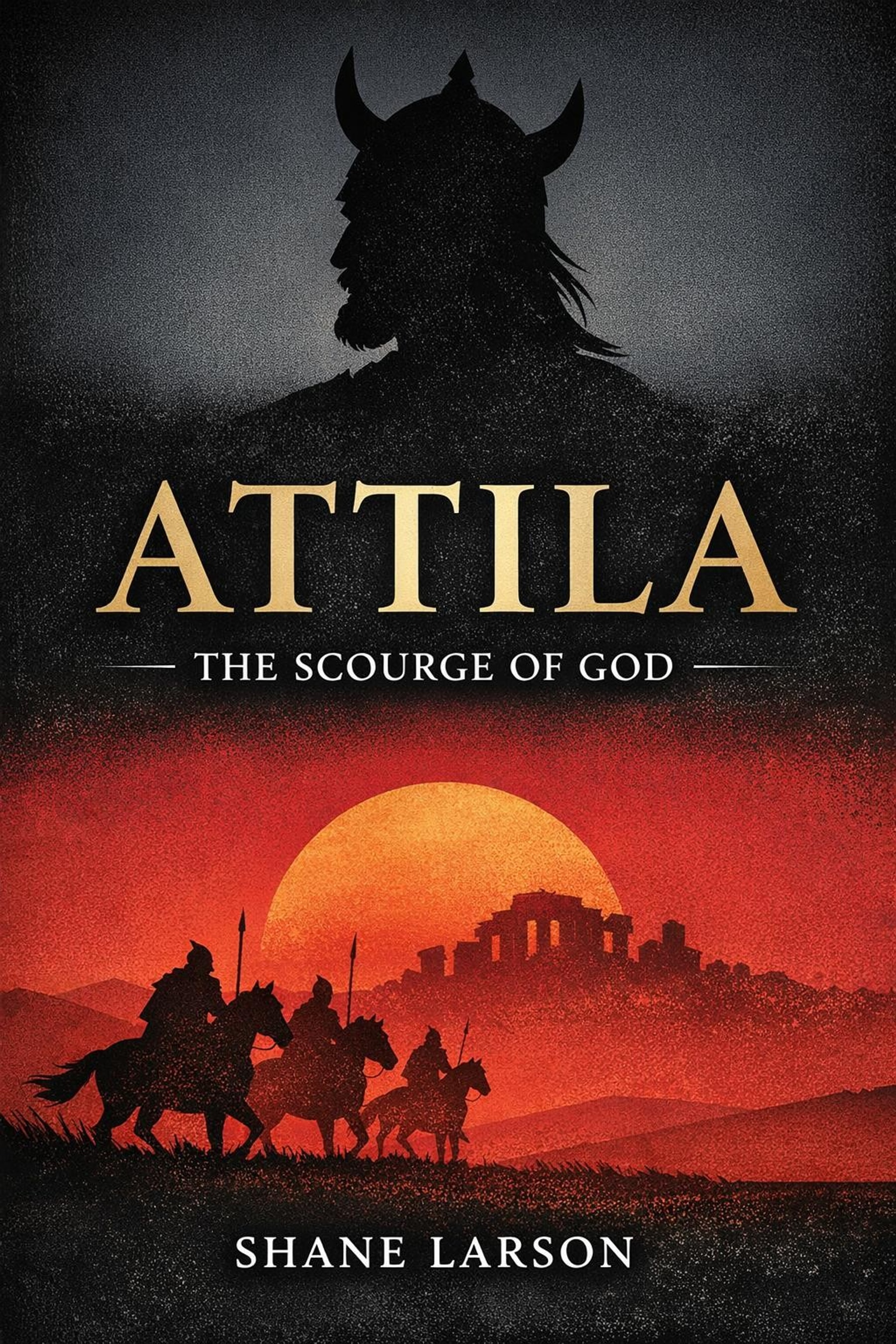
Attila
The Scourge of God
By Shane Larson
About This Book
When Rome Paid Tribute to a Man in a Wooden Cup
On a summer evening north of the Danube in 449 AD, a Roman diplomat named Priscus of Panium watched the most feared man in Europe drink wine from a plain wooden cup while his nobles ate from silver. Attila wore a simple tunic. His hair was cut in no particular style. He was short, dark-complexioned, and almost aggressively ordinary. He was also holding both Roman empires at knifepoint.
Priscus wrote it all down — the banquet, the conversations, the strange mix of austerity and menace — and that record is the only eyewitness account of Attila the world will ever have. Everything else we think we know about the Scourge of God has been filtered through fifteen hundred years of Christian moralizing, Germanic legend, and modern imagination. Strip that away and what remains is stranger than the myth: a steppe king who ruled a polyglot confederation stretching from the Baltic to the Caspian, extorted a fortune in gold from Constantinople, and briefly made the two halves of the Roman world pay him to leave them alone.
This book is about what he actually did — and why, within a single generation of his death, his people vanished so completely that historians still argue about where they came from and where they went.
The Story This Book Tells
Attila: The Scourge of God opens on the steppe that produced the Huns, tracing the long migration westward that pressed Gothic tribes across the Danube and triggered the refugee crisis that would reshape the late Roman world. It follows the rise of two brothers — Attila and Bleda — who inherited a kingdom from their uncle Rua and spent the next decade turning it into an extraction engine aimed at Constantinople.
From there the narrative moves through the tribute years, when the Eastern Empire handed over gold by the hundredweight to keep Hunnic armies out of the Balkans; the embassy of Priscus, the single window we possess into Attila's court; the murder of Bleda and Attila's consolidation of power; the bizarre episode of Honoria's smuggled ring and the proposal that gave Attila his pretext for invading the West; the Battle of the Catalaunian Plains, where the largest army late antiquity ever fielded ground itself to a stalemate against a coalition of Romans, Visigoths, and Alans; the Italian campaign that burned Aquileia to the ground and then, inexplicably, turned back at the Mincio after a meeting with Pope Leo I; and finally the wedding night in 453 when Attila died choking on his own blood beside a terrified Germanic bride.
The book closes on what came after: the civil war between his sons, the collapse of the confederation within two years, the disappearance of the Huns as a people within a generation, and the long afterlife of Attila himself in the Norse sagas as Atli and the Nibelungenlied as Etzel — a barbarian king kept alive in Germanic memory for a thousand years after Roman memory had turned him into a demon.
What's Inside
- The steppe origins — what the archaeological record actually tells us about the Huns before they appear in Roman sources, and why the "Xiongnu connection" debate is more contested than popular histories suggest
- The brothers' rise — Rua, Octar, Bleda, and Attila, and how a kingship structure most historians misunderstand actually functioned
- The tribute economy — how Attila monetized Constantinople, the specific treaties, the specific sums, and why gold was both the lever and the trap
- The Priscus embassy — the banquet, the conversations, the description of Attila's appearance and habits, and what a careful reading of Priscus reveals that the highlight reel misses
- Honoria's ring — the Western princess whose marriage plot gave Attila his casus belli against Valentinian III
- Chalons / the Catalaunian Plains — the tactical, political, and narrative reconstruction of the largest battle late antiquity ever saw, and why "who won" is the wrong question
- The Italian campaign and Leo I — Aquileia destroyed, the northern cities sacked, and the meeting at the Mincio that turned Attila back without a battle
- The wedding night death — Ildico, the hemorrhage, the secret burial, and the persistent question of whether Attila was killed
- The collapse — Ellac, Dengizich, Ernak, the Battle of Nedao, and how a confederation built on one man dissolved into nothing within twenty-four months
- The Germanic afterlife — Atli in the Norse Atlakviða, Etzel in the Nibelungenlied, and the Christian "Scourge of God" tradition that kept one name alive across fifteen centuries
Why I Wrote This
I wanted to know who Attila actually was, and every popular treatment I picked up gave me some version of the same cartoon: a wild-eyed barbarian in furs, sacking cities, shouting at the walls of Rome. That's not who Priscus met. Priscus met a careful, sober, deeply intelligent political operator who understood the two Roman empires better than most Romans did, and who used that understanding to bleed them slowly and systematically for almost two decades.
The real Attila is harder to write about than the cartoon because he doesn't line up neatly with any of the categories we default to — not "noble savage," not "raging destroyer," not "tragic hero." He was a steppe king running a protection racket on a continental scale, and he was extraordinarily good at it until the day he wasn't. I wanted to give him the same kind of serious, evidence-first treatment I'd want for any Roman emperor, and I wanted the book to close the loop on what happened after his death — because the speed of the Hunnic collapse is the second half of the story and almost nobody tells it.
Frequently Asked Questions
Do I need background in late Roman history to follow this book?
No. The book introduces the political situation of the Eastern and Western Empires in the fifth century as it goes, and explains the key players — Theodosius II, Valentinian III, Aetius, Pulcheria, Marcian — when they enter the narrative. A general sense that the Roman Empire was split in two by this point is enough to start.
Is this a narrative history or an academic monograph?
Narrative history, grounded in the primary sources. Priscus, Jordanes, Prosper, the Gallic chroniclers, and the archaeology are all there, and where the evidence is contested the book says so rather than picking a side silently. But the sentences are built for readers, not for a committee.
How does this compare to Christopher Kelly's Attila the Hun or Peter Heather's work on the fall of Rome?
Kelly's book is excellent on the embassy and the court. Heather is excellent on the broader migration-period context. This book sits between them: it covers Attila's full life and the aftermath in one volume, with more attention to the Germanic afterlife and the collapse of the confederation than either devotes. Read all three if you love the period.
Does the book take a position on how Attila died?
Yes, but it presents the alternatives fairly. The ancient sources give us a nosebleed hemorrhage on a wedding night; later tradition gives us murder by Ildico. The book walks through what each theory requires you to believe and where the evidence actually points.
Is this part of a series?
It stands alone, but it pairs naturally with Peak Grizzly's other late-antique and early-medieval titles — particularly The Fall of Rome, First Dark Age, and Iron Age Dawn — which cover the wider collapse and recovery of the Mediterranean world around Attila's lifetime.
Is the book available on Kindle Unlimited?
Yes. It's enrolled in Kindle Unlimited, so KU subscribers can read the full book at no additional cost.
If You Liked This, You Might Like
- The Fall of Rome — the wider collapse of the Western Empire in the century Attila helped accelerate.
- First Dark Age — what Europe and the Mediterranean looked like after the structures Attila pressured finally gave way.
- Boudica — another barbarian figure Rome could not understand and could not ignore, three centuries earlier.
- Zenobia of Palmyra — a different kind of challenge to Roman power from the other end of the empire.
Closing
Attila has been a legend for so long that the historical man is almost harder to see than the myth. This book is an attempt to put the man back in — steppe king, tribute collector, shrewd diplomat, battlefield commander, and the central figure in a twenty-year crisis that the Roman world did not survive intact.
For readers of Peter Heather, Tom Holland, Christopher Kelly, Mary Beard, and Adrian Goldsworthy.
Included with Kindle Unlimited — read it free if you're a member.
New Ancient History releases and free chapters — no spam, unsubscribe anytime.