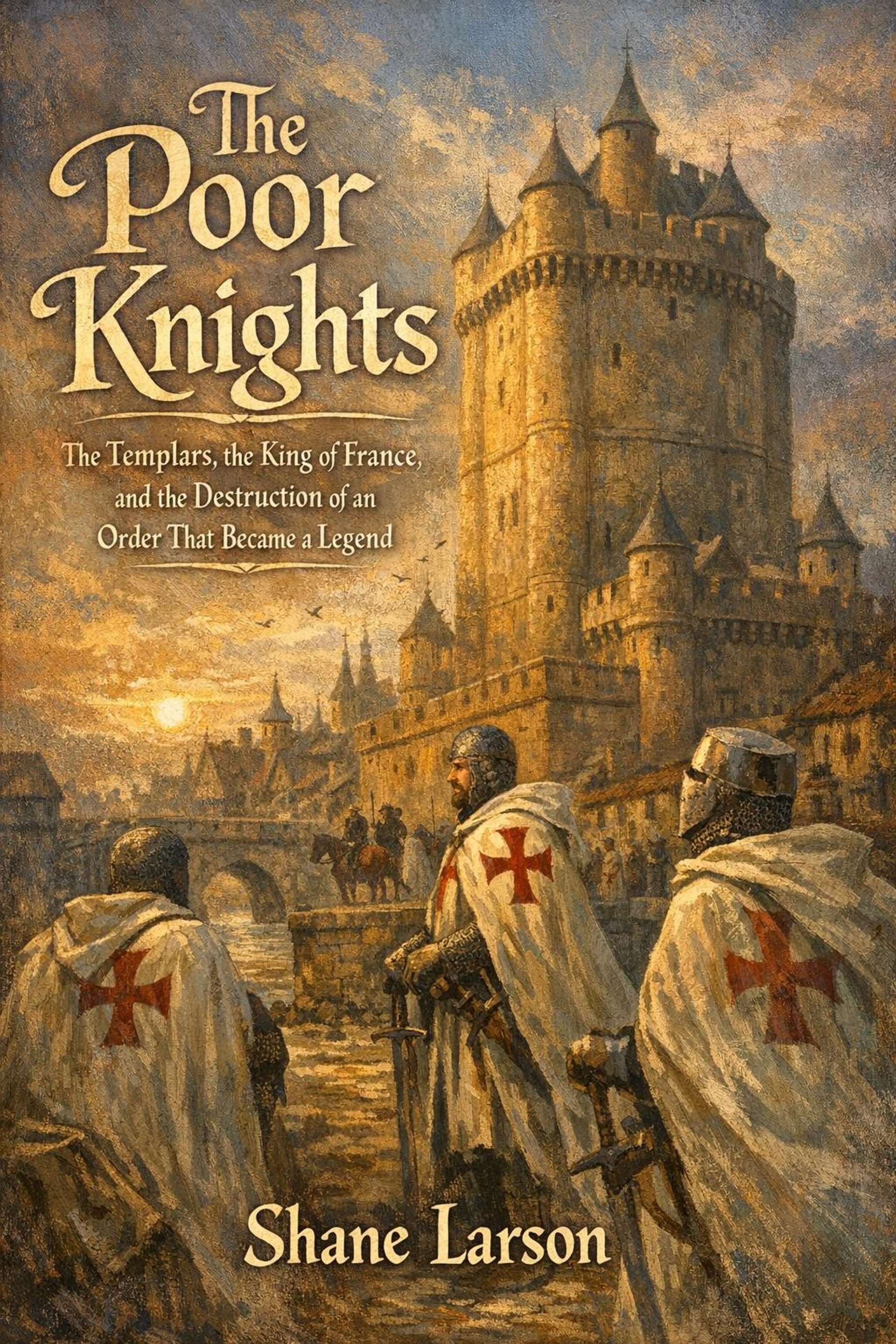
The Poor Knights
The Templars, the King of France, and the Destruction of an Order That Became a Legend
By Shane Larson
About This Book
On 12 October 1307 Jacques de Molay walked in a funeral procession through Paris. The king's sister-in-law was being buried, and the Grand Master of the Temple held a cord of the pall, a place of honor beside the royal family. The chroniclers noticed, and it is still the best evidence that he had no idea what was coming. Before first light the next morning, royal officers opened sealed letters that had gone out to every bailiff in France a month earlier, walked into the Temple enclosure north of the city, and arrested him and every brother inside.
Within two weeks the Grand Master had confessed. Within five years the order was abolished. It was never convicted of anything, and the pope who abolished it put that in writing.
The Knights Templar are the most written-about institution of the Middle Ages, and most of it is not history. This book takes the order from a few poor knights on the Jerusalem pilgrim road around 1119 to the pyre on the Seine in March 1314, then follows it into a second life as a legend, treating that legend as a historical subject with its own authors and dates.
The Case That Could Not Be Proved
The charges of 1307 were extraordinary: that new brothers were made to deny Christ, spit on the cross and exchange indecent kisses; that there was an idol; that the order's priests left the words of consecration out of the Mass. With torture permitted by the king's own letter, 138 brothers in Paris were examined and all but four confessed to something. The confessions went out to every court in Europe, and Clement V, who had not been consulted and was furious, found himself ordering every ruler in Christendom to arrest the Templars in his lands.
Then the same charges went to England, Aragon, Castile, Portugal, Cyprus and the German lands, where the king of France's officers were not in the room and the rack mostly was not either. Almost nobody confessed, and the councils that ruled found for the order. When the papal commission in Paris finally let the order defend itself in 1310, nearly six hundred brothers came forward, and the archbishop of Sens, a royal appointee, burned fifty-four of them in one day for withdrawing what they had said in irons.
So when the bishops gathered at Vienne they twice refused to condemn the Templars unheard, and the pope had to find another way. Vox in excelso, dated 22 March 1312 and read to the council with the king of France sitting beside the pope, abolishes the order non per modum diffinitive sententie, not by definitive sentence, because a sentence could not be given on the evidence. That distinction is the center of this book. Two years later Molay stood on a platform outside Notre-Dame, told the crowd that the order was innocent, and was burned that evening on an island in the Seine.
Why I Wrote This
The line that started this book is a single clause in a papal bull. Clement V shut the Templars down "not by definitive sentence", and most of what is written about them, in popular history and in fiction alike, skips straight past it. Once I had read it, I could not see the rest of the story the same way. The most famous trial of the Middle Ages ended without a verdict, and the man who ended it said so.
What held me after that was the shape of the archive. The brothers were not a writing order. What survives is their law, their property records, a chronicle, and the transcripts of an interrogation. Silence like that invites filling, and for three centuries people have filled it with grails, treasure fleets and bloodlines. The documents offer something smaller and much better: a real institution, a real injustice, and a pope who would not put his name to a conviction.
Frequently Asked Questions
Do I need to read The Crusades first?
No. The two books stand alone and point at each other. The Crusades tells the campaigns and introduces the military orders in passing; this book stays on the Order of the Temple and gives Hattin, the Third Crusade and Louis IX's crusade one orienting paragraph each before returning to what they did to the order.
Is this a book about the Holy Grail, Rosslyn Chapel and the Templar conspiracies?
It is a book that tests them. Part Four takes each legend in turn, states it fairly, dates its first appearance, names the person who introduced it, and sets that date against 1307. None of them is older than the eighteenth century. If you want a book that believes them, this is not it.
Were the Templars guilty?
Nearly every historian who has worked on the trial thinks not, and the book says so plainly. The argument is a comparison: where torture was used, Templars confessed; where it was not, almost none did. The live debates, over the reception ceremony and the Chinon absolution, are presented as debates with the historians on each side named.
Does it describe the torture and the burnings in detail?
No. Both are reported, with dates, numbers and witnesses, and neither is dramatized. The sodomy charge is reported as a charge in the record, without salacious detail. Clement V comes out of it as a constrained, ill man, not a villain.
How long is it, and is it in Kindle Unlimited?
About 78,000 words: fourteen chapters in four parts, an introduction and conclusion, and three appendices. It is released wide, so it is not in Kindle Unlimited; it is on the major ebook stores.
If You Liked This, You Might Like
- The Crusades — the war the Templars were founded to fight, told as a war; this book is the deep dive that one sends its readers to.
- The Hundred Years' War — begins where Philip IV's dynasty ends, with the extinction of the direct Capetian line in 1328 that the curse story turned into a judgment.
- The Absent King — the Latin East of the 1190s from the crusader side, the campaign this book deliberately leaves to another book.
- Al-Andalus — the Iberian frontier where the Templars held castles, resisted arrest, were acquitted, and in Portugal became the Order of Christ.
What was charged, what was confessed and what was proved were three different things, and the people who made the legend needed them to be one. The Poor Knights: The Templars, the King of France, and the Destruction of an Order That Became a Legend keeps them apart.
What You'll Learn
- The founding without the myth. The Easter 1119 massacre on the Jordan road, Hugues de Payens and his companions, the king's grant of quarters in the building the crusaders called the Temple of Solomon, and why William of Tyre's famous nine knights are a hostile witness's number written fifty years late.
- A monk who kills. Bernard of Clairvaux had to argue that killing in this cause was not homicide, and the letter of "Hugh the Sinner" shows the brothers themselves needed to hear it.
- The pope's own order. *Omne datum optimum* in 1139 lifted the Temple out of the reach of every bishop in Christendom, and the resentment that bought was still waiting in 1307.
- The bank that was not a bank. How the Paris Temple came to hold the treasury of France, what a Templar credit arrangement was and was not, and why the Italians outran them.
- An order without a war. Why the Hospitallers took Rhodes and the Teutonic Knights took Prussia while the Templars sat on Cyprus writing memoranda, and why that mattered more than any charge.
- The king and his lawyer. Philip IV's debasements, his expulsion of the Jews, and Guillaume de Nogaret's assault on a living pope at Anagni as the rehearsal for 1307.
- The Chinon parchment, found in the Vatican archives in 2001, with what it says and the range of what historians think it means.
- The legend, dated. The Masonic Templar story of the 1750s, the idol of 1818 and its goat's head of the 1850s, Rosslyn Chapel's founding in 1446, the Priory of Sion's founder admitting the forgery under oath in 1993, and Friday the thirteenth, which is nineteenth-century.
New Medieval History releases and free chapters — no spam, unsubscribe anytime.
More in This Genre
View all →