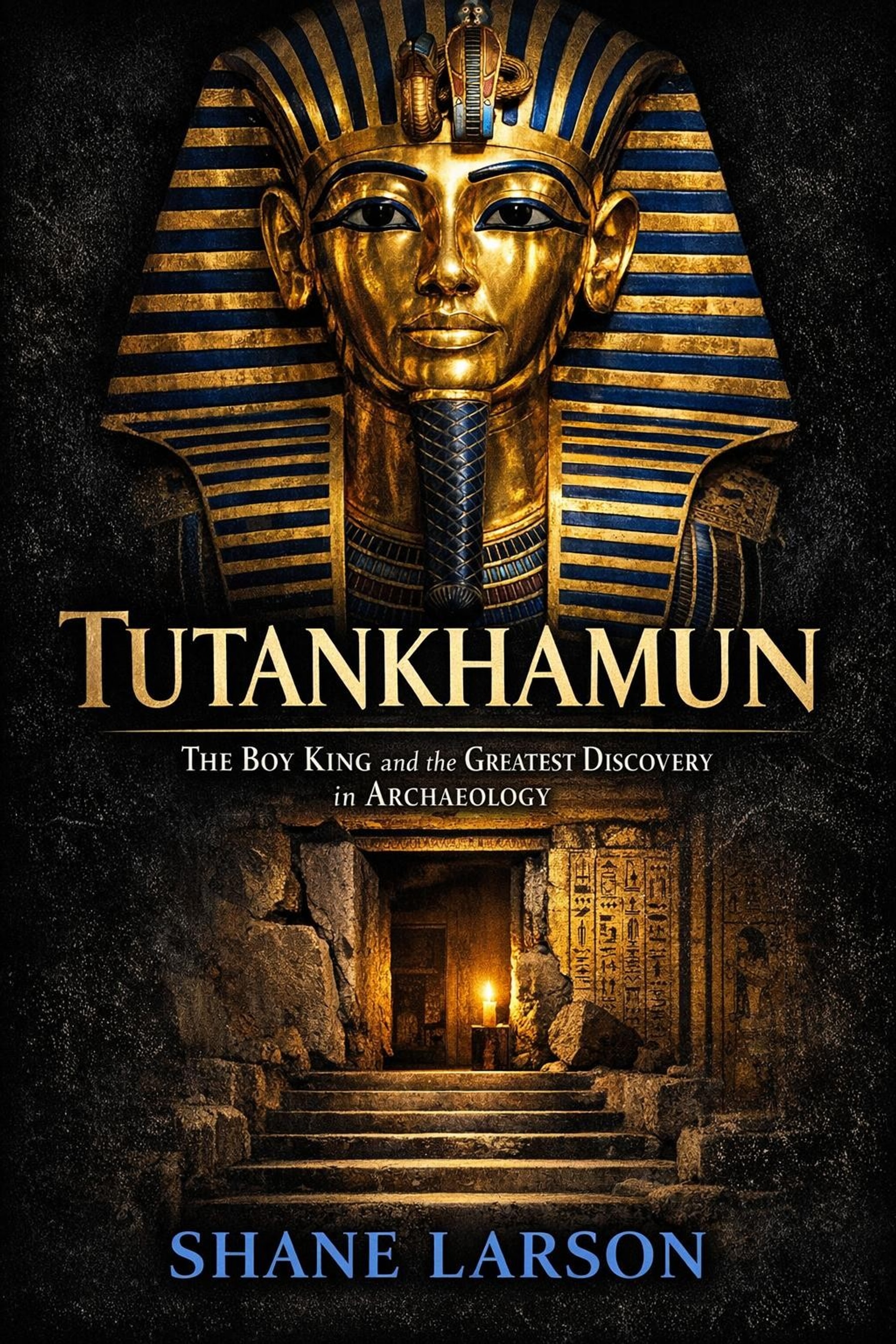
Tutankhamun
The Boy King and the Greatest Discovery in Archaeology
By Shane Larson
About This Book
In 2005, a portable CT scanner was trucked into the Valley of the Kings and set up beside the tomb. A team lifted the most famous body in the world out of its stone sarcophagus and slid it, feet first, into the machine. For a few minutes a teenage boy who died more than three thousand years ago passed through fifteen hundred cross-sectional images — his teeth, his skull, a badly broken leg, the tapered bones of a young man barely done growing. No curse stirred. What the scans delivered instead was something rarer in this story: a fact.
That is the whole problem with Tutankhamun. Almost everything that made him famous is noise — the gold, the "curse," the endless documentary speculation about murder. The actual person underneath is small, young, and genuinely tragic, and he keeps getting buried a second time under the legend built on top of him. He was a child when they put a crown on him. He was not yet twenty when he died. In between, he was a useful instrument in other men's hands, and after his death he was supposed to disappear entirely.
He very nearly did. His own successors chiseled his name off the monuments and left him off the official list of kings, as if he had never reigned. By any normal reckoning that should have been the end of him — one more erased pharaoh in a country full of them. Instead the erasure hid his tomb so thoroughly that it survived, intact, for thirty-two centuries, while every other royal grave in the valley was looted down to the walls.
The Argument
This book tells two stories at once and lets them illuminate each other. One is the boy's short life, set in the wreckage of the strangest episode in Egyptian history — his father Akhenaten's attempt to abolish the old gods and remake the country around a single sun-disk. When that revolution collapsed, a nine-year-old inherited the mess, and the men around him used his reign to quietly put everything back the way it had been. The other story is the discovery: Howard Carter's obsessive, near-bankrupt search, and the sixteen steps he uncovered in November 1922 on what was meant to be his final season.
Told in counterpoint, the two halves keep checking each other. Every object Carter catalogued becomes a clue to the life — the hurried, undersized tomb, the mismatched grave goods, the second-hand items pressed into service for a burial nobody had planned to hold so soon. The book treats the death itself as a forensic case rather than a mystery to be milked: it lines up a century of murder theories against what the CT scans and DNA testing actually show, and it is honest about where the evidence simply stops and speculation begins.
And then there is the curse — which gets a chapter of its own, not as folklore but as a case study in myth-manufacture. The most durable legend in the history of archaeology was not ancient at all. It was built in the 1920s out of a newspaper bidding war, a journalist's need for copy, and a public hungry for a story better than "an asthmatic aristocrat died of an infected mosquito bite." Follow who actually died, who lived to old age, and who profited, and the curse dissolves into something more interesting: a lesson in how we decide what to believe.
What's Inside
- The DNA that named his family: What genetic testing revealed about his parentage — and how generations of royal inbreeding shaped a fragile, short-lived boy.
- The men behind the throne: Who really governed Egypt while a child held the title, and what they wanted from him.
- The Restoration Stela, decoded: The grand proclamation issued in the boy king's name, undoing his father's heresy — written, almost certainly, by the officials standing behind his shoulder.
- How he actually died: The murder theories laid out one by one, then measured against the modern forensic picture — including that shattered leg and what it probably means.
- A letter to the enemy: The astonishing message a widowed Egyptian queen sent to the Hittite king begging for a husband — and the prince who set out for Egypt and never arrived.
- Sixteen steps down: The real texture of Carter's find — the years of failure, the sealed doorway, the decade of painstaking work behind the phrase "wonderful things."
- The curse, audited: A clear-eyed accounting of who died, who didn't, and how a press war conjured a supernatural story that outlived everyone involved.
- Erasure as preservation: Why the pharaohs who tried to delete Tutankhamun handed him, unintentionally, the only kind of immortality that mattered.
Why I Wrote This
I wrote a book about Akhenaten — the heretic pharaoh who tore Egypt's religion up by the roots — and when I finished it, I realized I'd left the reader at the edge of a cliff. Because the person who had to clean up after that revolution was a little boy, and his name is one everybody already knows for entirely the wrong reasons.
What kept pulling me back was the gap between the fame and the person. Tutankhamun is a household name attached to a golden mask and a spooky story, and underneath all of it is a kid who never got to be anything but a symbol — first for the officials who ruled through him, then for the successors who erased him, then for a twentieth-century public that wanted a curse. I wanted to give the boy back some of his actual life, and to show how good the real, documented story is once you stop reaching for the melodrama.
Frequently Asked Questions
Do I need to read Akhenaten first?
No, but the two fit together like a hinge. This book stands completely on its own and gives you everything you need about the Amarna period. If you have read Akhenaten, this reads as the direct sequel — the son inheriting the father's wreckage.
Is this a book about the treasure or about the boy?
Both, deliberately. The discovery and the objects are woven all the way through, but they're used as evidence for the life, not paraded as loot. If you want the story behind the gold rather than just photographs of it, this is built for that.
Does it actually settle how he died?
It settles what can be settled and refuses to pretend about the rest. The book walks through the forensic evidence carefully, explains why the popular murder theories fall apart, and then draws a clear line where honest conclusions end and guesswork begins.
Is the "curse" treated seriously?
Only as history, not as the supernatural. The curse gets a full chapter because it's a genuinely fascinating story — about journalism, publicity, and human psychology in the 1920s — just not the story people usually think it is.
If You Liked This, You Might Like
- Akhenaten — The father and the revolution that set this whole story in motion; the closest possible companion volume.
- Nefertiti — The famous queen of the Amarna court, moving through the same palaces and the same crisis from a different angle.
- The Bronze Age World — The wider Late Bronze Age that Egypt belonged to — the diplomacy, trade, and great-power rivalries that frame the Hittite letter and the boy king's reign.
- Ancient Apocalypse — The catastrophe that would bring this whole glittering world crashing down within two centuries of Tutankhamun's burial.
Strip away the mask and the myth and what's left is a better story: a used, erased, accidentally rescued child, recovered from the one place his enemies couldn't reach him.
Included with Kindle Unlimited — read it free if you're a member.
New Ancient History releases and free chapters — no spam, unsubscribe anytime.