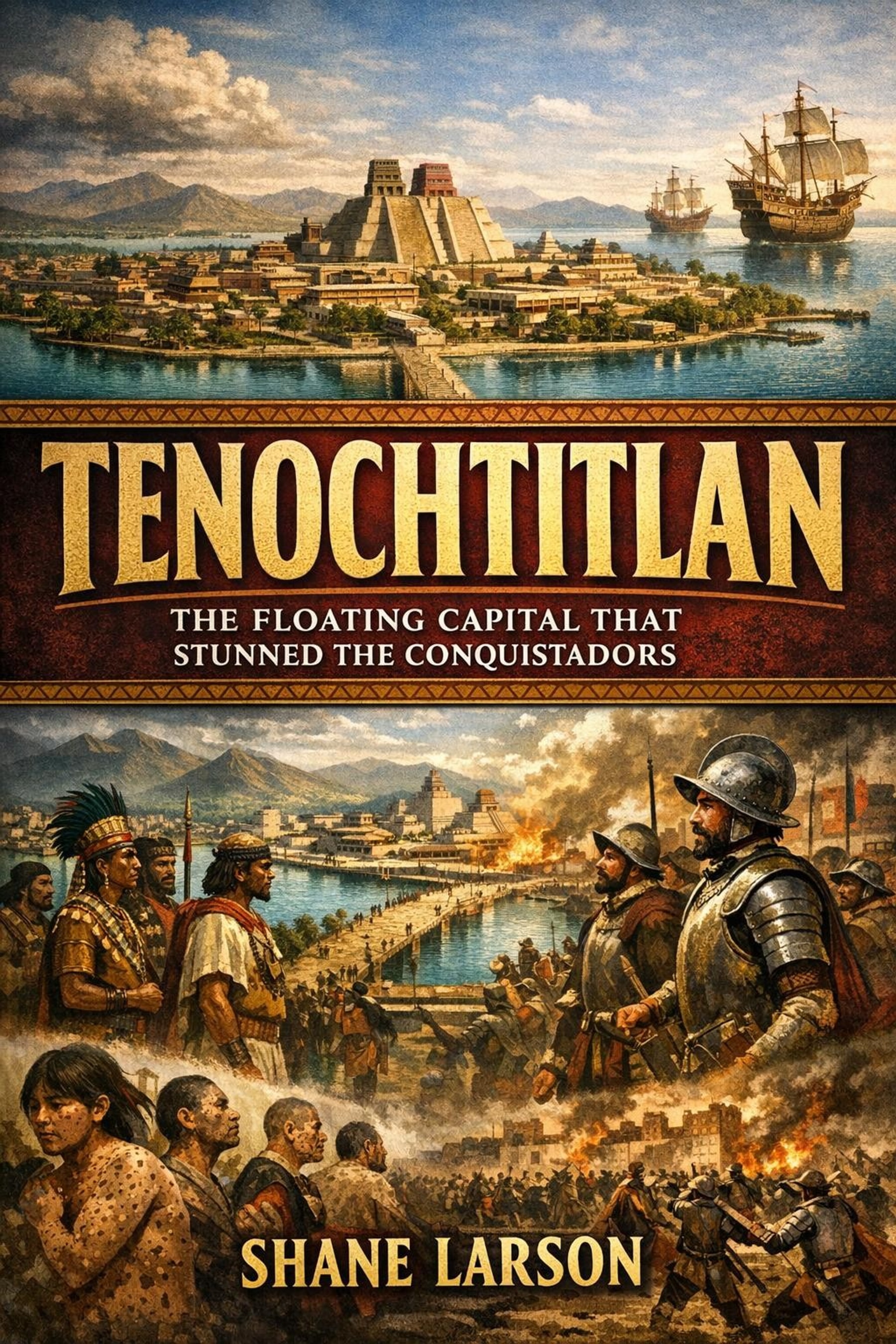
Tenochtitlan
The Floating Capital That Stunned the Conquistadors
By Shane Larson
About This Book
The Spanish soldier Bernal Díaz del Castillo, writing decades later as an old man in Guatemala, kept returning to the same problem in his memoir: nobody back in Spain would believe him. He had walked into a city floating on a lake. He had seen a market larger than any in Europe operating in perfect order. He had watched Moctezuma's attendants sweep the ground in front of his sandals. And he could not, fifty years on, make readers in Castile understand that he had not invented any of it.
The city was Tenochtitlan. In 1519 it was the largest city in the Americas and one of the largest in the world — somewhere between 150,000 and 300,000 people, on an island in the middle of Lake Texcoco, in what is now downtown Mexico City. By August 1521 it was rubble. The Spanish were already pulling stones from the Templo Mayor to build the cathedral that still stands on the same spot.
This book is about what stood there before the cathedral. How the Mexica built it. How it worked. How it fell. And what we know now that Díaz could not have known — that the people who tore Tenochtitlan apart were not, mostly, Spanish.
The Argument
The conquest story most readers grew up with is wrong in almost every important way. Cortés did not defeat the Aztec Empire with four hundred men and superior technology. He defeated it with two hundred thousand indigenous allies — Tlaxcalans, Totonacs, Texcocans, and others who had spent generations as tribute subjects of the Mexica and saw the Spanish as a useful weapon. The smallpox epidemic of 1520 did more damage than every Spanish cannon combined. And the city that fell was not a primitive society overwhelmed by a superior one. It was a sophisticated urban civilization, built by engineers who had solved problems Europe would not solve for two more centuries, brought down by a confluence of disease, political fracture, and a Spanish captain who understood exactly which buttons to press.
The book moves through the city in three arcs. First, the construction: how a refugee people, evicted from valley after valley, ended up on the only island nobody wanted, and what they did with it over the next two hundred years. Second, the operating system: chinampa agriculture, the tribute network, the calendar, the religious architecture, the markets, the canal grid, the social structure that fed and clothed a quarter-million people without coinage or wheeled transport. Third, the collapse: the arrival of Cortés, the political miscalculations on both sides, the noche triste, the eighty-day siege, the aftermath.
The Mexica are not romanticized here. They practiced state-scale human sacrifice. Their tribute empire was brutal in ways their subjects remembered with clarity when the Spanish arrived. But the city they built was extraordinary, and treating it as anything less — as a backdrop for a Spanish epic, as a curiosity, as a moral lesson — misses what actually happened.
What's Inside
- The founding myth, the historical reality, and how a band of mercenaries from somewhere north became the masters of central Mexico
- Chinampa engineering — how floating gardens worked, what they produced, and why they were five times more productive than European farming of the same period
- The dual-channel Chapultepec aqueduct, Nezahualcoyotl's salt-water dike, and the causeway-drawbridge system that doubled as flood control
- The Templo Mayor: the dual pyramid to Huitzilopochtli and Tlaloc, the tzompantli, the rediscovered offerings, and what the layered construction reveals about Mexica political history
- The market at Tlatelolco, the canal traffic, the daily logistics of feeding a city without livestock or wheels
- The tribute empire — what flowed in, from where, and what the subject peoples thought of paying it
- The first contact: what Cortés actually wrote home, what the Mexica thought he was, and where both sides got each other wrong
- The smallpox epidemic of 1520, the death of Cuitláhuac, and the collapse of Mexica political cohesion at exactly the wrong moment
- The siege: brigantines on the lake, the systematic destruction of the causeways, and the eighty-day grind that ended at Tlatelolco
- What was found in 1978 when Mexico City electrical workers hit a stone disk of Coyolxauhqui — and what the ongoing Templo Mayor excavations have revealed since
Why I Wrote This
I came to the Mexica through the engineering. I'm a software architect by background, and the first thing that hooked me wasn't the conquest narrative or the sacrifices or the gold — it was the chinampas. The idea that someone had solved the urban-food-supply problem in the fifteenth century, on a swampy island, using reed mats and lake mud, and had done it better than the systems supplying Madrid and London at the same time, was the kind of fact that wouldn't let me go.
The deeper I got, the more I realized how much of what I'd absorbed about the conquest was Spanish PR. Cortés wrote his own version. Bernal Díaz wrote a corrective fifty years later but couldn't escape the assumption that the Spanish were the protagonists. The indigenous accounts — the Florentine Codex, the Lienzo de Tlaxcala, the testimonies collected by Sahagún — tell a different story, and a more interesting one. I wanted to write the book I would have wanted to read after my first trip to the Templo Mayor museum: the city on its own terms first, the conquest second, with the engineering taken as seriously as the politics.
Frequently Asked Questions
Do I need to know anything about Mesoamerican history to read this?
No. The book assumes no prior background. The first chapters cover the Mexica origin, the Valley of Mexico's earlier inhabitants, and the rise of the Triple Alliance. By the time the Spanish arrive in chapter five, you'll have the context you need.
Is this a narrative history or a reference book?
Narrative history. It's structured to be read straight through. There are maps and a glossary of Nahuatl terms, but the body of the book is prose, not a textbook.
How does this compare to Charles Mann's 1491?
1491 is a wide-angle survey of the pre-contact Americas across two continents. This book is a deep treatment of one city. If 1491 sold you on the idea that the Americas before 1492 were more populated and more sophisticated than you'd been taught, this book is the close-up case study of the single most sophisticated example.
Does it deal with human sacrifice?
Yes, directly. The chapter on Mexica religion covers the theology behind it, the scale (the recent osteological work on the tzompantli has revised earlier numbers significantly), and what it meant politically. The book doesn't sensationalize it and doesn't try to explain it away.
Is it available on Kindle Unlimited?
Yes. The Kindle edition is enrolled in Kindle Unlimited.
Is there a sequel or companion volume?
The book stands alone. It's part of Peak Grizzly's broader catalog on lost civilizations and imperial collapse — readers who want to follow the thread of how complex societies fall apart should look at the Collapse Pattern series.
If You Liked This, You Might Like
- The Sea Peoples — A different empire, a different collapse, but the same essential pattern: a sophisticated civilization that didn't see what was coming until it was already in the harbor.
- Ancient Apocalypse — The Bronze Age systems collapse, treated with the same engineering-first lens used here for the Mexica.
- The Maya: Rise, Reign, and Reckoning — The other great Mesoamerican civilization, with the long view of what happens to cities when the rain stops coming.
- Collapse Proof — The synthesis volume of the Collapse Pattern series, which uses Tenochtitlan as one of its case studies.
The greatest city in the Americas was built in less than two centuries and dismantled in less than three months. This is the book about what was lost in between — and what, beneath the pavement of the Zócalo, is still there.
Included with Kindle Unlimited — read it free if you're a member.
New Ancient History releases and free chapters — no spam, unsubscribe anytime.